

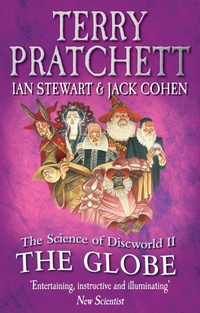
The Science Of Discworld II
The Globe
Published on 11. April 2013
Book
Paperback/Softback
368 pages
978-0-09-195171-9 (ISBN)
Description
Acclaimed The Science of Discworld centred around an original Pratchett story about the wizards of Discworld. In it they accidentally witnessed the creation and evolution of our universe, a plot which was interleaved with a Cohen & Stewart non-fiction narrative about Big Science.
In The Science of Discworld II: The Globe our authors join forces again to see just what happens when the wizards meddle with history in a battle against the elves for the future of humanity on Earth. London is replaced by a dozy Neanderthal village. The Renaissance is given a push. The role of fat women in art is developed. And one very famous playwright gets born and writes The Play.
Weaving together a fast-paced Discworld novelette with cutting-edge scientific commentary on the evolution and development of the human mind, culture, language, art, and science, The Globe presents a fascinating and brilliantly original view of the world we live in. The scene of the final epic battle is the first production of A Midsummer's Night Dream at the Globe Theatre.
In The Science of Discworld II: The Globe our authors join forces again to see just what happens when the wizards meddle with history in a battle against the elves for the future of humanity on Earth. London is replaced by a dozy Neanderthal village. The Renaissance is given a push. The role of fat women in art is developed. And one very famous playwright gets born and writes The Play.
Weaving together a fast-paced Discworld novelette with cutting-edge scientific commentary on the evolution and development of the human mind, culture, language, art, and science, The Globe presents a fascinating and brilliantly original view of the world we live in. The scene of the final epic battle is the first production of A Midsummer's Night Dream at the Globe Theatre.
Reviews / Votes
Entertaining, instructive and illuminating * New Scientist * Superb, neatly fulfilling its goal of introducing science without being boring or didactic. This is a genuinely mind-expanding and very funny book. * Good Book Guide * Superb, neatly fulfilling its goal of introducing science without being boring or didactic. This is a genuinely mind-expanding and very funny book. * Good Book Guide * Entertaining, instructive and illuminating * New Scientist *More details
Edition
Revised edition
Language
English
Place of publication
London
United Kingdom
Publishing group
Ebury Publishing
Target group
Professional and scholarly
College/higher education
Product notice
Paperback (UK-B)
Dimensions
Height: 198 mm
Width: 128 mm
Thickness: 25 mm
Weight
263 gr
ISBN-13
978-0-09-195171-9 (9780091951719)
Copyright in bibliographic data and cover images is held by Nielsen Book Services Limited or by the publishers or by their respective licensors: all rights reserved.
Schweitzer Classification
Other editions
New editions
Terry, Stewart Pratchett
Science of Discworld II:
Book
05/2003
Ebury Press
€29.89
Article exhausted; check for reprint
Additional editions
E-Book
06/2011
1st Edition
Ebury Digital
€6.99
Available for download
Previous edition
Terry, Stewart Pratchett
Science of Discworld II:
Book
05/2003
Ebury Press
€29.89
Article exhausted; check for reprint
Persons
Ian Stewart (Author)
Professor Ian Stewart is the author of many popular science books. He is the mathematics consultant for New Scientist and a Professor of Mathematics at the University of Warwick. He was awarded the Michael Faraday Prize for furthering the public understanding of science, and in 2001 became a Fellow of the Royal Society.
Terry Pratchett (Author)
Terry Pratchett was the acclaimed creator of the global bestselling Discworld series, the first of which, The Colour of Magic, was published in 1983. In all, he was the author of over fifty bestselling books which have sold over 100 million copies worldwide. His novels have been widely adapted for stage and screen, and he was the winner of multiple prizes, including the Carnegie Medal. He was awarded a knighthood for services to literature in 2009, although he always wryly maintained that his greatest service to literature was to avoid writing any.
www.terrypratchettbooks.com
Jack Cohen (Author)
Dr Jack Cohen is an internationally-known reproductive biologist, and lives in Newent, Gloucestershire. Jack has a laboratory in his kitchen, helps couples get pregnant by referring them to colleagues, invents biologically realistic aliens for science fiction writers and, in his spare time, throws boomerangs. Jack, who has more letters to his name than can be repeated here, writes, lectures, talks and campaigns to promote public awareness of science, particularly biology. He is mostly retired.
Professor Ian Stewart is the author of many popular science books. He is the mathematics consultant for New Scientist and a Professor of Mathematics at the University of Warwick. He was awarded the Michael Faraday Prize for furthering the public understanding of science, and in 2001 became a Fellow of the Royal Society.
Terry Pratchett (Author)
Terry Pratchett was the acclaimed creator of the global bestselling Discworld series, the first of which, The Colour of Magic, was published in 1983. In all, he was the author of over fifty bestselling books which have sold over 100 million copies worldwide. His novels have been widely adapted for stage and screen, and he was the winner of multiple prizes, including the Carnegie Medal. He was awarded a knighthood for services to literature in 2009, although he always wryly maintained that his greatest service to literature was to avoid writing any.
www.terrypratchettbooks.com
Jack Cohen (Author)
Dr Jack Cohen is an internationally-known reproductive biologist, and lives in Newent, Gloucestershire. Jack has a laboratory in his kitchen, helps couples get pregnant by referring them to colleagues, invents biologically realistic aliens for science fiction writers and, in his spare time, throws boomerangs. Jack, who has more letters to his name than can be repeated here, writes, lectures, talks and campaigns to promote public awareness of science, particularly biology. He is mostly retired.