

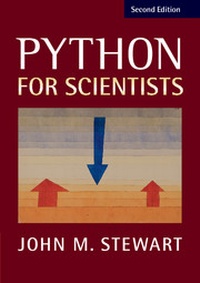
Python for Scientists
2nd Edition
Published on 20. July 2017
Book
Paperback/Softback
270 pages
978-1-316-64123-1 (ISBN)
Description
Scientific Python is a significant public domain alternative to expensive proprietary software packages. This book teaches from scratch everything the working scientist needs to know using copious, downloadable, useful and adaptable code snippets. Readers will discover how easy it is to implement and test non-trivial mathematical algorithms and will be guided through the many freely available add-on modules. A range of examples, relevant to many different fields, illustrate the language's capabilities. The author also shows how to use pre-existing legacy code (usually in Fortran77) within the Python environment, thus avoiding the need to master the original code. In this new edition, several chapters have been re-written to reflect the IPython notebook style. With an extended index, an entirely new chapter discussing SymPy and a substantial increase in the number of code snippets, researchers and research students will be able to quickly acquire all the skills needed for using Python effectively.
Reviews / Votes
Review of first edition: '... the practitioner who wants to learn Python will love it. This is the type of book I have been looking for to learn Python ... concise, yet practical.' Adhemar Bultheel, European Mathematical Society (euro-math-soc.eu) '... I still think the conciseness of the book is a major asset. It provides just enough to get you started with the language if you are already familiar with some computer programming or with a system like Maple or Mathematica.' Adhemar Bultheel, European Mathematical Society (euro-math-soc.eu) 'I highly recommend this book as a practical guide to real-life scientific programming. The book is well written, interspersed with great humor, and is presented from the viewpoint of a researcher who wants others to avoid suffering the same pitfalls and mistakes that he experienced.' Andreas Rueger, The Leading Edge 'This book is a rich resource for scientists who are familiar with programming and want to go beyond classical commercial scientific programming packages such as Mathematica and Maple ... if you want to expand your research toolbox and computational flexibility, this book is a fantastic find ... I highly recommend this book as a practical guide to real-life scientific programming. The book is well written, interspersed with great humor, and is presented from the viewpoint of a researcher who wants others to avoid suffering the same pitfalls and mistakes that he experienced.' Andreas Rueger, The Leading EdgeMore details
Edition
2nd Revised edition
Language
English
Place of publication
Cambridge
United Kingdom
Target group
College/higher education
Professional and scholarly
Edition type
Revised edition
Product notice
Paperback (trade)
Illustrations
Worked examples or Exercises
Dimensions
Height: 245 mm
Width: 174 mm
Thickness: 14 mm
Weight
550 gr
ISBN-13
978-1-316-64123-1 (9781316641231)
Copyright in bibliographic data and cover images is held by Nielsen Book Services Limited or by the publishers or by their respective licensors: all rights reserved.
Schweitzer Classification
Other editions
New editions
John M. Stewart | Michael Mommert
Python for Scientists
Book
08/2023
3rd Edition
Cambridge University Press
€42.70
Shipment within 15-20 days
Additional editions
John M. Stewart
Python for Scientists
E-Book
07/2017
Cambridge University Press
€30.49
Available for download
John M. Stewart
Python for Scientists
E-Book
06/2017
2nd Edition
Cambridge University Press
€36.99
Available for download
Previous edition
John M. Stewart
Python for Scientists
Book
07/2014
Cambridge University Press
€39.60
Article exhausted; check for reprint
Person
John M. Stewart was Emeritus Reader in Gravitational Physics at the University of Cambridge, and a Life Fellow at King's College, Cambridge before his death in 2016. He was the author of Non-equilibrium Relativistic Kinetic Theory (1971) and Advanced General Relativity (Cambridge, 1991), and he translated and edited Hans Stephani's General Relativity (Cambridge, 1990).
Content
1. Introduction; 2. Getting started with IPython; 3. A short Python tutorial; 4. NumPy; 5. Two-dimensional graphics; 6. Multi-dimensional graphics; 7. SymPy, a computer algebra system; 8. Ordinary differential equations; 9. Partial differential equations - a pseudospectral approach; 10. Case study - multigrid; Appendix A. Installing a Python environment; Appendix B. Fortran77 subroutines for pseudospectral methods; References; Hints for using the index; Index.