

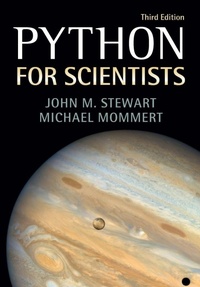
Python for Scientists
3rd Edition
Published on 17. August 2023
Book
Paperback/Softback
304 pages
978-1-009-01480-9 (ISBN)
Description
The third edition of this practical introduction to Python has been thoroughly updated, with all code migrated to Jupyter notebooks. The notebooks are available online with executable versions of all of the book's content (and more). The text starts with a detailed introduction to the basics of the Python language, without assuming any prior knowledge. Building upon each other, the most important Python packages for numerical math (NumPy), symbolic math (SymPy), and plotting (Matplotlib) are introduced, with brand new chapters covering numerical methods (SciPy) and data handling (Pandas). Further new material includes guidelines for writing efficient Python code and publishing code for other users. Simple and concise code examples, revised for compatibility with Python 3, guide the reader and support the learning process throughout the book. Readers from all of the quantitative sciences, whatever their background, will be able to quickly acquire the skills needed for using Python effectively.
Reviews / Votes
'This volume provides an important update to the resources available to physicists and other scientists who manipulate quantitative data for one of their most common tasks: computation ... The focus is on providing the practicing scientist a clear, concise guide to an important resource, and the author has chosen his topics appropriately. Both Python and this book deserve wide circulation.' Computing Reviews 'I highly recommend this book as a practical guide to real-life scientific programming. The book is well written, interspersed with great humor, and is presented from the viewpoint of a researcher who wants others to avoid suffering the same pitfalls and mistakes that he experienced.' The Leading Edge '... this book is still an excellent starting point to put you on the tracks to master the language and enjoy the marvels of the latest version of Python.' Adhemar Bultheel, European Mathematical Society (euro-math-soc.eu) 'The book is well written, and would be a very good choice for a course for scientists learning Python. It would also be an excellent choice for self-study. ... Highly recommended.' R. Bharath, ChoiceMore details
Edition
3rd Revised edition
Language
English
Place of publication
Cambridge
United Kingdom
Target group
College/higher education
Professional and scholarly
Edition type
Revised edition
Product notice
Paperback (trade)
Illustrations
Worked examples or Exercises
Dimensions
Height: 244 mm
Width: 170 mm
Thickness: 16 mm
Weight
525 gr
ISBN-13
978-1-009-01480-9 (9781009014809)
Copyright in bibliographic data and cover images is held by Nielsen Book Services Limited or by the publishers or by their respective licensors: all rights reserved.
Schweitzer Classification
Other editions
Additional editions
John M. Stewart | Michael Mommert
Python for Scientists
E-Book
08/2023
3rd Edition
Cambridge University Press
€41.99
Available for download
Previous edition
John M. Stewart
Python for Scientists
Book
07/2017
2nd Edition
Cambridge University Press
€59.60
Article exhausted; check for reprint
Persons
John M. Stewart was Emeritus Reader in Gravitational Physics at the University of Cambridge, and a Life Fellow at King's College, Cambridge before his death in 2016. He was the author of 'Non-equilibrium Relativistic Kinetic Theory (Springer, 1971) and 'Advanced General Relativity' (Cambridge, 1991), and he translated and edited Hans Stephani's 'General Relativity' (Cambridge, 1990). Michael Mommert is Assistant Professor for Computer Vision at the University of St. Gallen, Switzerland, where he combines computer vision and Earth observation to implement efficient learning methods for a wide range of use cases. Before, he was a Solar System Astronomer and actively wrote scientific open-source code for this community.
Content
1. Introduction; 2. About Python; 3. Basic Python; 4. NumPy - Numerical math; 5. SciPy - Numerical methods; 6. Matplotlib - Plotting; 7. SymPy - Symbolic math; 8. Pandas - Data handling; 9. Performance Python; 10. Software development tools; Index.