

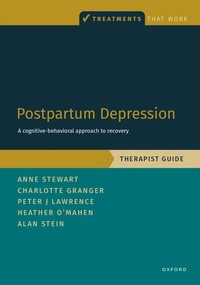
Postpartum Depression Therapist Guide
A Cognitive-Behavioral Approach to Recovery
Will be published approx. on 2. March 2026
Book
Paperback/Softback
304 pages
978-0-19-775970-7 (ISBN)
Description
Many parents suffer from depression after having a baby. This can be both debilitating and distressing for the parent(s) and their families. Depression in the postpartum period often goes unrecognised, leaving parents struggling with its impact. Early identification and treatment of postpartum depression is essential in order to promote the best outcome possible for parents and their babies.
This book provides a step-by-step guide of an evidence-based treatment for postpartum depression and aims to be a resource for therapists treating parents using this approach. The programme is divided into four modules which address: (i) assessment and goal setting - covering strengths and values as well as risks and challenges, (ii) behavioural activation -encouraging helpful behaviours that reduce the depressive symptoms as well as how to counter unhelpful avoidance, (iii) managing unhelpful thinking - working out how to address rumination and build self-compassion and finally (iv) relapse prevention - working out what has helped and how to stay well. As well as these four standard modules there are also additional sessions covering how to manage distressing intrusive thoughts and dealing with traumatic images/memories of the birth.
This book can be used in conjunction with the accompanying workbook for the parent(s) undertaking this treatment including detailed worksheets and resources.
This book provides a step-by-step guide of an evidence-based treatment for postpartum depression and aims to be a resource for therapists treating parents using this approach. The programme is divided into four modules which address: (i) assessment and goal setting - covering strengths and values as well as risks and challenges, (ii) behavioural activation -encouraging helpful behaviours that reduce the depressive symptoms as well as how to counter unhelpful avoidance, (iii) managing unhelpful thinking - working out how to address rumination and build self-compassion and finally (iv) relapse prevention - working out what has helped and how to stay well. As well as these four standard modules there are also additional sessions covering how to manage distressing intrusive thoughts and dealing with traumatic images/memories of the birth.
This book can be used in conjunction with the accompanying workbook for the parent(s) undertaking this treatment including detailed worksheets and resources.
More details
Series
Language
English
Place of publication
New Delhi
India
Product notice
Paperback (trade)
Unsewn / adhesive bound
Dimensions
Height: 244 mm
Width: 170 mm
Thickness: 20 mm
Weight
567 gr
ISBN-13
978-0-19-775970-7 (9780197759707)
Copyright in bibliographic data and cover images is held by Nielsen Book Services Limited or by the publishers or by their respective licensors: all rights reserved.
Schweitzer Classification
Persons
Dr. Anne Stewart, Consultant Child & Adolescent Psychiatrist Oxford Health, UK. Honorary Senior Clinical Lecturer, Dept of Psychiatry, University of Oxford, UK
Dr. Charlotte Granger, Acting Consultant Clinical Psychologist, Norfolk and Suffolk NHS Foundation Trust
Dr. Peter J Lawrence, Associate Professor of Clinical Psychology, School of Psychology, University of Southampton
Prof. Heather O'Mahen, Professor of Perinatal and Clinical Psychology, University of Exeter
Prof. Alan Stein, Senior Research Fellow in Global Health and Public Policy, Blavatnik School of Government, Emeritus Professor of Child & Adolescent Psychiatry, University of Oxford
Dr. Charlotte Granger, Acting Consultant Clinical Psychologist, Norfolk and Suffolk NHS Foundation Trust
Dr. Peter J Lawrence, Associate Professor of Clinical Psychology, School of Psychology, University of Southampton
Prof. Heather O'Mahen, Professor of Perinatal and Clinical Psychology, University of Exeter
Prof. Alan Stein, Senior Research Fellow in Global Health and Public Policy, Blavatnik School of Government, Emeritus Professor of Child & Adolescent Psychiatry, University of Oxford
Content
- Chapter 1: Introductory Information for Therapists on Postpartum/Postnatal Depression
- Chapter 2 Development and Summary of the Oxford Postnatal Programme
- Module 1: Preparing: Finding Out What Is Going On for You
- Chapter 3 Session 1: Understanding Your Depression
- Chapter 4 Session 2: Values and Goal Setting
- Module 2: Activating: Doing Things that Make You Feel Better
- Chapter 5 Session 3: Looking After Yourself
- Chapter 6 Session 4: Routines and Social Support
- Chapter 7 Session 5: Nourishing and Depleting Activities
- Chapter 8 Session 6: Problem-solving
- Module 3: Thinking: Helping Your Mind to Help You
- Chapter 9 Session 7: Understanding How We Can Get Stuck in Our Thoughts
- Chapter 10 Session 8: Finding Alternatives to Getting Stuck in Our Thoughts
- Chapter 11 Session 9: Understanding the Importance of Self-Compassion
- Chapter 12 Session 10: Putting Self-Compassion into Action
- Module 4: Heading to the future: Planning How to Stay Well
- Chapter 13 Session 11: Preparing to Finish Therapy
- Chapter 14 Session 12: Finishing Therapy
- Additional Sessions
- Chapter 15 Session 13: Understanding and Managing Intrusive Thoughts, Images, and Urges
- Chapter 16 Session 14: Understanding and Managing Traumatic Images or Memories
- Beyond This Treatment Program
- Chapter 17 Booster Sessions and Moving On
- Chapter 18 Growth and Change Through Treatment and Beyond