

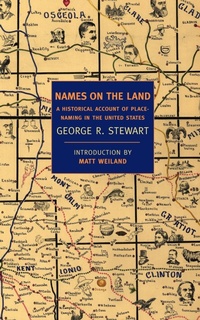
Names on the Land
A Historical Account of Place-Naming in the United States
Published on 1. July 2008
Book
Paperback/Softback
560 pages
978-1-59017-273-5 (ISBN)
Description
George R. Stewart's classic study of place-naming in the United States was written during World War II as a tribute to the varied heritage of the nation's peoples. More than half a century later, Names on the Land remains the authoritative source on its subject, while Stewart's intimate knowledge of America and love of anecdote make his book a unique and delightful window on American history and social life.
Names on the Land is a fascinating and fantastically detailed panorama of language in action. Stewart opens with the first European names in what would later be the United States—Ponce de León's flowery Florída, Cortés's semi-mythical isle of California, and the red Rio Colorado—before going on to explore New England, New Amsterdam, and New Sweden, the French and the Russian legacies, and the unlikely contributions of everybody from border ruffians to Boston Brahmins. These lively pages examine where and why Indian names were likely to be retained; nineteenth-century fads that gave rise to dozens of Troys and Athens and to suburban Parksides, Brookmonts, and Woodcrest Manors; and deep and enduring mysteries such as why "Arkansas” is Arkansaw, except of course when it isn't.
Names on the Land will engage anyone who has ever wondered at the curious names scattered across the American map. Stewart's answer is always a story—one of the countless stories that lie behind the rich and strange diversity of the USA.
Names on the Land is a fascinating and fantastically detailed panorama of language in action. Stewart opens with the first European names in what would later be the United States—Ponce de León's flowery Florída, Cortés's semi-mythical isle of California, and the red Rio Colorado—before going on to explore New England, New Amsterdam, and New Sweden, the French and the Russian legacies, and the unlikely contributions of everybody from border ruffians to Boston Brahmins. These lively pages examine where and why Indian names were likely to be retained; nineteenth-century fads that gave rise to dozens of Troys and Athens and to suburban Parksides, Brookmonts, and Woodcrest Manors; and deep and enduring mysteries such as why "Arkansas” is Arkansaw, except of course when it isn't.
Names on the Land will engage anyone who has ever wondered at the curious names scattered across the American map. Stewart's answer is always a story—one of the countless stories that lie behind the rich and strange diversity of the USA.
More details
Language
English
Place of publication
New York
United States
Publishing group
New York Review Books
Product notice
Paperback (trade)
Unsewn / adhesive bound
Dimensions
Height: 204 mm
Width: 131 mm
Thickness: 29 mm
Weight
576 gr
ISBN-13
978-1-59017-273-5 (9781590172735)
Copyright in bibliographic data and cover images is held by Nielsen Book Services Limited or by the publishers or by their respective licensors: all rights reserved.
Schweitzer Classification
Persons
George R. Stewart (1895—1980) was born in Pennsylvania and educated at Princeton. He received his Ph.D. in English literature from Columbia University in 1922, and joined the English faculty at the University of California, Berkeley, in 1924. He was a toponymist, founding member of the American Name Society, and a prolific and highly successful writer of novels and of popular nonfiction, especially dealing with U.S. history and with the American West.