

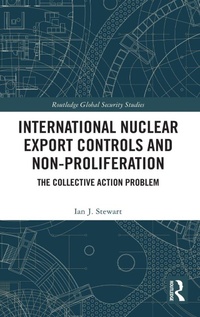
International Nuclear Export Controls and Non-Proliferation
The Collective Action Problem
1st Edition
Published on 28. September 2021
Book
Hardback
274 pages
978-1-032-04687-7 (ISBN)
Description
This book examines the evolution of international nuclear non-proliferation trade controls over time.
The book argues that the international nuclear export controls have developed in a sub-optimal way as a result of a non-proliferation collective action problem. This has resulted in competition among suppliers, owing to the absence of an overarching effective system of control. While efforts have been undertaken to address this collective action problem and strengthen controls over time, these measures have been inherently limited, it is argued here, because of the same structural factors and vested interests that led to the creation of the problem in the first place. This study examines international controls from the beginning of the nuclear age and early efforts to control the atom, up to more recent times and the challenge posed by Iranian and North Korean nuclear ambitions. Drawing on a rich body of original archival research and interviews, the book demonstrates that the collective action problem has restrained cooperation in preventing nuclear proliferation and that gaps persist in the international nuclear trade control regime.
This book will be of much interest to students of nuclear proliferation and arms control, security studies, and International Relations.
The book argues that the international nuclear export controls have developed in a sub-optimal way as a result of a non-proliferation collective action problem. This has resulted in competition among suppliers, owing to the absence of an overarching effective system of control. While efforts have been undertaken to address this collective action problem and strengthen controls over time, these measures have been inherently limited, it is argued here, because of the same structural factors and vested interests that led to the creation of the problem in the first place. This study examines international controls from the beginning of the nuclear age and early efforts to control the atom, up to more recent times and the challenge posed by Iranian and North Korean nuclear ambitions. Drawing on a rich body of original archival research and interviews, the book demonstrates that the collective action problem has restrained cooperation in preventing nuclear proliferation and that gaps persist in the international nuclear trade control regime.
This book will be of much interest to students of nuclear proliferation and arms control, security studies, and International Relations.
More details
Series
Language
English
Place of publication
London
United Kingdom
Publishing group
Taylor & Francis Ltd
Target group
College/higher education
Professional and scholarly
Illustrations
1 s/w Tabelle
1 Tables, black and white
Dimensions
Height: 240 mm
Width: 161 mm
Thickness: 20 mm
Weight
593 gr
ISBN-13
978-1-032-04687-7 (9781032046877)
Copyright in bibliographic data and cover images is held by Nielsen Book Services Limited or by the publishers or by their respective licensors: all rights reserved.
Schweitzer Classification
Other editions
Additional editions
Ian J. Stewart
International Nuclear Export Controls and Non-Proliferation
The Collective Action Problem
Book
05/2023
1st Edition
Routledge
€65.60
Shipment within 10-20 days
Ian J. Stewart
International Nuclear Export Controls and Non-Proliferation
The Collective Action Problem
E-Book
09/2021
1st Edition
Routledge
€59.49
Available for download
Ian J. Stewart
International Nuclear Export Controls and Non-Proliferation
The Collective Action Problem
E-Book
09/2021
1st Edition
Routledge
€59.49
Available for download
Person
Ian J. Stewart is Executive Director of the James Martin Center for Nonproliferation Studies in Washingtong DC, USA.
Content
1. Introduction: international nuclear export controls and non-proliferation, and the collective action problem 2. The missed opportunity? Effective control of atomic energy 3. Atoms, sometimes for peace: the emergence of the non-proliferation collective action problem 4. Strategies that failed? US non-proliferation strategy from 1964 to 1980 5. International nuclear trade controls after the Cold War 6. Universalising non-proliferation trade controls 7. Conclusions