

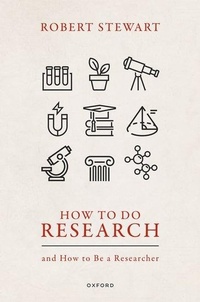
How to Do Research
and How to Be a Researcher
Published on 24. November 2022
Book
Hardback
272 pages
978-0-19-286865-7 (ISBN)
Description
There are many textbooks on research methods, plenty of books on popular science, and specialist texts on a whole range of academic fields. However, few bring these together as a framework for a career involving research, and few attempt a practical appraisal of the challenges and opportunities involved in being 'a researcher'. Here, the principles underlying humanity's past and continuing acquisition of knowledge are illustrated across a variety of academic fields, from history to quantum physics - telling stories of clever and inventive people with good ideas, but also of personalities, politics, and power. This book draws together these strands to provide an informal and concise account of knowledge acquisition in all its guises.
Having set out what research hopes to achieve, and why we are all researchers at heart, early chapters describe the basic principles underlying this - ways of thinking which may date back to the philosophers of the Athenian marketplace but are still powerful influences on the way research is carried out today. Drawing on a broad range of disciplines, Stewart takes the reader well beyond the pure 'scientific method', which might work well enough in physics or chemistry but falls apart in life sciences, let alone humanities. Later chapters consider the realities of carrying out research and the ways in which these continue to shape its progress - researchers and their personalities, their employers, funding, publication, political forces, and power structures.
Written in an accessible and engaging style, this book is for anyone embarking on a research project or beginning to think about a career involving research, and for those in need of refocusing on why they started research in the first place.
Having set out what research hopes to achieve, and why we are all researchers at heart, early chapters describe the basic principles underlying this - ways of thinking which may date back to the philosophers of the Athenian marketplace but are still powerful influences on the way research is carried out today. Drawing on a broad range of disciplines, Stewart takes the reader well beyond the pure 'scientific method', which might work well enough in physics or chemistry but falls apart in life sciences, let alone humanities. Later chapters consider the realities of carrying out research and the ways in which these continue to shape its progress - researchers and their personalities, their employers, funding, publication, political forces, and power structures.
Written in an accessible and engaging style, this book is for anyone embarking on a research project or beginning to think about a career involving research, and for those in need of refocusing on why they started research in the first place.
Reviews / Votes
New and Noteworthy! * The Lunar and Planetary Information Bulletin *More details
Language
English
Place of publication
Oxford
United Kingdom
Target group
Professional and scholarly
Dimensions
Height: 163 mm
Width: 241 mm
Thickness: 21 mm
Weight
614 gr
ISBN-13
978-0-19-286865-7 (9780192868657)
Copyright in bibliographic data and cover images is held by Nielsen Book Services Limited or by the publishers or by their respective licensors: all rights reserved.
Schweitzer Classification
Other editions
Additional editions
E-Book
11/2022
OUP eBook
€19.49
Available for download
Person
Rob Stewart has led, taught, and thought about research for over 25 years at Kings College London and the NIHR Maudsley Biomedical Research Centre.
Content
1: Introduction
2: Origin stories
3: God or clockwork? The importance of ignorance
4: Careful observation
5: Ideas under pressure
6: Choosing a solution
7: The ideal and the reality
8: Consensus
9: Designing research - from description to theory-building
10: Designing research - experiments
11: Designing research - alternatives to experiments
12: Designing research - R&D
13: Communication 1 - getting published
14: Communication 2 - getting known
15: Money
16: Power and politics
17: How to be a researcher - some conclusions
2: Origin stories
3: God or clockwork? The importance of ignorance
4: Careful observation
5: Ideas under pressure
6: Choosing a solution
7: The ideal and the reality
8: Consensus
9: Designing research - from description to theory-building
10: Designing research - experiments
11: Designing research - alternatives to experiments
12: Designing research - R&D
13: Communication 1 - getting published
14: Communication 2 - getting known
15: Money
16: Power and politics
17: How to be a researcher - some conclusions