

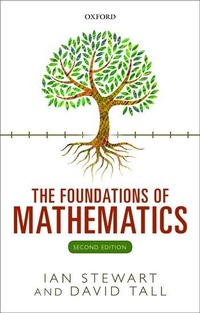
The Foundations of Mathematics
2nd Edition
Published on 12. March 2015
Book
Paperback/Softback
416 pages
978-0-19-870643-4 (ISBN)
Description
The transition from school mathematics to university mathematics is seldom straightforward. Students are faced with a disconnect between the algorithmic and informal attitude to mathematics at school, versus a new emphasis on proof, based on logic, and a more abstract development of general concepts, based on set theory.
The authors have many years' experience of the potential difficulties involved, through teaching first-year undergraduates and researching the ways in which students and mathematicians think. The book explains the motivation behind abstract foundational material based on students' experiences of school mathematics, and explicitly suggests ways students can make sense of formal ideas.
This second edition takes a significant step forward by not only making the transition from intuitive to formal methods, but also by reversing the process- using structure theorems to prove that formal systems have visual and symbolic interpretations that enhance mathematical thinking. This is exemplified by a new chapter on the theory of groups.
While the first edition extended counting to infinite cardinal numbers, the second also extends the real numbers rigorously to larger ordered fields. This links intuitive ideas in calculus to the formal epsilon-delta methods of analysis. The approach here is not the conventional one of 'nonstandard analysis', but a simpler, graphically based treatment which makes the notion of an infinitesimal natural and straightforward.
This allows a further vision of the wider world of mathematical thinking in which formal definitions and proof lead to amazing new ways of defining, proving, visualising and symbolising mathematics beyond previous expectations.
The authors have many years' experience of the potential difficulties involved, through teaching first-year undergraduates and researching the ways in which students and mathematicians think. The book explains the motivation behind abstract foundational material based on students' experiences of school mathematics, and explicitly suggests ways students can make sense of formal ideas.
This second edition takes a significant step forward by not only making the transition from intuitive to formal methods, but also by reversing the process- using structure theorems to prove that formal systems have visual and symbolic interpretations that enhance mathematical thinking. This is exemplified by a new chapter on the theory of groups.
While the first edition extended counting to infinite cardinal numbers, the second also extends the real numbers rigorously to larger ordered fields. This links intuitive ideas in calculus to the formal epsilon-delta methods of analysis. The approach here is not the conventional one of 'nonstandard analysis', but a simpler, graphically based treatment which makes the notion of an infinitesimal natural and straightforward.
This allows a further vision of the wider world of mathematical thinking in which formal definitions and proof lead to amazing new ways of defining, proving, visualising and symbolising mathematics beyond previous expectations.
Reviews / Votes
The writing is both rigorous and thorough, and the authors use compact presentations to support their explanations and proofs. Highly recommended. * N. W. Schillow, CHOICE *More details
Edition
2nd Revised edition
Language
English
Place of publication
Oxford
United Kingdom
Target group
College/higher education
Edition type
Revised edition
Illustrations
113 b/w line drawings
Dimensions
Height: 214 mm
Width: 141 mm
Thickness: 24 mm
Weight
508 gr
ISBN-13
978-0-19-870643-4 (9780198706434)
Copyright in bibliographic data and cover images is held by Nielsen Book Services Limited or by the publishers or by their respective licensors: all rights reserved.
Schweitzer Classification
Other editions
Additional editions
Ian Stewart | David Tall
The Foundations of Mathematics
E-Book
03/2015
2nd Edition
OUP eBook
€22.49
Available for download
Persons
Ian Stewart is Emeritus Professor of Mathematics at the University of Warwick. He remains an active research mathematician and is a Fellow of the Royal Society. Famed for his popular science writing and broadcasting, for which he is the recipient of numerous awards, his bestselling books include: Does God Play Dice?, Nature's Numbers, and Professor Stewart's Cabinet of Mathematical Curiosities. He also co-authored The Science of Discworld series with Terry Pratchett and Jack Cohen
David Tall is Emeritus Professor of Mathematical Thinking at the University of Warwick. Internationally known for his contributions to mathematics education, his most recent book is How Humans Learn to Think Mathematically (2013).
David Tall is Emeritus Professor of Mathematical Thinking at the University of Warwick. Internationally known for his contributions to mathematics education, his most recent book is How Humans Learn to Think Mathematically (2013).
Content
I: THE INTUITIVE BACKGROUND; II: THE BEGINNINGS OF FORMALISATION; III: THE DEVELOPMENT OF AXIOMATIC SYSTEMS; IV: USING AXIOMATIC SYSTEMS; V: STRENGTHENING THE FOUNDATIONS