

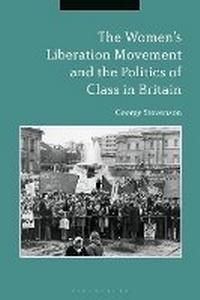
The Women's Liberation Movement and the Politics of Class in Britain
Published on 20. August 2020
Book
Paperback/Softback
288 pages
978-1-350-17828-1 (ISBN)
Description
This is the first study of the British Women's Liberation Movement's relationship with class politics. It explores the meaning of class to women's liberationists' identities and activism, both nationally and regionally, using a previously neglected feminist cluster in North East England as a case study.
Stevenson demonstrates that British feminism was shaped fundamentally by its relationship to, synthesis with, and rejection of class politics. Through these processes, feminists recognised how post-war changes in the economy and gender roles were reshaping class and the Women's Liberation Movement attempted to remake class politics in response. However, socio-economic and cultural class differences between the women involved - linked to occupation, education and background - remained intractable obstacles causing tensions within groups, fragmentations into specific class-based groups and the ultimate failure of the movement to coalesce into a coherent coalition with labour politics, despite great levels of solidarity around particular struggles.
Examining regional feminism against the national backdrop, The Women's Liberation Movement and the Politics of Class in Britain provides an engaging exploration of the fruitful but challenging relationship between British feminism and class politics in a capitalist society.
Stevenson demonstrates that British feminism was shaped fundamentally by its relationship to, synthesis with, and rejection of class politics. Through these processes, feminists recognised how post-war changes in the economy and gender roles were reshaping class and the Women's Liberation Movement attempted to remake class politics in response. However, socio-economic and cultural class differences between the women involved - linked to occupation, education and background - remained intractable obstacles causing tensions within groups, fragmentations into specific class-based groups and the ultimate failure of the movement to coalesce into a coherent coalition with labour politics, despite great levels of solidarity around particular struggles.
Examining regional feminism against the national backdrop, The Women's Liberation Movement and the Politics of Class in Britain provides an engaging exploration of the fruitful but challenging relationship between British feminism and class politics in a capitalist society.
Reviews / Votes
Hearing [working-class activists] in their own words, express their experiences is fascinating, and making a record of this collective memory is part of what give Stevenson's book its value ... A helpful chronicle of the arguments, ideologies and activisms of this time. * Cercles Book Review * [The Women's Liberation Movement and the Politics of Class in Britain] shows how essential it is to grasp the relationship of class and oppression. * Counterfire * This highly readable book constitutes a major piece of original historical research that sheds much light on the under-researched topic of the Women's Liberation Movement and class, and will prove invaluable to both scholars and students of feminism alike. * Natalie Thomlinson, Lecturer of Modern British Cultural History, University of Reading, UK * This is an important book and distinctive contribution to the study of feminist politics, political history and the history of the 1970s in Britain. This is a vibrant and evocative study of the strains of identity and intersectionality within left-progressive politics. More than that its interrogation of the definitions and political applications of the categories of class and gender will be of vital use and interest to scholars across the social sciences. * Lawrence Black, Professor of Modern History, University of York, UK * As so often, the full complexities of a seemingly familiar history emerge from a careful and imaginative dissection of its micro-political dynamics. In this bravely argumentative account of the politics of Women's Liberation in 1970s Britain, George Stevenson delivers exactly such a contribution. * Geoff Eley, Karl Pohrt Distinguished University Professor of Contemporary History, University of Michigan, USA *More details
Language
English
Place of publication
London
United Kingdom
Publishing group
Bloomsbury Publishing PLC
Target group
College/higher education
Illustrations
3 bw illus
Dimensions
Height: 232 mm
Width: 152 mm
Thickness: 18 mm
Weight
880 gr
ISBN-13
978-1-350-17828-1 (9781350178281)
Copyright in bibliographic data and cover images is held by Nielsen Book Services Limited or by the publishers or by their respective licensors: all rights reserved.
Schweitzer Classification
Other editions
Additional editions
George Stevenson
The Women's Liberation Movement and the Politics of Class in Britain
E-Book
02/2019
1st Edition
Bloomsbury Academic
€37.49
Available for download
George Stevenson
The Women's Liberation Movement and the Politics of Class in Britain
E-Book
02/2019
1st Edition
Bloomsbury Academic
€37.49
Available for download
Person
George Stevenson is the Social and Cultural Studies Module Convenor at INTO Newcastle University, UK. He completed a PhD in history at Durham University and was a postdoctoral research fellow at the University of Southampton, UK. He has published articles in the Labour History Review, Women's History Review and History Workshop Online.
Content
List of Illustrations
List of Tables
Introduction
Part I - Production and Reproduction: The Class Politics of Feminism
1. The Women's Liberation Movement and Class Politics
2. Women Workers in the 1970s: Feminists or Part of the Class Struggle?
3. Class Struggle in the Reproductive Sphere
Part II - Individuals in Movement: The Personal, the Political and the Universal
4. Struggling with 'Sisterhood': Class within the WLM
5. Class, Autobiography and Collective Memory in the WLM
Conclusion
Bibliography
Index
List of Tables
Introduction
Part I - Production and Reproduction: The Class Politics of Feminism
1. The Women's Liberation Movement and Class Politics
2. Women Workers in the 1970s: Feminists or Part of the Class Struggle?
3. Class Struggle in the Reproductive Sphere
Part II - Individuals in Movement: The Personal, the Political and the Universal
4. Struggling with 'Sisterhood': Class within the WLM
5. Class, Autobiography and Collective Memory in the WLM
Conclusion
Bibliography
Index