

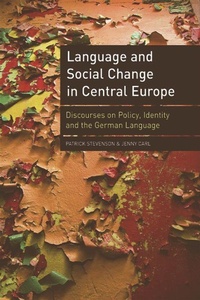
Language and Social Change in Central Europe
Discourses on Policy, Identity and the German Language
Published on 31. July 2010
Book
Hardback
288 pages
978-0-7486-3598-6 (ISBN)
Description
This book explores the dynamics of language and social change in central Europe in the context of the end of the Cold War and eastern expansion of the European Union. One outcome of the profound social transformations in central Europe since the Second World War has been the reshaping of the relationship between particular languages and linguistic varieties, especially between 'national' languages and regional or ethnic minority languages. Previous studies have investigated these transformed relationships from the macro perspective of language policies, while others have taken more fine-grained approaches to individual experiences with language. Combining these two perspectives for the first time - and focusing on the German language, which has a uniquely complex and problematic history in the region - the authors offer an understanding of the complex constellation of language politics in central Europe.Stevenson and Carl's analysis draws on a range of theoretical, conceptual and analytical approaches - language ideologies, language policy, positioning theory, discourse analysis, narrative analysis and life histories - and a wide range of data sources, from European and national language policies to individual language biographies. The authors demonstrate how the relationship between German and other languages has played a crucial role in the politics of language and processes of identity formation in the recent history of central Europe.
More details
Language
English
Place of publication
Edinburgh
United Kingdom
Target group
Professional and scholarly
Product notice
Unsewn / adhesive bound
Cloth over boards
With dust jacket
Dimensions
Height: 236 mm
Width: 157 mm
Thickness: 23 mm
Weight
612 gr
ISBN-13
978-0-7486-3598-6 (9780748635986)
Copyright in bibliographic data and cover images is held by Nielsen Book Services Limited or by the publishers or by their respective licensors: all rights reserved.
Schweitzer Classification
Other editions
Additional editions
Patrick Stevenson | Jenny Carl
Language and Social Change in Central Europe
Discourses on Policy, Identity and the German Language
E-Book
07/2010
Edinburgh University Press
€0.00
Available for download
Persons
Patrick Stevenson is Professor of German and Linguistic Studies at the University of Southampton. His current research interests include the politics of language, multilingualism, language and migration, and language biographies. He has published widely in the field of German sociolinguistics and his recent book publications include: Language and German Disunity: A sociolinguistic history of East and West 1945-2000 (OUP, 2002); (ed., with Clare Mar-Molinero) Language Ideologies, Policies and Practices: Language and the future of Europe (Palgrave, 2006); (ed., with Jenny Carl) Language, Discourse and Identity in Central Europe: The German language in a multilingual space (Palgrave, 2009); and (ed., with Gabrielle Hogan-Brun and Clare Mar-Molinero) Testing Regimes: Critical perspectives on language, migration and citizenship in Europe (Benjamins, 2009).. Jenny Carl completed her doctorate on representations of European identities in parliamentary discourses in Scotland, Wales and Northern Ireland at the University of Osnabrueck, Germany. She is currently working as a Research Fellow at the University of Southampton and in the EU research network LINEE (Languages in a Network of European Excellence). She is co-editor (with Patrick Stevenson) of Language, Discourse and Identity in Central Europe: The German language in a multilingual space (Palgrave, 2009).
Content
1. Introduction; 2. The sociolinguistics of globalisation: theoretical orientations; 3. Language in central Europe: the footprint of German; 4. Sociolinguistic histories: Hungary and the Czech Republic; 5. Interventions and intersections; 6. Language and belonging; 7. Language in time, place and space; 8. Conclusions.