

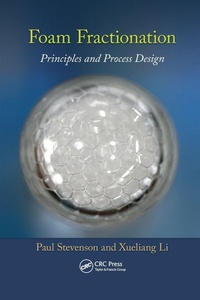
Foam Fractionation
Principles and Process Design
1st Edition
Published on 22. November 2017
Book
Paperback/Softback
206 pages
978-1-138-07428-6 (ISBN)
Description
Foam fractionation is a separation process in which proteins and other amphipathic species adsorb to the surface of bubbles. The bubbles are then removed from the solution in the form of foam at the top of a column. Due to its cost-effectiveness, foam fractionation has the potential for rapid commercial growth, especially in biotechnology.
To assist in the widespread adoption of this highly affordable yet powerful process, Foam Fractionation: Principles and Process Design:
Provides a systematic explanation of the underlying physics of foam fractionation
Discusses the fundamentals of molecular adsorption to gas liquid interfaces and the dynamics of foam
Describes foam fractionation process intensification strategies
Supplies design guidance for plant-scale installations
Contains the latest knowledge of foam fractionation transport processes
Presents a case study of the world's largest commercial foam fractionation plant producing the food preservative Nisin
Foam Fractionation: Principles and Process Design capitalizes on the authors' extensive practical experience of foam fractionation and allied processes to give process engineers, industrial designers, chemical engineers, academics, and graduate students alike a greater understanding of the mechanistic basis and real-world applications of foam fractionation.
To assist in the widespread adoption of this highly affordable yet powerful process, Foam Fractionation: Principles and Process Design:
Provides a systematic explanation of the underlying physics of foam fractionation
Discusses the fundamentals of molecular adsorption to gas liquid interfaces and the dynamics of foam
Describes foam fractionation process intensification strategies
Supplies design guidance for plant-scale installations
Contains the latest knowledge of foam fractionation transport processes
Presents a case study of the world's largest commercial foam fractionation plant producing the food preservative Nisin
Foam Fractionation: Principles and Process Design capitalizes on the authors' extensive practical experience of foam fractionation and allied processes to give process engineers, industrial designers, chemical engineers, academics, and graduate students alike a greater understanding of the mechanistic basis and real-world applications of foam fractionation.
Reviews / Votes
"This is an excellent, well-written book. It can appeal to a range of readers from those interested in foaming out wastes from fish tanks to those concerned with inexpensively recovering enzymes from dilute industrial and waste solutions. I learned a lot reading the early draft even from the introductory chapter..."-Robert D. Tanner, Emeritus Professor, Vanderbilt University, Nashville, Tennessee, USA and Visiting Associate, California Institute of Technology, Pasadena, USA
"The authors' deep appreciation for and extensive knowledge of foam fractionation shines through in their writing. They have written a lucid, approachable, and in-depth account of an important but poorly understood topic."
-Czarena Crofcheck, Associate Professor and Director of Undergraduate Studies, Biosystems and Agricultural Engineering, University of Kentucky, Lexington, USA
More details
Language
English
Place of publication
London
United Kingdom
Publishing group
Taylor & Francis Ltd
Target group
College/higher education
Academics, graduate students, researchers, industrial designers, engineers, and industry professionals involved in biotechnology, chemical engineering, biochemical engineering, food engineering/science and pharmaceuticals.
Illustrations
78 s/w Abbildungen, 4 s/w Tabellen
4 Tables, black and white; 78 Illustrations, black and white
Dimensions
Height: 234 mm
Width: 156 mm
Thickness: 11 mm
Weight
324 gr
ISBN-13
978-1-138-07428-6 (9781138074286)
Copyright in bibliographic data and cover images is held by Nielsen Book Services Limited or by the publishers or by their respective licensors: all rights reserved.
Schweitzer Classification
Other editions
Additional editions
Book
02/2014
1st Edition
CRC Press
€423.40
Article not available at the moment
E-Book
02/2014
CRC Press
€138.99
Available for download
E-Book
02/2014
1st Edition
CRC Press
€138.99
Available for download
Persons
Paul Stevenson undertook four chemical engineering degrees and his post-doctoral training at the University of Cambridge, UK. Currently he is faculty at the University of Hull, a guest professor at the China University of Petroleum, adjunct associate professor in the Reservoir Engineering Group of the University of Western Australia, and chief technical officer at Lower Belford Resources. He previously held academic positions at the Universities of Auckland, New Zealand, and Newcastle, Australia. His research work lies at the nexus of multiphase flow and surface science and involves investigations into enhanced oil recovery, gas-liquid mass transfer and mineral flotation.
Xueliang Li received his master's degree from Hebei University of Technology, China, where he researched foam fractionation in collaboration with Tianjin Kangyi Biotechnology Co., Ltd. He subsequently worked directly for the company, participating in the design of the only industrial protein foam fractionation units in the world. He commenced doctoral studies at the University of Newcastle, Australia, and then transferred to the University of Auckland, New Zealand, where he worked as a research assistant in the Department of Chemical and Materials Engineering. Upon graduation, he joined Lanzatech NZ Ltd., Auckland, New Zealand and currently leads their bioreactor scaling up effort.
Xueliang Li received his master's degree from Hebei University of Technology, China, where he researched foam fractionation in collaboration with Tianjin Kangyi Biotechnology Co., Ltd. He subsequently worked directly for the company, participating in the design of the only industrial protein foam fractionation units in the world. He commenced doctoral studies at the University of Newcastle, Australia, and then transferred to the University of Auckland, New Zealand, where he worked as a research assistant in the Department of Chemical and Materials Engineering. Upon graduation, he joined Lanzatech NZ Ltd., Auckland, New Zealand and currently leads their bioreactor scaling up effort.
Content
Introduction. Adsorption of Surface Active Species to Gas-Liquid Interfaces. Hydrodynamics of Pneumatic Foam. Mechanisms of Foam Instability. Hydrodynamics of Bubble Swarms. Modes of Operation. Bubble Production and Foamate Recovery. Column and Process Design. Process Intensification. Case Study: The Production of Nisin.