

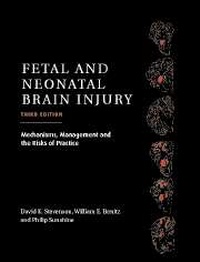
Fetal and Neonatal Brain Injury
Mechanisms, Management and the Risks of Practice
3rd Edition
Published on 6. February 2003
Book
Hardback
926 pages
978-0-521-80691-6 (ISBN)
Description
Now in its third edition, this is a comprehensive survey of fetal and neonatal brain injury arising from hypoxia, ischemia or other causes. The publication spans a broad range of areas from epidemiology and pathogenesis, through to clinical manifestations and obstetric care, and then on to diagnosis, long-term outcomes, and medico-legal aspects. An important theme running throughout is to highlight scientific and clinical advances that have a role to play in minimising risk, improving clinical care and outcomes. The text describes how placental abnormalities, imaging studies and laboratory measurements can identify the timing and severity of the injury event. Despite these advances, fetal and neonatal brain injury remains a major concern with devastating consequences. It is hoped that this definitive account will provide the clinician not only with a better understanding of the mechanisms involved but also with the best available knowledge necessary to deal with this intractable problem.
Reviews / Votes
Review of second edition: 'The material is excellent, well outlined, and well referenced. I would recommend it for all professionals who consult in intensive care nurseries, who are involved in complex obstetrics and who are involved in the medico-legal areas concerning 'bad babies' ... This textbook should continue to be a landmark in neonatal brain injury for the years ahead.' Journal of Perinatology Review of second edition 'Overall this book will provide readers with a broad, contemporary overview of pathophysiologic mechanisms that may contribute to fetal and neonatal brain injury and of current clinical practice. Physicians preparing to serve as expert witnesses in legal cases in which the cause of fetal or neonatal brain injury is in contention are likely to find it an informative reference.' New England Journal of Medicine 'This book provides a thorough overview of the principles and practice involved in managing infants who have suffered brain injury during the foetal or neonatal period. It is well written and presented ... it is also readable - I enjoyed reading many of the chapters in their entirety. Now in its third edition, the information is right up to date ... overall this is a great book ... I will be recommending it to my neonatal colleagues and I expect to refer to it regularly myself.' Pediatric RehabilitationMore details
Edition
3rd Revised edition
Language
English
Place of publication
Cambridge
United Kingdom
Target group
Professional and scholarly
Edition type
Revised edition
Illustrations
126 Tables, unspecified; 2 Plates, color; 168 Halftones, unspecified; 9 Line drawings, unspecified
Dimensions
Height: 256 mm
Width: 199 mm
Thickness: 48 mm
Weight
2395 gr
ISBN-13
978-0-521-80691-6 (9780521806916)
Copyright in bibliographic data and cover images is held by Nielsen Book Services Limited or by the publishers or by their respective licensors: all rights reserved.
Schweitzer Classification
Other editions
New editions
David K. Stevenson | William E. Benitz | Philip Sunshine
Fetal and Neonatal Brain Injury
Book
06/2009
4th Edition
Cambridge University Press
€217.88
Article exhausted; check for reprint
Additional editions
David K. Stevenson | William E. Benitz | Philip Sunshine
Fetal and Neonatal Brain Injury
Mechanisms, Management and the Risks of Practice
E-Book
05/2005
3rd Edition
Cambridge University Press
€201.99
Available for download
Persons
Content
List of contributors; Foreword; Preface; Part I. Epidemiology, Pathophysiology and Pathogenesis of Fetal and Neonatal Brain Injury: 1. Perinatal asphyxia: an overview; 2. Mechanisms of brain damage in animal models of hyopoxia-ischemia in newborns; 3. Cellular and molecur biology of perinatal hypoxia-ischemic brain damage; 4. Fetal response to asphyxia; 5. Congenital malformations of the brain; 6. Prematurity and complications of labor and delivery; 7. Intrauterine growth retardation (restriction); 8. Hemorrhagic lesions of the central nervous system; Part II. Pregnancy, Labor, and Delivery Complications Causing Brain Injury: 9. Maternal diseases that affect fetal development; 10. Antepartum evaluation of fetal well-being; 11. Intrapartum evaluation of the fetus; 12. Obstetrical conditions and practices that affect the fetus and newborn - Section I and II; 13. Fetal and neonatal brain injury as a consequence of maternal substance abuse; 14. Chorioamnionitis and its possible relation top subsequent cerebral palsy; 15. Bacterial sepsis in the neonate; 16. Neonatal bacterial meningitis; 17. Neurological sequelae of congenital perinatal infection; 18. Perinatal human immunodeficiency virus infection; 19. Inborn errors of metabolism with featgures of hypoxic-ischemic encephalopathy; Part III. Diagnosis of the Infant with Asphyxia: 20. Clinical manifestations of hypoxic-ischemic encephalopathy; 21. The use of the EEG in assessing acute and chronic brain damage in the newborn; 22. Structural and functional imaging of hypoxic-ischemic injury (HII) in the fetal and neonatal brain; 23. Near-infrared spectroscopy and imaging; 24. Placental pathology and the etiologu of fetal and neonatal brain injury; 25. Correlations of clinical, laboratory, imaging and placental findings as to the timing of asphyxial events; Part IV. Specific Conditions Associated with Fetal and Neonatal Brain Injury: 26. Hypoglycemia in the neonate; 27. Hyperbilirubenemia and kernicterus; 28. Polycythemia; 29. Hydrops fetalis; 30. Acidosis/alkalosis; 31. Meconium staining and the meconium aspiration syndrome; 32. Persistent pulmonary hypertension of the newborn; 33. Pediatric cardiac surgery: relevance to fetal and neonatal brain injury; Part V. Management of the Depressed or Neurologically Dysfunctional Neonate: 34. Neonatal resuscitation: immediate management; 35. Extended management; 36. Neuroprotective mechanisms after hypoxic-ischemic injury; 37. The Management of neonatal seizures; 38. Use of a simulated program in the education of neonatal resuscitation; 39. Nutritional support of the asphyxiated newborn; Part VI. Assessing the Outcome of the Asphyxiated Infant: 40. Assessment of preterm infants' neurobehavrioural functioning: reliability, validity, normative data, and prediction to age two; 41. Long-term follow-up of term infants with perinatal asphyxia; 42. Appropriateness of intensive care application; 43. Medicolegal issues in perinatal brain injury; Index.