

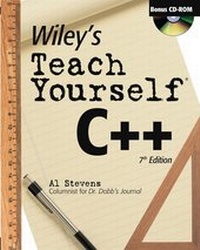
Wiley's Teach Yourself C++
7th Edition
Published on 4. April 2003
Book
Paperback/Softback
738 pages
978-0-7645-2644-2 (ISBN)
Description
C++ is a procedural programming language with object-oriented extensions, meaning that a programmer can define and code programs as procedural modules and define and instantiate objects. This classic programmer's book teaches how to learn basic C++ programming, and provides easy-to-understand writing and numerous code examples.
Reviews / Votes
"...a thoroughbred in a field of also-rans...stands head and shoulders above many of the works in this field..." (Linux Format, August 2003) "...this book is highly recommended..." (CVu, October 2003)More details
Edition
7., Auflage
Language
English
Place of publication
Foster City
United States
Publishing group
John Wiley & Sons Inc
Target group
Professional and scholarly
Edition type
Revised edition
Dimensions
Height: 23.3 cm
Width: 19.3 cm
Weight
1049 gr
ISBN-13
978-0-7645-2644-2 (9780764526442)
Schweitzer Classification
Other editions
Previous edition

Al Stevens
Teach Yourself C++
Book
05/2000
6th Edition
Hungry Minds Inc,U.S.
€47.90
Article exhausted; check for reprint
Person
Al Stevens is a highly-respected author and instructor who has been writing the C Programming column for Dr. Dobb's Journal since 1988. His skill in teaching complex programming languages is legendary, and previous editions of Wiley's Teach Yourself C++ have sold more than 100,000 copies.
Content
Preface.
Acknowledgments.
Part I: The C++ Language.
Chapter 1: An Introduction to Programming in C++.
Chapter 2: Writing Simple C++ Programs.
Chapter 3: Functions.
Chapter 4: Program Flow Control.
Chapter 5: C++ Data Type Organization.
Chapter 6: Structures and Unions.
Chapter 7: More About C++ Data.
Chapter 8: Pointers, Addresses, and Dynamic Memory Allocation.
Chapter 9: Reference Variables.
Chapter 10: Recursion.
Chapter 11: The Preprocessor.
Chapter 12: Function Templates.
Chapter 13: Program Organization.
Part II: Working with Classes.
Chapter 14: C++ Classes.
Chapter 15: Constructors and Destructors.
Chapter 16: Conversion.
Chapter 17: Arrays of Class Objects.
Chapter 18: Class Members.
Chapter 19: Friends.
Chapter 20: Classes and the Heap.
Chapter 21: Overloading Operators.
Chapter 22: Class Libraries.
Chapter 23: Class Inheritance.
Chapter 24: Multiple Inheritance.
Chapter 25: Class Templates.
Part III: The Standard C++ Library.
Chapter 26: Standard C Library Functions.
Chapter 27: Introduction to the Standard C++ Library.
Chapter 28: Formatting IOStreams and the stringstream Classes.
Chapter 29: File I/O Streams.
Part IV: The Standard Template Library.
Chapter 30: Introduction to STL.
Chapter 31: STL Sequence Containers.
Chapter 32: Associative Containers.
Chapter 33: Generic Algorithms.
Chapter 34: Iterators.
Part V: Advanced Topics.
Chapter 35: Exception Handling.
Chapter 36: Namespaces.
Chapter 37: C++ Typecasts.
Chapter 38: Runtime Type Information (RTTI).
Chapter 39: Locales.
Chapter 40: Object-Oriented Programming.
Appendix A: Library Listings.
Appendix B: What's on the CD-ROM?
Appendix C: Quincy 2002 User's Guide.
Appendix D: C++ Reference Tables.
Appendix E: Bibliography.
Glossary.
Index.
End-User License Agreement.
Acknowledgments.
Part I: The C++ Language.
Chapter 1: An Introduction to Programming in C++.
Chapter 2: Writing Simple C++ Programs.
Chapter 3: Functions.
Chapter 4: Program Flow Control.
Chapter 5: C++ Data Type Organization.
Chapter 6: Structures and Unions.
Chapter 7: More About C++ Data.
Chapter 8: Pointers, Addresses, and Dynamic Memory Allocation.
Chapter 9: Reference Variables.
Chapter 10: Recursion.
Chapter 11: The Preprocessor.
Chapter 12: Function Templates.
Chapter 13: Program Organization.
Part II: Working with Classes.
Chapter 14: C++ Classes.
Chapter 15: Constructors and Destructors.
Chapter 16: Conversion.
Chapter 17: Arrays of Class Objects.
Chapter 18: Class Members.
Chapter 19: Friends.
Chapter 20: Classes and the Heap.
Chapter 21: Overloading Operators.
Chapter 22: Class Libraries.
Chapter 23: Class Inheritance.
Chapter 24: Multiple Inheritance.
Chapter 25: Class Templates.
Part III: The Standard C++ Library.
Chapter 26: Standard C Library Functions.
Chapter 27: Introduction to the Standard C++ Library.
Chapter 28: Formatting IOStreams and the stringstream Classes.
Chapter 29: File I/O Streams.
Part IV: The Standard Template Library.
Chapter 30: Introduction to STL.
Chapter 31: STL Sequence Containers.
Chapter 32: Associative Containers.
Chapter 33: Generic Algorithms.
Chapter 34: Iterators.
Part V: Advanced Topics.
Chapter 35: Exception Handling.
Chapter 36: Namespaces.
Chapter 37: C++ Typecasts.
Chapter 38: Runtime Type Information (RTTI).
Chapter 39: Locales.
Chapter 40: Object-Oriented Programming.
Appendix A: Library Listings.
Appendix B: What's on the CD-ROM?
Appendix C: Quincy 2002 User's Guide.
Appendix D: C++ Reference Tables.
Appendix E: Bibliography.
Glossary.
Index.
End-User License Agreement.