

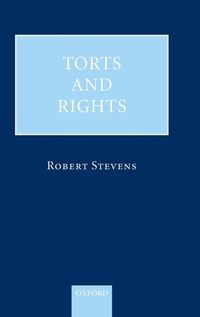
Torts and Rights
Published on 6. September 2007
Book
Hardback
404 pages
978-0-19-921160-9 (ISBN)
Description
The law of torts is concerned with the secondary obligations generated by the infringement of primary rights. This work seeks to show that this apparently simple proposition enables us to understand the law of torts as found in the common law.
Using primarily English materials, but drawing heavily upon the law of other common law jurisdictions, Stevens seeks to give an account of the law of torts which relies upon the core material familiar to most students and practitioners with a grasp of the law of torts. This material is drawn together in support of a single argument in a provocative and accessible style, and puts forward a new theoretical model for analysing the law of torts, providing an overarching framework for radically reconceiving the subject.
Using primarily English materials, but drawing heavily upon the law of other common law jurisdictions, Stevens seeks to give an account of the law of torts which relies upon the core material familiar to most students and practitioners with a grasp of the law of torts. This material is drawn together in support of a single argument in a provocative and accessible style, and puts forward a new theoretical model for analysing the law of torts, providing an overarching framework for radically reconceiving the subject.
Reviews / Votes
This is a major contribution to the literature, demanding the attention of anyone with a serious interest in the theory of the law of tortious responsibility. * European Tort Law * This intelligent and ambitious book is going to influence deeply future discourse. * Russell Brown, Canadian Business Law Journal * Torts and Rights is full of stimulating and provocative analysis and argument, both descriptive and normative. It deserves a large and wide audience. * Peter Cane, The Modern Law Review * In Torts and Rights, Stevens has taken the claim of rights-based theorists one step further and in a far-ranging tour de force shows how most of the well-recognised torts can be understood from this perspective. * JW Neyers, Kings Law Journal * Whilst Stevens audience may not find themselves in agreement with all of his conclusions, few will be able to deny the coherence of his presentation or the clarity of his reasoning. Its impact on the law of torts is bound to be significant; tort lawyers, you have been warned. * Sarah Green, The Cambridge Law Journal * A much clearer and rational analysis of the structure of tort law * Simon Douglas, Law Quarterly Review * Packed with a host of valuable insights * John Murphy, Oxford Journal of Legal Studies * Stevens presents a convincing and hard-hitting rights-based portrayal of the whole of the law of torts in an economical 361 pages. * JW Neyers, King's Law Journal, 19 * A valuable contribution to the subject. * Lord Hoffmann, from the Foreword *More details
Language
English
Place of publication
Oxford
United Kingdom
Target group
Professional and scholarly
Dimensions
Height: 240 mm
Width: 161 mm
Thickness: 26 mm
Weight
766 gr
ISBN-13
978-0-19-921160-9 (9780199211609)
Copyright in bibliographic data and cover images is held by Nielsen Book Services Limited or by the publishers or by their respective licensors: all rights reserved.
Schweitzer Classification
Other editions
Additional editions
Person
Robert Stevens is Professor of Commercial Law at University College London, and was formerly a lecturer at the University of Oxford and a Fellow of Lady Margaret Hall, where he taught since 1994. He has also lectured at the Universities of Nijmegen and Leiden and for the Judicial Studies Board. He is a commercial barrister. He has published widely on many aspects of private law, always seeking to show how the theory of academic law has practical relevance to the law as found in the courts.
Content
1. Introduction ; 2. Rights ; 3. Loss ; 4. Remedies ; 5. Fault ; 6. Causation ; 7. Remoteness ; 8. Privity ; 9. Concurrence ; 10. State ; 11. Attribution ; 12. Accessories ; 13. Classification ; 14. Policy ; 15. Justice ; 16. Conclusion