

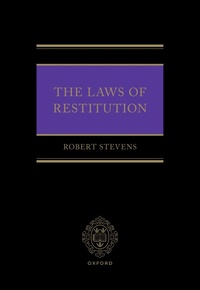
The Laws of Restitution
Published on 28. February 2025
Book
Paperback/Softback
496 pages
978-0-19-894540-6 (ISBN)
Description
In The Laws of Restitution, Robert Stevens seeks to show that there is no unified law of restitution or unjust enrichment. This is in contrast to the traditional view of restitution which has long been thought to be reducible to a single "unjust enrichment".
The author proposes that there are instead (depending on how you count them) seven or eight different kinds of private law claim, none of which have anything important in common one with another, that have been grouped together by commentators. Few of these claims have anything to do with enrichment, and what is restituted differs between them. Like all private law claims, those gathered here concern (in)justice between individuals, but they have no further unity. Many of them are not based upon an agreement or a wrong, but that negative feature has no utility. As such, Stevens argues that "restitution" or "unjust enrichment" should cease to be discussed as unified areas of law.
In this work, Stevens identifies and describes the various reasons for "restitution" that any properly constructed system of private law ought to recognise. He also explains how the law of restitution relates to, and is bound up with, areas of contract, torts, equity, and property law.
The author proposes that there are instead (depending on how you count them) seven or eight different kinds of private law claim, none of which have anything important in common one with another, that have been grouped together by commentators. Few of these claims have anything to do with enrichment, and what is restituted differs between them. Like all private law claims, those gathered here concern (in)justice between individuals, but they have no further unity. Many of them are not based upon an agreement or a wrong, but that negative feature has no utility. As such, Stevens argues that "restitution" or "unjust enrichment" should cease to be discussed as unified areas of law.
In this work, Stevens identifies and describes the various reasons for "restitution" that any properly constructed system of private law ought to recognise. He also explains how the law of restitution relates to, and is bound up with, areas of contract, torts, equity, and property law.
Reviews / Votes
The book will be useful for similar reasons to Australian practitioners and judges, especially because in the areas of law addressed Australian authority is often thin and English authority persuasive. * Sydney Law Review *More details
Language
English
Place of publication
Oxford
United Kingdom
Target group
Professional and scholarly
Product notice
Paperback (trade)
Unsewn / adhesive bound
Dimensions
Height: 245 mm
Width: 171 mm
Thickness: 29 mm
Weight
868 gr
ISBN-13
978-0-19-894540-6 (9780198945406)
Copyright in bibliographic data and cover images is held by Nielsen Book Services Limited or by the publishers or by their respective licensors: all rights reserved.
Schweitzer Classification
Person
Robert Stevens is the Herbert Smith Freehills Professor of English Private Law at the University of Oxford. Previously he was a Professor of commercial law at UCL, a lecturer in law at the University of Oxford, and a Fellow and Tutor in Law at Lady Margaret Hall. He is also a commercial barrister and has published widely on many aspects of private law, always seeking to show how the theory of academic law has practical relevance to the law as found in the courts. He is the author of Torts and Rights (OUP, 2007).
Content
Foreword
Preface
Part I Introduction
1: Summary
2: Foundations
Part II Unjustified Performance
3: Performance
4: Reversal
5: Theory
6: Practice
Part III Conditional Performance
7: Conditions
8: Contract
Part IV Intervention in Another's Affairs
9: Discharge
10: Necessity
Part V Property and Trusts
11: Things
12: Equity: General
13: Equity: Restitution
14: Improvements
Part VI Wrongdoing
15: Wrongs
16: Profits
17: Damages
Part VII Countervailing Reasons
18: Defences
19: Illegality
Part VIII Apologia
20: Conclusion
Preface
Part I Introduction
1: Summary
2: Foundations
Part II Unjustified Performance
3: Performance
4: Reversal
5: Theory
6: Practice
Part III Conditional Performance
7: Conditions
8: Contract
Part IV Intervention in Another's Affairs
9: Discharge
10: Necessity
Part V Property and Trusts
11: Things
12: Equity: General
13: Equity: Restitution
14: Improvements
Part VI Wrongdoing
15: Wrongs
16: Profits
17: Damages
Part VII Countervailing Reasons
18: Defences
19: Illegality
Part VIII Apologia
20: Conclusion