

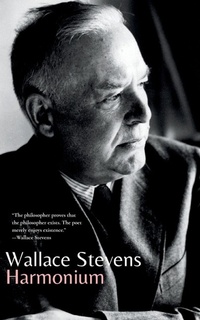
Harmonium
Published on 6. September 2025
Book
Paperback/Softback
132 pages
978-1-956716-16-0 (ISBN)
Description
First published in 1923, Harmonium marked the beginning of Wallace Stevens' celebrated career as an American modernist poet. As his first book, published when he was 44, Stevens demonstrated a remarkable range, already showing a mature style.
In this book, some famous poems of Stevens include "Thirteen Ways of Looking at a Blackbird," "The Snow Man," "The Emperor of Ice Cream," "Sunday Morning," and many other influential poems commonly anthologized in American poetry books.
Harmonium helped Wallace Stevens win the 1955 Pulitzer Prize in Poetry and 1955 National Book Award for Poetry for The Collected Poems of Wallace Stevens. Although, many of his most treasured works are found in his first book of poems. In this new edition by American publisher Yellow Leaf Press, the celebrated first book of Wallace Stevens is brought back to life.
More details
Language
English
Product notice
Paperback (trade)
Unsewn / adhesive bound
Dimensions
Height: 203 mm
Width: 127 mm
Thickness: 8 mm
Weight
151 gr
ISBN-13
978-1-956716-16-0 (9781956716160)
Copyright in bibliographic data and cover images is held by Nielsen Book Services Limited or by the publishers or by their respective licensors: all rights reserved.
Schweitzer Classification
Person
Wallace Stevens (1879-1955) was an American modernist poet celebrated for his richly imaginative verse that explored the interplay between reality and the imagination. Born in Reading, Pennsylvania, he studied at Harvard and later earned a law degree from New York Law School, eventually becoming an executive at the Hartford Accident and Indemnity Company. Despite his demanding business career, Stevens produced some of the 20th century's most acclaimed poetry, including Harmonium (1923) and The Collected Poems of Wallace Stevens (1954), which won the Pulitzer Prize. His works often meditate on art, nature, and the search for meaning in a secular world. Today, he is remembered as one of the central figures of American modernist poetry, blending philosophical depth with lyrical beauty.