

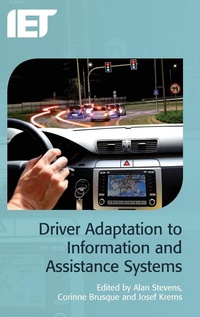
Driver Adaptation to Information and Assistance Systems
Published on 19. December 2013
Book
Hardback
382 pages
978-1-84919-639-0 (ISBN)
Description
Driver information and assistance systems have emerged as an integral part of modern road vehicles in order to support the driver while driving. They make use of the newest information technologies in order to enhance driver awareness, safety and comfort, and thereby avoiding driver errors and accidents. Driver Adaptation to Information and Assistance Systems brings together recent work by the Marie-Curie Initial Training Network ADAPTATION. The project has studied drivers' behavioural adaptation to these new technologies from an integrative perspective working under a joint conceptual theoretical framework of behavioural adaptation that can be used to generate research hypotheses about how drivers will adapt to information and assistance systems and to derive guidelines for the design and deployment of such systems.
The book aims to provide the reader with a better understanding of drivers' adaptation processes over time in response to information and assistance system use at different levels (energetic, cognitive and motivational levels); an appreciation of the impact of specificities of drivers population on technology use and skill acquisition; insights on the effects of system functionality, design and reliability as important system characteristics influencing drivers' adaptation; and recommendations on research methods and appropriate tools to investigate adaptation processes.
The book aims to provide the reader with a better understanding of drivers' adaptation processes over time in response to information and assistance system use at different levels (energetic, cognitive and motivational levels); an appreciation of the impact of specificities of drivers population on technology use and skill acquisition; insights on the effects of system functionality, design and reliability as important system characteristics influencing drivers' adaptation; and recommendations on research methods and appropriate tools to investigate adaptation processes.
More details
Series
Language
English
Place of publication
Stevenage
United Kingdom
Target group
College/higher education
Professional and scholarly
Dimensions
Height: 240 mm
Width: 161 mm
Thickness: 25 mm
Weight
754 gr
ISBN-13
978-1-84919-639-0 (9781849196390)
Copyright in bibliographic data and cover images is held by Nielsen Book Services Limited or by the publishers or by their respective licensors: all rights reserved.
Schweitzer Classification
Other editions
Additional editions
Alan Stevens | Corinne Brusque | Josef Krems
Driver Adaptation to Information and Assistance Systems
E-Book
12/2013
1st Edition
Institution of Engineering and Technology
€157.49
Available for download
Persons
Alan Stevens is Chief Research Scientist and Research Director, Transportation, at the Transport Research Laboratory (TRL), in the UK, where he has been working on the application of new technology to transport for 25 years. He is an internationally recognised expert in human-machine interaction (HMI) in the driving environment and his consultancy activities focus on providing advice on policy and interoperability issues to Government, developing research programs and carrying out specific technical and human factors studies in Intelligent Transport Systems. He is Editor-in-Chief of The Journal of Intelligent Transport Systems.
Corinne Brusque is Research Manager and Scientific Director in charge of evaluation at Ifsttar (French Institute of Science and Technology for Transport, Development and Networks). Her main research topics concern the factors affecting in-vehicle technology adoption, drivers' exposure to distraction related to in-vehicle technologies and the impact of in-vehicle technologies on drivers' behaviour.
Josef Krems is Professor of Cognitive and Industrial Psychology at Chemnitz University of Technology. His current research projects focus on three areas: traffic and transport (safety, driver assistance, green driving and sustainability); human factors (human-machine interaction, usability); and user acceptance.
Corinne Brusque is Research Manager and Scientific Director in charge of evaluation at Ifsttar (French Institute of Science and Technology for Transport, Development and Networks). Her main research topics concern the factors affecting in-vehicle technology adoption, drivers' exposure to distraction related to in-vehicle technologies and the impact of in-vehicle technologies on drivers' behaviour.
Josef Krems is Professor of Cognitive and Industrial Psychology at Chemnitz University of Technology. His current research projects focus on three areas: traffic and transport (safety, driver assistance, green driving and sustainability); human factors (human-machine interaction, usability); and user acceptance.
Content
Chapter 1: The ADAPTATION project
Chapter 2: Behavioural adaptation in response to driving assistance technologies: A literature review
Chapter 3: Methods to assess behavioural adaptation over time as a result of ADAS use
Chapter 4: Effect of ADAS use on drivers' information processing and Situation Awareness
Chapter 5: Early adopters' mental model of Adaptive Cruise Control (ACC) and its influence on behavioural adaptation to the system
Chapter 6: Intelligent driver support systems: Effects of learning and aging
Chapter 7: Researching safety issues with intersection assistance systems for the older driver
Chapter 8: Motivational factors when investigating ADAS impacts on driver behaviour
Chapter 9: Drivers' adaptation to mobile phone use: Interaction strategies, consequences on driving behaviour and potential impact on road safety
Chapter 10: Evaluating the potential for workload based driving assistance systems from a psychological, technological and physiological perspective
Chapter 11: Distraction and inattention prevention by combining Behaviour-Based Safety with Advanced Driver Assistance Systems
Chapter 12: Effectiveness of Forward Collision Warning Systems: A contribution from the cognitive analysis combining behavioural and electrophysiological measurements
Chapter 13: Introduction of automated platooning in traffic: What is the impact on non-automated drivers? - An analysis of the influence of the short time headways held by automated platoons
Chapter 14: User-centred design approach to model scenarios on driving simulators
Chapter 15: Development of a database for storage and analysis of behavioural data
Chapter 16: Synthesis of new knowledge on adaptation processes in response to ADAS and associated advances in research methods
Chapter 17: Recommendations for research on drivers' behavioural adaptation and for the design and deployment of ADAS
Chapter 2: Behavioural adaptation in response to driving assistance technologies: A literature review
Chapter 3: Methods to assess behavioural adaptation over time as a result of ADAS use
Chapter 4: Effect of ADAS use on drivers' information processing and Situation Awareness
Chapter 5: Early adopters' mental model of Adaptive Cruise Control (ACC) and its influence on behavioural adaptation to the system
Chapter 6: Intelligent driver support systems: Effects of learning and aging
Chapter 7: Researching safety issues with intersection assistance systems for the older driver
Chapter 8: Motivational factors when investigating ADAS impacts on driver behaviour
Chapter 9: Drivers' adaptation to mobile phone use: Interaction strategies, consequences on driving behaviour and potential impact on road safety
Chapter 10: Evaluating the potential for workload based driving assistance systems from a psychological, technological and physiological perspective
Chapter 11: Distraction and inattention prevention by combining Behaviour-Based Safety with Advanced Driver Assistance Systems
Chapter 12: Effectiveness of Forward Collision Warning Systems: A contribution from the cognitive analysis combining behavioural and electrophysiological measurements
Chapter 13: Introduction of automated platooning in traffic: What is the impact on non-automated drivers? - An analysis of the influence of the short time headways held by automated platoons
Chapter 14: User-centred design approach to model scenarios on driving simulators
Chapter 15: Development of a database for storage and analysis of behavioural data
Chapter 16: Synthesis of new knowledge on adaptation processes in response to ADAS and associated advances in research methods
Chapter 17: Recommendations for research on drivers' behavioural adaptation and for the design and deployment of ADAS