

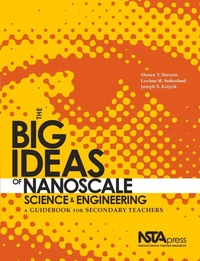
The Big Ideas of Nanoscale Science and Engineering
A Guidebook for Secondary Teachers
Will be published approx. on 26. November 2009
Book
Paperback/Softback
295 pages
978-1-935155-07-2 (ISBN)
Description
Given the ability of nanoscience and nanotechnology to exploit the unique properties that matter exhibits at the nanoscale, the research resulting from these emerging fields is poised to dramatically affect everyday life. In fact, many widely used electronic, pharmaceutical, cosmetic, and textile products already employ nanotechnology.With the support of the National Science Foundation, scientists, educators, researchers, and curriculum developers have achieved a rough consensus on what the key concepts-or "big ideas"-of nanoscience might be for middle and high school science students:
¿ Size and Scale
¿ Structure of Matter
¿ Forces and Interactions
¿ Quantum Effects
¿ Size-Dependent Properties
¿ Self-Assembly
¿ Tools and Instrumentation
¿ Models and Simulations
¿ Science, Technology, and Society
This volume provides in-depth discussions of each big idea. Nine additional chapters examine learning goals and how to reach them, students' likely misconceptions, and ideas for integrating nanoscale science and engineering with traditional science content. An appreciation of nanoscience will help students understand fundamental science concepts across disciplines. Also, learning the enormous implications of the extremely tiny nanoscale phenomena will pique students' interest in the study of 21st-century science and at the same time motivate them to learn traditional science.
More details
Language
English
Place of publication
Arlington
United States
Target group
Professional and scholarly
Product notice
Paperback (trade)
Unsewn / adhesive bound
Dimensions
Height: 272 mm
Width: 208 mm
Thickness: 13 mm
Weight
581 gr
ISBN-13
978-1-935155-07-2 (9781935155072)
Copyright in bibliographic data and cover images is held by Nielsen Book Services Limited or by the publishers or by their respective licensors: all rights reserved.
Schweitzer Classification
Persons
Raised on a family farm in Canada, Prof Sutherland is a interdisciplinary social scientist with a background European agrarian development, human-environment relations, and farm-level decision-making. She is perhaps best known for her work in developing the 'Triggering Change' model of farmer decision-making.