

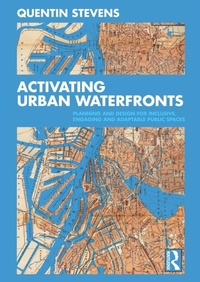
Activating Urban Waterfronts
Planning and Design for Inclusive, Engaging and Adaptable Public Spaces
1st Edition
Published on 15. December 2020
Book
Paperback/Softback
246 pages
978-0-367-47324-2 (ISBN)
Description
Activating Urban Waterfronts shows how urban waterfronts can be designed, managed and used in ways that can make them more inclusive, lively and sustainable. The book draws on detailed examination of a diversity of waterfronts from cities across Europe, Australia and Asia, illustrating the challenges of connecting these waterfront precincts to the surrounding city and examining how well they actually provide connection to water. The book challenges conventional large scale, long-term approaches to waterfront redevelopment, presenting a broad re-thinking of the formats and processes through which urban redevelopment can happen. It examines a range of actions that transform and activate urban spaces, including informal appropriations, temporary interventions, co-design, creative programming of uses, and adaptive redevelopment of waterfronts over time. It will be of interest to anyone involved in the development and management of waterfront precincts, including entrepreneurs, the creative industries, community organizations, and, most importantly, ordinary users.
More details
Language
English
Place of publication
London
United Kingdom
Publishing group
Taylor & Francis Ltd
Target group
College/higher education
Professional and scholarly
General, Professional, Professional Practice & Development, and Undergraduate Advanced
Illustrations
89 s/w Abbildungen, 83 s/w Photographien bzw. Rasterbilder, 6 s/w Tabellen
6 Tables, black and white; 83 Halftones, black and white; 89 Illustrations, black and white
Dimensions
Height: 246 mm
Width: 174 mm
Thickness: 14 mm
Weight
466 gr
ISBN-13
978-0-367-47324-2 (9780367473242)
Copyright in bibliographic data and cover images is held by Nielsen Book Services Limited or by the publishers or by their respective licensors: all rights reserved.
Schweitzer Classification
Other editions
Additional editions
Quentin Stevens
Activating Urban Waterfronts
Planning and Design for Inclusive, Engaging and Adaptable Public Spaces
Book
12/2020
1st Edition
Routledge
€206.40
Shipment within 15-20 days
Quentin Stevens
Activating Urban Waterfronts
Planning and Design for Inclusive, Engaging and Adaptable Public Spaces
E-Book
12/2020
1st Edition
Routledge
€48.49
Available for download
Quentin Stevens
Activating Urban Waterfronts
Planning and Design for Inclusive, Engaging and Adaptable Public Spaces
E-Book
12/2020
1st Edition
Routledge
€48.49
Available for download
Person
Quentin Stevens is an Associate Professor in the School of Architecture and Urban Design at RMIT University in Melbourne, Australia. He has professional degrees in Architecture and Urban Planning and previous taught at the Bartlett School of Planning, University College London. He has published widely on the social uses of public spaces, including the books Transforming Urban Waterfronts: Fixity and Flow, The Ludic City, and Loose Space. His current areas of research interest include temporary and tactical urbanism, the contribution that public space design makes to social cohesion, and the role of memorials in national identity.
Content
Introduction
Part 1: Plugging the Waterfront into the City
1. Three 'Southbanks'
2. Postcolonial Waterfronts: Global Imagery and Local Realities
Quentin Stevens, Marek Kozlowski and Norsidah Ujang
3. Tracing the Shifting Waterfront
4. Artificial Waterfronts
Part 2: Switching the Waterfront On
5. Appropriating the Spectacle
Quentin Stevens and Kim Dovey
6. The 'City Beach' as a New Waterfront Development Model
7. Post-Fordist Placemaking
Quentin Stevens and Mhairi Ambler
8. Sandpit Urbanism
9. A Temporary Waterfront: Prompting Public Engagement
Jacob Mikkelsen, Quentin Stevens, Catherine Hills and Florian 'Floyd' Mueller
Conclusion
Part 1: Plugging the Waterfront into the City
1. Three 'Southbanks'
2. Postcolonial Waterfronts: Global Imagery and Local Realities
Quentin Stevens, Marek Kozlowski and Norsidah Ujang
3. Tracing the Shifting Waterfront
4. Artificial Waterfronts
Part 2: Switching the Waterfront On
5. Appropriating the Spectacle
Quentin Stevens and Kim Dovey
6. The 'City Beach' as a New Waterfront Development Model
7. Post-Fordist Placemaking
Quentin Stevens and Mhairi Ambler
8. Sandpit Urbanism
9. A Temporary Waterfront: Prompting Public Engagement
Jacob Mikkelsen, Quentin Stevens, Catherine Hills and Florian 'Floyd' Mueller
Conclusion