

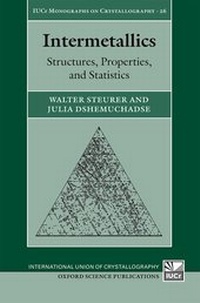
Intermetallics
Structures, Properties, and Statistics
Published on 1. September 2016
Book
Hardback
592 pages
978-0-19-871455-2 (ISBN)
Description
The fascinating world of intermetallics is largely unexplored. There are many exciting physical properties and important technological applications of intermetallics, from magnetism to superconductivity. The main focus of this book is on the statistics, topology and geometry of crystal structures and structure types of intermetallic phases. The underlying physics, in particular chemical bonding, is discussed whenever it helps understand the stability of structures
and the origin of their physical properties. The authors' approach, based on the statistical analysis of more than twenty thousand intermetallic compounds in the data base Pearson's Crystal Data, uncovers important structural relationships and illustrates the relative simplicity of most of the general
structural building principles. It also shows that a large variety of actual structures can be related to a rather small number of aristotypes. The text aims to be readable and beneficial in one way or another to everyone interested in intermetallic phases, from graduate students to experts in solid state chemistry and physics, and materials science. For that purpose it avoids the use of enigmatic abstract terminology for the classification of structures. Instead, it focuses on the statistical
analysis of crystal structures and structure types in order to draw together a larger overview of intermetallics, and indicate the gaps in it - areas still to be explored, and potential sources of worthwhile research. The text should be read as a reference guide to the incredibly rich world of
intermetallic phases.
and the origin of their physical properties. The authors' approach, based on the statistical analysis of more than twenty thousand intermetallic compounds in the data base Pearson's Crystal Data, uncovers important structural relationships and illustrates the relative simplicity of most of the general
structural building principles. It also shows that a large variety of actual structures can be related to a rather small number of aristotypes. The text aims to be readable and beneficial in one way or another to everyone interested in intermetallic phases, from graduate students to experts in solid state chemistry and physics, and materials science. For that purpose it avoids the use of enigmatic abstract terminology for the classification of structures. Instead, it focuses on the statistical
analysis of crystal structures and structure types in order to draw together a larger overview of intermetallics, and indicate the gaps in it - areas still to be explored, and potential sources of worthwhile research. The text should be read as a reference guide to the incredibly rich world of
intermetallic phases.
Reviews / Votes
A very timely book. When scientists are launching algorithms for material properties informatics the need for statistical treatment of existing data is great. This pair of highly acclaimed authors do it carefully, thoroughly and authoritatively providing the reader with highly valuable meta-data. A must for metallurgists and material scientists. * Sven Lidin, Lund University, Sweden * Are intermetallic compounds typical inorganic materials or not? Are their crystal structures complex or not? Are their properties useful or not? Julia Dshemuchadse and Walter Steurer approach these questions by consequently applying statistical analysis to the information on thousands of crystal structures. This is a highly recommended lecture for those readers who aim at transcending the knowledge of usual textbooks. * Juri Grin, Max Planck Institute for Chemical Physics of Solids, Germany * This book is written by leading structural scientists and will be of wide appeal to researchers in chemistry, materials, condensed matter physics and beyond (e.g. to those interested in possible new products and devices). The book is firmly based on rigorous crystallography results. * John Helliwell, Emeritus Professor of Chemistry, University of Manchester, UK * This is a much needed book on a topic that continues to surprise. The coverage is comprehensive and the outlook is futuristic. It is highly recommended for crystallographers and chemists. * G. R. Desiraju, Solid State and Structural Chemistry Unit, Indian Institute of Science *More details
Other editions
Additional editions
E-Book
09/2016
1st Edition
OUP eBook
€104.99
Available for download
Persons
Walter Steurer studied chemistry at the University of Vienna, Austria. After finishing his doctoral dissertation under the supervision of Prof. Hans Nowotny, he moved, in 1980, to the University of Munich, Germany, where he worked as a research assistant and lecturer. In 1987 he concluded his habilitation thesis in the field of crystallography and mineralogy. For a short period, from 1992 until 1993, he was Professor of Crystallography at the University of Hanover,
Germany. Since fall 1993, he has been Full Professor of crystallography at the ETH and University of Zurich, Switzerland, until his retirement in 2016.
Julia Dshemuchadse studied physics at the Technical University of Dresden, Germany, and obtained her PhD in Materials Science from ETH Zurich, Switzerland, in 2013 for her thesis on the structure of complex intermetallics under the supervision of Prof. Walter Steurer. She studied the statistics of complex intermetallics during a subsequent two-year postdoc with Prof. Steurer. In 2015, she was awarded the "Max-von-Laue-Preis" of the German Crystallographic Society (DGK). Since 2015, she is
studying the self-assembly of complex phases with Prof. Sharon Glotzer at the University of Michigan, USA, funded by a postdoctoral fellowship of the Swiss National Science Foundation.
Germany. Since fall 1993, he has been Full Professor of crystallography at the ETH and University of Zurich, Switzerland, until his retirement in 2016.
Julia Dshemuchadse studied physics at the Technical University of Dresden, Germany, and obtained her PhD in Materials Science from ETH Zurich, Switzerland, in 2013 for her thesis on the structure of complex intermetallics under the supervision of Prof. Walter Steurer. She studied the statistics of complex intermetallics during a subsequent two-year postdoc with Prof. Steurer. In 2015, she was awarded the "Max-von-Laue-Preis" of the German Crystallographic Society (DGK). Since 2015, she is
studying the self-assembly of complex phases with Prof. Sharon Glotzer at the University of Michigan, USA, funded by a postdoctoral fellowship of the Swiss National Science Foundation.
Content
PART I: CONCEPTS; PART II: STRUCTURES; PART III: PROPERTIES