

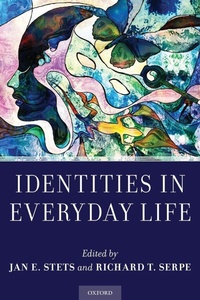
Identities in Everyday Life
Published on 13. June 2019
Book
Hardback
422 pages
978-0-19-087306-6 (ISBN)
Description
Identities in Everyday Life explores how identity theory in social psychology can help us understand a wide array of issues across six areas of life including psychological well-being; authenticity; morality; gender, race, and sexuality; group membership; and early-to-later adult identities. Bringing together over 45 scholars presenting original theoretical or empirical work, the chapters build upon prior work to understand the source, development, and dynamics of individuals' identities as they unfold within and across situations. These studies not only advance scholarly research on identities, but they also provide an understanding of the relevance of identities for people's everyday lives. The findings are relevant to a broad-based set of researchers in the academy across disciplines in the social sciences, education, and health, to students at both the graduate and undergraduate level who are interested in identities at both a personal and professional level, to mental health professionals, and to the average person in society.
Reviews / Votes
"The volume is based on scholarship presented at the second biannual conference on identity theory and research...The majority of chapters discuss specific studies, adopting the standard academic research article format. Despite the format, the language employed seems geared more toward general readers than academics. Recommended." * CHOICE * This volume is an important collection of research and theory by some of the most influential scholars currently working on the question of identity. In breaking so much fertile ground, this finely edited compendium promises to extend identity theory and invite many new and innovative avenues of research. * Peter Callero, Professor of Sociology, Western Oregon University * As today's climate of identity driven politics and social divisions has highlighted for us, identity processes are central to the link between a society's social structure and the behaviors and motives of the individuals within it. Stets and Serpe's edited volume offers us a valuable new look at how these linkages work out in everyday contemporary life. * Celia Rigdgeway, Lucie Stern Professor of Social Sciences, Emerita, Stanford University *More details
Language
English
Place of publication
New York
United States
Dimensions
Height: 260 mm
Width: 183 mm
Thickness: 27 mm
Weight
985 gr
ISBN-13
978-0-19-087306-6 (9780190873066)
Copyright in bibliographic data and cover images is held by Nielsen Book Services Limited or by the publishers or by their respective licensors: all rights reserved.
Schweitzer Classification
Other editions
Additional editions
Jan E. Stets | Richard T. Serpe
Identities in Everyday Life
E-Book
04/2019
1st Edition
OUP eBook
€90.99
Available for download
Jan E. Stets | Richard T. Serpe
Identities in Everyday Life
E-Book
04/2019
1st Edition
OUP eBook
€90.99
Available for download
Persons
Jan E. Stets is Professor and Co-Chair of the Department of Sociology and Director of the Social Psychology Research Laboratory at the University of California, Riverside. She is past Director of the Sociology Program at the National Science Foundation, and past Co-Editor of Social Psychology Quarterly. Professor Stets is a sociological social psychologist who works in the areas of self and identity, emotions, morality, and social exchange. She is the author of a dozen books and over 80 papers. She is the recipient of NSF grants, a Fellow of the American Association for the Advancement of Science, Fellow of the Society for Experimental Social Psychology, and a member of the Sociological Research Association. She received the Lifetime Achievement Award from the ASA Emotions Section.
Richard T. Serpe is Professor and Chair of the Department of Sociology at Kent State University. He is past Co-Editor of Social Psychology Quarterly and Sociological Perspectives. Professor Serpe
is a sociological social psychologist who has been working in identity theory for the past forty years. His recent research is designed to further contextualize identity processes in terms of differential placement within the social structure. He has conducted or directed over 270 research projects funded by several private foundations, public and private organizations, local, state, and federal agencies.
Richard T. Serpe is Professor and Chair of the Department of Sociology at Kent State University. He is past Co-Editor of Social Psychology Quarterly and Sociological Perspectives. Professor Serpe
is a sociological social psychologist who has been working in identity theory for the past forty years. His recent research is designed to further contextualize identity processes in terms of differential placement within the social structure. He has conducted or directed over 270 research projects funded by several private foundations, public and private organizations, local, state, and federal agencies.
Content
- Part I. INTRODUCTION
- Chapter 1: Overview
- Jan E. Stets and Richard T. Serpe
- Part II. WELL-BEING
- Chapter 2: Identity Accumulation, Verification, and Well-Being
- Peter J. Burke and Christine Cerven
- Chapter 3: Perceived Similarity in Identity Meanings, Identity Verification, and Positive Emotions
- Matthew Grindal and Ryan Trettevik,
- Chapter 4: Multiple Identities and Self-Esteem
- Richard T. Serpe and Fritz Yarrison, Jan E. Stets, and Sheldon Stryker
- Part III. AUTHENTICITY
- Chapter 5: Authenticity and the Religious Identity
- Philip S. Brenner
- Chapter 6: Authenticity, Digital Media, and Person Identity Verification
- Jenny L. Davis
- Part IV. MORALITY
- Chapter 7: Toward a Theory of Moral Identity Development
- John Aldecoa
- Chapter 8: The Moral Identity and Immoral Behavior
- Jan E. Stets and Kevin McCaffree
- Chapter 9: Intersectional Identities and Stigma Recovery: Affective and Cognitive Responses to Unethical Prosocial Events
- Maria C. Ramos, Lynn Smith-Lovin, and Bethany Young
- Part V. GENDER, RACIAL, and SEXUALITY ISSUES
- Chapter 10: Gender Identity Among U.S. Adults
- K. Jill Kiecolt, Michael Hughes, and Hans Momplaisir
- Chapter 11: Racial Identity and Racial Attitudes among White Americans
- Matthew O. Hunt and Ashely V. Reichelmann,
- Chapter 12: Racial Exclusion and Queer Identity
- Shaeleya Miller
- Part VI. IDENTITIES AND GROUPS
- Chapter 13: Identities Meanings and Categorical Inequality
- Kimberly B. Rogers
- Chapter 14: Controlled, Verified, and Understood: Status and Identity in the Field of Higher Education
- Freda B. Lynn, Olga A. Novoselova, and Graham N. S. Miller
- Chapter 15: Identity Formation in Street Demonstrations
- Bert Klandermans and Jacquelien van Stekelenburg
- Part VII. IDENTITIES OVER THE LIFE COURSE
- Chapter 16: The Nature of the Ballet and Hip-Hop Dancer Identity
- Melanie Kushida
- Chapter 17: The Role of Signification Others in Shaping Fathers' Identities and Behavior
- Jessica L. Collett, Kelcie Vercel, and Kayla D. R. Pierce
- Chapter 18: Identity and the Self in Elderly Adults with Alzheimer's Disease
- Linda Francis, Richard E. Adams, Alexandra Konig, and Jesse Hoey