

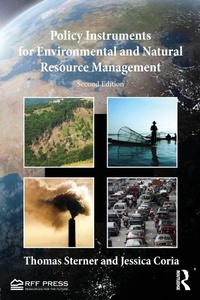
Policy Instruments for Environmental and Natural Resource Management
Second Edition
2nd Edition
Published on 13. December 2011
Book
Paperback/Softback
638 pages
978-1-61726-098-8 (ISBN)
Description
Thomas Sterner's book is an attempt to encourage more widespread and careful use of economic policy instruments. The book compares the accumulated experiences of the use of economic policy instruments in the U.S. and Europe, as well as in rich and poor countries in Asia, Africa, and Latin America. Ambitious in scope, it discusses the design of instruments that can be employed in any country in a wide range of contexts, including transportation, industrial pollution, water pricing, waste, fisheries, forests, and agriculture.
While deeply rooted in economics, Policy Instruments for Environmental and Natural Resource Management is informed by political, legal, ecological, and psychological research. The new edition enhances what has already been widely hailed as a highly innovative work. The book includes greatly expanded coverage of climate change, covering aspects related to policy design, international equity and discounting, voluntary carbon markets, permit trading in United States, and the Clean Development Mechanism. Focusing ever more on leading ideas in both theory and policy, the new edition brings experimental economics into the main of its discussions. It features expanded coverage of the monitoring and enforcement of environmental policy, technological change, the choice of policy instruments under imperfect competition, and subjects such as corporate social responsibility, bio-fuels, payments for ecosystem services, and REDD.
The Open Access version of this book, available at http://www.taylorfrancis.com, has been made available under a Creative Commons Attribution-Non Commercial-ShareAlike (CC BY-NC-SA) 4.0 license.
While deeply rooted in economics, Policy Instruments for Environmental and Natural Resource Management is informed by political, legal, ecological, and psychological research. The new edition enhances what has already been widely hailed as a highly innovative work. The book includes greatly expanded coverage of climate change, covering aspects related to policy design, international equity and discounting, voluntary carbon markets, permit trading in United States, and the Clean Development Mechanism. Focusing ever more on leading ideas in both theory and policy, the new edition brings experimental economics into the main of its discussions. It features expanded coverage of the monitoring and enforcement of environmental policy, technological change, the choice of policy instruments under imperfect competition, and subjects such as corporate social responsibility, bio-fuels, payments for ecosystem services, and REDD.
The Open Access version of this book, available at http://www.taylorfrancis.com, has been made available under a Creative Commons Attribution-Non Commercial-ShareAlike (CC BY-NC-SA) 4.0 license.
More details
Edition
2nd edition
Language
English
Place of publication
Washington
United States
Publishing group
Taylor & Francis Inc
Target group
College/higher education
Dimensions
Height: 234 mm
Width: 156 mm
Thickness: 35 mm
Weight
983 gr
ISBN-13
978-1-61726-098-8 (9781617260988)
Copyright in bibliographic data and cover images is held by Nielsen Book Services Limited or by the publishers or by their respective licensors: all rights reserved.
Schweitzer Classification
Other editions
Additional editions
Thomas Sterner | Jessica Coria
Policy Instruments for Environmental and Natural Resource Management
E-Book
10/2013
2nd Edition
Routledge
€92.49
Available for download
Thomas Sterner | Jessica Coria
Policy Instruments for Environmental and Natural Resource Management
E-Book
10/2013
2nd Edition
Routledge
€92.49
Available for download
Thomas Sterner | Jessica Coria
Policy Instruments for Environmental and Natural Resource Management
Second Edition
Book
12/2011
2nd Edition
Resources for the Future Press (RFF Press)
€254.90
Shipment within 3-4 weeks
Persons
Thomas Sterner is a professor of environmental economics at the University of Gothenburg. He is a former president of the European Association of Environmental and Resource Economists. He is the lead editor of the RFF Press-Environment for Development book series.
Jessica Coria is a postdoc at the University of Gothenburg.
Jessica Coria is a postdoc at the University of Gothenburg.
Content
1. Background and Overview Part 1: The Need for Environmental and Natural Resource Policy 2. Causes of Environmental Degradation 3. The Evolution of Rights Part 2: Review of Policy Instruments 4. Direct Regulation of the Environment 5. Taxes 6. Tradable Permits 7. Subsidies, Deposit-Refund Schemes, and Refunded Emissions Payments 8. Property Rights, Legal Instruments, and Informational Policies Part 3: Selection of Policy Instruments 9. Efficiency of Policy Instruments 10. Role of Uncertainty and Asymmetric information 11. Equilibrium Effects and Market Conditions 12. Distribution of Costs 13. Politics and Enforcement of Policy Instruments 14. International Aspects and Climate Change 15. Design of Policy Instruments Part 4: Policy Instruments for Road Transportation 16. Environmental Damages Caused by Transportation and Road Pricing Vehicles 17. Taxation or Regulation for Fuel Efficiency 18. Fuel Quality Policies 19. Vehicle Standards, Urban Planning and Lessons Learned Part 5: Policy Instruments for Industrial Pollution 20. Global Climate Change: International, Domestic Policies and Carbon Markets 21. Experience in Developing Countries Part 6: Policy Instruments for the Management of Natural Resources and Ecosystems 22. Adapting Models to Ecosystems: Ecology, Time and Space 23. Water 24. Waste 25. Fisheries 26. Agriculture 27. Forestry 28. Ecosystems Part 7: Conclusion