

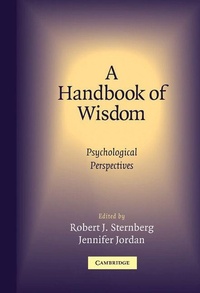
A Handbook of Wisdom
Psychological Perspectives
Published on 20. June 2005
Book
Hardback
406 pages
978-0-521-83401-8 (ISBN)
Description
A topic ignored in mainstream scientific inquiry for decades, wisdom is beginning to return to the place of reverence that it held in ancient schools of intellectual study. A Handbook of Wisdom, first published in 2005, explores wisdom's promise for helping scholars and lay people to understand the apex of human thought and behavior. At a time when poor choices are being made by notably intelligent and powerful individuals, this book presents analysis and review on a form of reasoning and decision-making that is not only productive and prudent, but also serves a beneficial purpose for society. A Handbook of Wisdom is a collection of chapters from some of the most prominent scholars in the field of wisdom research. Written from multiple perspectives, including psychology, philosophy, and religion, this book gives the reader an in-depth understanding of wisdom's past, present, and possible future direction within literature, science, and society.
Reviews / Votes
"This handbook provides a valuable compendium of the current state of knowledge about wisdom. It is a worthwhile read, and the conscientious reader will be more knowledgeable if not wiser."-David D. Simpson, PsycCritiques "Wisdom appears to have much to do with outstanding futures-thinking, and thus in a very broad sense can be seen as a method to be cultivated."
-Future Survey
More details
Language
English
Place of publication
Cambridge
United Kingdom
Target group
Professional and scholarly
College/higher education
Illustrations
9 Tables, unspecified; 4 Line drawings, unspecified
Dimensions
Height: 235 mm
Width: 157 mm
Thickness: 28 mm
Weight
807 gr
ISBN-13
978-0-521-83401-8 (9780521834018)
Copyright in bibliographic data and cover images is held by Nielsen Book Services Limited or by the publishers or by their respective licensors: all rights reserved.
Schweitzer Classification
Other editions
Additional editions
E-Book
05/2006
1st Edition
Cambridge University Press
€41.49
Available for download
E-Book
06/2005
Cambridge University Press
€34.49
Available for download
Persons
Robert J. Sternberg (PhD) is IBM Professor of Psychology and Education at Yale, Director of the PACE Center at Yale, and was the 2003 President of the American Psychological Association. He is the author of over 1000 publications on topics related to cognition and intelligence. He has won numerous awards from professional associations and holds five honorary doctorates. Jennifer Jordan (PhD, Yale University) received her doctorate in social psychology from Yale University and is currently a post-doctoral fellow for the Allwin Initiative for Corporate Citizenship at the Tuck School of Business at Dartmouth College. Her research interests include moral leadership, awareness, and decision-making within the business domain. In collaboration with Robert Sternberg, she co-edited A Handbook of Wisdom: Psychological Perspectives. She is also a 2004 recipient of the Yale University John F. Enders Research Grant, an American Psychological Association Dissertation Award, and the 2005 Academy of Management SIM Division Dissertation Award.
Content
Foreword Monika Ardelt; Part I. Theories of Wisdom across Time, Culture, and Peoples: 1. Wisdom in history James E. Birren and Cheryl M. Svensson; 2. Cultural foundations of wisdom: an integrated developmental approach Masami Takahashi and Willis F. Overton; 3. Philosophical theories of wisdom Lisa M. Osbeck and Daniel N. Robinson; 4. From the inside out: people's implicit theories of wisdom Susan Bluck and Judith Glueck; 5. The psychology of wisdom: theoretical and empirical challenges Ute Kunzmann and Paul B. Baltes; Part II. The Development of Wisdom across the Lifespan: 6. Young and growing wiser: wisdom during adolescence and young adulthood M. J. Richardson and M. Pasupathi; 7. The quest for wisdom in adulthood: a psychological perspective Jennifer Jordan; Part III. Wisdom and the Person: 8. Wisdom and personality Ursula M. Staudinger, Jessica DOErner and Charlotte Mickler; 9. The role of emotions in the development of wisdom Mihaly Csikszentmihalyi and Jeanne Nakamura; Part IV. Wisdom in Society: 10. Morality, ethics, and wisdom Joel J. Kupperman; 11. Crossing boundaries to generative wisdom: an analysis of professional work Jeffrey L. Solomon, Paula Marshall and Howard Gardner; 12. Wisdom in public policy Lloyd S. Etheredge; Part V. The Absence of Wisdom: 13. Foolishness Robert J. Sternberg; Discussion Warren Brown.