

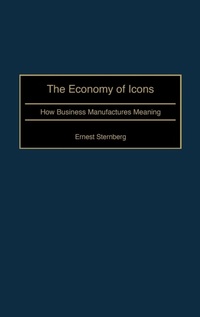
The Economy of Icons
How Business Manufactures Meaning
Published on 30. September 1999
Book
Hardback
192 pages
978-0-275-96641-6 (ISBN)
Description
Though many still think that we live in an information economy, Ernest Sternberg asserts that the driving force in 21st-century capitalism is not information, but image. Through studies of food processing, real estate development, tourism, movies, and labor performances, he examines how businesses endow products with evocative meaning.
It has become common wisdom that we live in a postindustrial information society in which data and calculation underlie wealth. But now that information is as routinely produced as industrial or agricultural goods, businesses are discovering that they best achieve competitive advantage by producing what consumers most dearly seek-personal meaning. The 21st-century economy produces just that: not merely information, but evocative images; not just commodities, but meaning-laden icons. As Sternberg shows, foods now appeal through their sensuality and nostalgia; houses and stores draw customers through their exoticism; people sell their labor through the deliberate performance of the self for the market; and tourist destinations offer up carefully crafted thematic experiences. Whereas farms, factories, and information processors once stood at the core of the economy, now movie studios do, producing the product valued above all, meaningful content, from which downstream firms acquire the themes that animate desire.
Now that meaning pervades production, Sternberg argues, modes of inquiry once reserved for the humanities make sense in the study of the economy. Drawing on art history and aesthetics, he introduces iconography as a mode of cultural analysis adapted to the study of commercial production. Through comparative studies of diverse economic sectors, ranging from food processing to tourism, Sternberg carries out an iconographic analysis of the new economy. This is a provocative study for scholars, students, and professionals dealing with marketing and consumer research, culture and media studies, socio-economics, and economic geography.
It has become common wisdom that we live in a postindustrial information society in which data and calculation underlie wealth. But now that information is as routinely produced as industrial or agricultural goods, businesses are discovering that they best achieve competitive advantage by producing what consumers most dearly seek-personal meaning. The 21st-century economy produces just that: not merely information, but evocative images; not just commodities, but meaning-laden icons. As Sternberg shows, foods now appeal through their sensuality and nostalgia; houses and stores draw customers through their exoticism; people sell their labor through the deliberate performance of the self for the market; and tourist destinations offer up carefully crafted thematic experiences. Whereas farms, factories, and information processors once stood at the core of the economy, now movie studios do, producing the product valued above all, meaningful content, from which downstream firms acquire the themes that animate desire.
Now that meaning pervades production, Sternberg argues, modes of inquiry once reserved for the humanities make sense in the study of the economy. Drawing on art history and aesthetics, he introduces iconography as a mode of cultural analysis adapted to the study of commercial production. Through comparative studies of diverse economic sectors, ranging from food processing to tourism, Sternberg carries out an iconographic analysis of the new economy. This is a provocative study for scholars, students, and professionals dealing with marketing and consumer research, culture and media studies, socio-economics, and economic geography.
More details
Language
English
Place of publication
United States
Publishing group
Bloomsbury Publishing Plc
Target group
College/higher education
Professional and scholarly
Dimensions
Height: 240 mm
Width: 161 mm
Thickness: 15 mm
Weight
455 gr
ISBN-13
978-0-275-96641-6 (9780275966416)
Copyright in bibliographic data and cover images is held by Nielsen Book Services Limited or by the publishers or by their respective licensors: all rights reserved.
Schweitzer Classification
Other editions
Additional editions
E-Book
09/1999
1st Edition
Praeger Publishers Inc
€82.49
Available for download
Person
ERNEST STERNBERG is Associate Professor of Planning at the School of Architecture and Planning, SUNY at Buffalo. Among his earlier publications is Photonic Technology and Industrial Policy: U.S. Responses to Technological Change and a variety of scholarly articles on regional economic development, public-private partnerships in the economy, the theory of market failure, the roles of culture in the economy, and the trends shaping the future of capitalism.
Content
Introduction Fabulous Food Sanctuaries in the Landscape The Labor of the Persona The Fabulous Mode of Production Staging a Natural Wonder The Meaningful Restaurant Selected Bibliography