

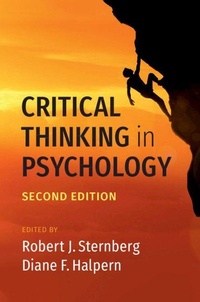
Critical Thinking in Psychology
2nd Edition
Published on 16. January 2020
Book
Hardback
402 pages
978-1-108-49715-2 (ISBN)
Description
Good scientific research depends on critical thinking at least as much as factual knowledge; psychology is no exception to this rule. And yet, despite the importance of critical thinking, psychology students are rarely taught how to think critically about the theories, methods, and concepts they must use. This book shows students and researchers how to think critically about key topics such as experimental research, statistical inference, case studies, logical fallacies, and ethical judgments. Using updated research findings and new insights, this volume provides a comprehensive overview of what critical thinking is and how to teach it in psychology. Written by leading experts in critical thinking in psychology, each chapter contains useful pedagogical features, such as critical-thinking questions, brief summaries, and definitions of key terms. It also supplies descriptions of each chapter author's critical-thinking experience, which evidences how critical thinking has made a difference to facilitating career development.
Reviews / Votes
'Political polarization, healthcare scams, media misinformation - we live in a sea of hustles and biases! What's known about how critical thinking falters and how to do better are the powerful themes of this timely volume.' David Perkins, Harvard University, Massachusetts 'Critical thinking is rarely in abundant supply and its apparent death has become particularly salient in a time of 'fake news' and 'alternative facts'. By synthesizing research across the behavioral sciences, this superb book highlights what it takes to think critically, identifies obstacles and opportunities, and offers sage advice. It will be useful for years to come.' Norbert Schwarz, University of Southern CaliforniaMore details
Edition
2nd Revised edition
Language
English
Place of publication
Cambridge
United Kingdom
Target group
College/higher education
Professional and scholarly
Edition type
Revised edition
Illustrations
Worked examples or Exercises; 12 Tables, black and white; 9 Line drawings, black and white
Dimensions
Height: 235 mm
Width: 157 mm
Thickness: 26 mm
Weight
734 gr
ISBN-13
978-1-108-49715-2 (9781108497152)
Copyright in bibliographic data and cover images is held by Nielsen Book Services Limited or by the publishers or by their respective licensors: all rights reserved.
Schweitzer Classification
Other editions
Additional editions
Robert J. Sternberg | Diane F. Halpern
Critical Thinking in Psychology
Book
01/2020
2nd Edition
Cambridge University Press
€42.50
Shipment within 15-20 days
Robert J. Sternberg
Critical Thinking in Psychology
E-Book
01/2020
Cambridge University Press
€26.99
Available for download
Robert J. Sternberg | Diane F. Halpern
Critical Thinking in Psychology
E-Book
01/2020
2nd Edition
Cambridge University Press
€28.99
Available for download
Previous edition
Robert J. Sternberg | Henry L. Roediger III | Diane F. Halpern
Critical Thinking in Psychology
Book
09/2006
Cambridge University Press
€82.94
Article exhausted; check for reprint
Persons
Content
1. An introduction to critical thinking: maybe it will change your life Diane F. Halpern and Robert J. Sternberg; 2. Nobelists gone wild: case studies in the domain specificity of critical thinking Scott O. Lilienfeld, Candice Basterfield, Shauna M. Bowes and Thomas H. Costello; 3. Why science succeeds, and sometimes doesn't Jonathan Baron; 4. Critical thinking and the rejection of unsubstantiated claims D. Alan Bensley; 5. Promoting critical thinking by teaching, or taking, psychology courses Douglas A. Bernstein; 6. Avoiding and overcoming misinformation on the Internet Jason L. G. Braasch and Arthur C. Graesser; 7. Critical thinking impacts our everyday lives Heather A. Butler and Diane F. Halpern; 8. Research suffers when we all agree: how sociopolitical homogeneity impairs critical thinking in the academy Stephen J. Ceci and Wendy M. Williams; 9. When all is just a click away: is critical thinking obsolete in the digital age? Gerd Gigerenzer; 10. Critical thinking: promise, progress, and paradox Jane S. Halonen and Dana S. Dunn; 11. Evaluating experimental research Henry L. Roediger, III and Jeremy K. Yamashiro; 12. Critical thinking as scientific reasoning: examining the power of sports momentum John Ruscio and Kevin Brady; 13. Critical thinking in STEM disciplines Robert J. Sternberg; 14. Why would anyone do or believe such a thing? A social influence analysis Anthony R. Pratkanis; 15. Conclusion: how to think critically about politics (and anything else!) Robert J. Sternberg and Diane F. Halpern.