

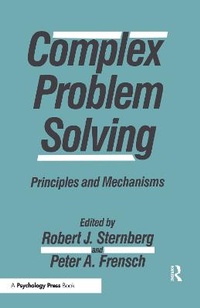
Complex Problem Solving
Principles and Mechanisms
Published on 1. August 1991
Book
Hardback
432 pages
978-0-8058-0650-2 (ISBN)
Description
Although complex problem solving has emerged as a field of psychology in its own right, the literature is, for the most part, widely scattered, and often so technical that it is inaccessible to non-experts. This unique book provides a comprehensive, in-depth, and accessible introduction to the field of complex problem solving. Chapter authors -- experts in their selected domains -- deliver systematic, thought-provoking analyses generally written from an information-processing point of view. Areas addressed include politics, electronics, and computers.
Reviews / Votes
"...succeeds in providing readable introductions...a major accomplishment. It is very easy to overwhelm readers with the complexity of the tasks and the complexity of the models designed to describe performance on the tasks. Add to this the unfamiliarity of the tasks to many readers and the authors have a major challenge on their hands. They clearly meet the challenge....useful for researchers working within the domain of problem solving as well as for people seeking a basic understanding of this topic."-Contemporary Psychology
"...strengthens psychology's claim to new domains and methods in the study of problem solving....if you have been wondering what has been happening recently in the higher end of cognitive psychology, then this book is well worth reading."
-American Journal of Psychology
"...contains chapters of uniformly high quality that illustrate how cognitive psychology is coming to understand complex problem solving in a wide range of human endeavors. There is a rich offering of methods, findings, and research problems in the areas of reading, writing, and calculation through to problem solving in electronics, legal reasoning, and international relations....Students of problem solving will appreciate the change that this book represents from the earlier experimental work on simple laboratory tasks."
-Robert Glaser
University of Pittsburgh
More details
Language
English
Place of publication
Philadelphia
United States
Publishing group
Taylor & Francis Inc
Target group
College/higher education
Professional and scholarly
Dimensions
Height: 229 mm
Width: 152 mm
Weight
860 gr
ISBN-13
978-0-8058-0650-2 (9780805806502)
Copyright in bibliographic data and cover images is held by Nielsen Book Services Limited or by the publishers or by their respective licensors: all rights reserved.
Schweitzer Classification
Other editions
Additional editions
E-Book
01/2014
1st Edition
Psychology Press Ltd
€111.99
Available for download
E-Book
01/2014
1st Edition
Psychology Press Ltd
€111.99
Available for download
Book
08/1991
Psychology Press
€118.30
Shipment within 10-20 days
Persons
Robert J. Sternberg, Peter A. Frensch
Content
Contents: Part I:Reading, Writing, and Arithmetic.K.E. Stanovich, A.E. Cunningham, Reading as Constrained Reasoning. M. Bryson, C. Bereiter, M. Scardamalia, E. Joram, Going Beyond the Problem as Given: Problem Solving in Expert and Novice Writers. S.M. Sokol, M. McCloskey, Cognitive Mechanisms in Calculation. Part II:Social Sciences.J.F. Voss, C.R. Wolfe, J.A. Lawrence, R.A. Engle, From Representation to Decision: An Analysis of Problem Solving in International Relations. R.K. Wagner, Managerial Problem Solving. J. Funke, Solving Complex Problems: Exploration and Control of Complex Social Systems. E. Amsel, R. Langer, L. Loutzenhiser, Do Lawyers Reason Differently from Psychologists? A Comparative Design for Studying Expertise. Part III:Natural Sciences.M. Hegarty, Knowledge and Processes in Mechanical Problem Solving. A. Lesgold, S. Lajoie, Complex Problem Solving in Electronics. D.S. Kay, Computer Interaction: Debugging the Problems. Part IV:Games.P.A. Frensch, R.J. Sternberg, Skill-Related Differences in Game Playing. Part V:Conclusions.E. Hunt, Some Comments on the Study of Complexity.