

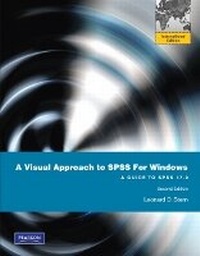
A Visual Approach to SPSS for Windows
A Guide to SPSS 17.0: International Edition
2nd Edition
Published on 20. May 2010
Book
Paperback/Softback
432 pages
978-0-205-00207-8 (ISBN)
Description
SPSS is, essentially, a visually-driven program, but most texts rely primarily on a verbal approach to describe its use. A Visual Approach to SPSS for Windows is the first text of its kind to employ what the author refers to as "visual sequencing" to teach students how to use SPSS.
This book is great for anyone interested in learning to use SPSS!
This book is great for anyone interested in learning to use SPSS!
More details
Edition
2nd edition
Language
English
Place of publication
United States
Publishing group
Pearson Education (US)
Target group
College/higher education
Dimensions
Height: 216 mm
Width: 276 mm
Thickness: 20 mm
Weight
814 gr
ISBN-13
978-0-205-00207-8 (9780205002078)
Copyright in bibliographic data is held by Nielsen Book Services Limited or its licensors: all rights reserved.
Schweitzer Classification
Other editions
New editions
Leonard Stern | Leonard D. Stern
Visual Approach to SPSS for Windows, A: A Guide to SPSS 17.0
Pearson New International Edition
Book
08/2013
2nd Edition
Pearson Education Limited
€86.49
Shipment within 10-20 days
Previous edition
Book
09/2007
Pearson
€53.41
Article exhausted; check for reprint
Person
Leonard Stern teaches courses in statistics, research methods, and human memory in the Department of Psychology at Eastern Washington Unversity. He received a B.A. in chemistry from Colby College, an M.A. from the University of Oregon in interdisciplinary studies, and an M. A. and Ph.D. in experimental psychology from the University of Oregon. He is the author of a text book on memory and one describing use of a software package to perform psychology experiments using computers. One of his current areas of interest is circumstances under which false memory occurs.
Content
Preface
Chapter 1: The Basics
Chapter 2: Entering and Saving Data
Chapter 3: Modifying Data in the Data Editor
Chapter 4: Defining Variables' Properties
Chapter 5: The SPSS Statistics Viewer
Chapter 6: Graphing Data with the Chart Builder
Chapter 7: Data Transformation and Case Selection
Chapter 8: The Frequencies Procedure
Chapter 9: Other Procedures for Obtaining Descriptive Measures
Chapter 10: Bivariate Correlation and Regression
Chapter 11: Multiple Regression and Correlation
Chapter 12: Chi-Square Tests of Independence and Goodness-of-Fit
Chapter 13: One and Two Sample T-Tests
Chapter 14: One-Way Analysis of Variance
Chapter 15: Two-Way and Higher Order Analyses of Variance
Chapter 16: Within-Subjects ANOVAS
Chapter 17: Nonparametric or Distribution Free Tests
Chapter 18: Exploratory Factor Analysis
Chapter 19: Discriminant Analysis
Appendix A: Using the Chart Editor to Insert a Reference Line and Data Labels
Appendix B: Using the Chart Editor to Add a Title to the X-Axis
Appendix C: Using Codebook to Obtain an Overview of the Variables in a Data File
References
Index
Chapter 1: The Basics
Chapter 2: Entering and Saving Data
Chapter 3: Modifying Data in the Data Editor
Chapter 4: Defining Variables' Properties
Chapter 5: The SPSS Statistics Viewer
Chapter 6: Graphing Data with the Chart Builder
Chapter 7: Data Transformation and Case Selection
Chapter 8: The Frequencies Procedure
Chapter 9: Other Procedures for Obtaining Descriptive Measures
Chapter 10: Bivariate Correlation and Regression
Chapter 11: Multiple Regression and Correlation
Chapter 12: Chi-Square Tests of Independence and Goodness-of-Fit
Chapter 13: One and Two Sample T-Tests
Chapter 14: One-Way Analysis of Variance
Chapter 15: Two-Way and Higher Order Analyses of Variance
Chapter 16: Within-Subjects ANOVAS
Chapter 17: Nonparametric or Distribution Free Tests
Chapter 18: Exploratory Factor Analysis
Chapter 19: Discriminant Analysis
Appendix A: Using the Chart Editor to Insert a Reference Line and Data Labels
Appendix B: Using the Chart Editor to Add a Title to the X-Axis
Appendix C: Using Codebook to Obtain an Overview of the Variables in a Data File
References
Index