

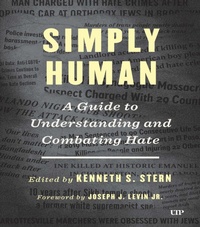
Simply Human
A Guide to Understanding and Combating Hate
Published on 23. September 2025
Book
Paperback/Softback
360 pages
978-1-4875-5183-4 (ISBN)
Description
In Simply Human, leading global hate studies experts join forces, guiding us to a better understanding of human hatred, what works to confront it, what doesn't, and why. Edited by Kenneth Stern, a founder of the field of Hate Studies and the director of the Bard Center for the Study of Hate, this book will change the way you think about how hate affects our lives and our politics. It's "simply human" that we are too often pulled into the seductive comfort of "us versus them" thinking. But that doesn't mean we can't do better as individuals and societies. Simply Human will challenge readers look to at the world in a new light, take action against hate, and put meaning behind their words.
This easy-to-read volume, co-created by experts in brain science, political science, social psychology, and philosophy, includes a checklist of key takeaways from each contributor that can be used as an educational tool in classrooms, workplaces, and beyond. Hate is too corrosive for our societies, and costs too much, both morally and economically, for us to continue shooting in the dark. This book provides enlightening perspectives on our relationships to hatred and can be considered a blueprint for sharper thinking and more effective action.
This easy-to-read volume, co-created by experts in brain science, political science, social psychology, and philosophy, includes a checklist of key takeaways from each contributor that can be used as an educational tool in classrooms, workplaces, and beyond. Hate is too corrosive for our societies, and costs too much, both morally and economically, for us to continue shooting in the dark. This book provides enlightening perspectives on our relationships to hatred and can be considered a blueprint for sharper thinking and more effective action.
Reviews / Votes
"Simply Human doesn't just explain the dynamics of hate-it equips us to confront them with clarity and care. In a time of confusion and division, it reminds us that some things are still up to us." -- Eric K. Ward, Executive Vice President, Race Forward "Building on decades of expertise, editor Kenneth S. Stern curates a powerful collection of evidence-based perspectives, offering a deeper understanding of hate. This is a timely and indispensable guide for anyone striving to build a more just and humane society." -- Kristine F. Hoover, Professor and Chair of Organizational Leadership, Gonzaga University "This is a rare, important book, filled with dispassionate, fact-based thought that actually makes one feel hopeful." -- Robert Sapolsky, John A. and Cynthia Fry Gunn Professor of Biology, Neurology, Neurological Sciences, and Neurosurgery, Stanford University "As the former Special Envoy to Monitor and Combat Antisemitism in the US State Department, I saw first-hand how essential a better and more comprehensive understanding of hate is, and this book helps us navigate the challenge." -- Hannah Rosenthal, Former Special Envoy to Monitor and Combat Anti-Semitism, US State DepartmentMore details
Language
English
Place of publication
Toronto
Canada
Target group
College/higher education
Professional and scholarly
Product notice
Paperback (trade)
Illustrations
6 illustrations
Dimensions
Height: 227 mm
Width: 151 mm
Thickness: 21 mm
Weight
486 gr
ISBN-13
978-1-4875-5183-4 (9781487551834)
Copyright in bibliographic data and cover images is held by Nielsen Book Services Limited or by the publishers or by their respective licensors: all rights reserved.
Schweitzer Classification
Person
Attorney and award-winning author Kenneth S. Stern is the director of the Bard Center for the Study of Hate.
Content
Foreword
Joe Levin
Editor's Preface
Kenneth S. Stern
1. The Ethics of Combating Hate
Thomas Brudholm & Birgitte Schepelern Johansen
2. Elucidating the Brain Mechanisms That Underlie Hateful Behavior
Adriana Galvan
3. The Psychology of Group-Based Hate: Characteristics, Origins, and Implications for Interventions
Mengyao Li
4. Multidirectional Memory in the NGO Sector: The Case of the Hate Crimes Working Group and the Value of Cross-Sector Engagement
Adam Levin
5. "Intimacy at a Distance": Using Parasocial Interaction to Reduce Prejudice
Sarah E. Lowe & Charlene Joy Jimenez
6. How NGOs Can Use Economic Arguments to Undermine Hate: A Case Study of Hate Against LGBTI People
M.V. Lee Badgett
7. The Role of Civil Society in Helping to Establish a Framework for the Effective Enforcement of Hate Crime Laws
Jennifer Schweppe & Mark Austin Walters
8. Hate and Conspiracy Theories
Joseph E. Uscinski
9. Counterspeech.org: NGO Strategies for Responding to Online Hateful Speech
Cathy Buerger
10. Funding Divides: How Philanthropic Systems Can Link Public Dollars to Social Division and Political Extremism
Lila Corwin Berman
11. Considerations for Evaluation: Center Learning
Irit Houvras
Conclusion
Kenneth S. Stern
Joe Levin
Editor's Preface
Kenneth S. Stern
1. The Ethics of Combating Hate
Thomas Brudholm & Birgitte Schepelern Johansen
2. Elucidating the Brain Mechanisms That Underlie Hateful Behavior
Adriana Galvan
3. The Psychology of Group-Based Hate: Characteristics, Origins, and Implications for Interventions
Mengyao Li
4. Multidirectional Memory in the NGO Sector: The Case of the Hate Crimes Working Group and the Value of Cross-Sector Engagement
Adam Levin
5. "Intimacy at a Distance": Using Parasocial Interaction to Reduce Prejudice
Sarah E. Lowe & Charlene Joy Jimenez
6. How NGOs Can Use Economic Arguments to Undermine Hate: A Case Study of Hate Against LGBTI People
M.V. Lee Badgett
7. The Role of Civil Society in Helping to Establish a Framework for the Effective Enforcement of Hate Crime Laws
Jennifer Schweppe & Mark Austin Walters
8. Hate and Conspiracy Theories
Joseph E. Uscinski
9. Counterspeech.org: NGO Strategies for Responding to Online Hateful Speech
Cathy Buerger
10. Funding Divides: How Philanthropic Systems Can Link Public Dollars to Social Division and Political Extremism
Lila Corwin Berman
11. Considerations for Evaluation: Center Learning
Irit Houvras
Conclusion
Kenneth S. Stern