

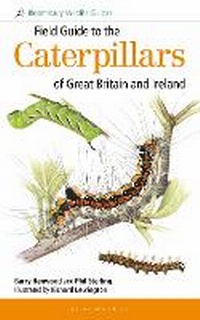
Field Guide to the Caterpillars of Great Britain and Ireland
Published on 19. March 2020
Book
Hardback
448 pages
978-1-4729-3358-4 (ISBN)
Description
'A much-needed guide - you can't truly understand a moth or a butterfly without first getting to know the caterpillar.' - Nick Baker
This beautifully illustrated field guide covers caterpillars of the moth and butterfly species that are most likely to be encountered in the British Isles. The comprehensive introduction covers how to study caterpillars and provides a window into their diverse natural histories, while the species accounts cover status, field characters, similar species, habitat, foodplant and field notes, and are accompanied with up-to-date distribution maps.
This beautifully illustrated field guide covers caterpillars of the moth and butterfly species that are most likely to be encountered in the British Isles. The comprehensive introduction covers how to study caterpillars and provides a window into their diverse natural histories, while the species accounts cover status, field characters, similar species, habitat, foodplant and field notes, and are accompanied with up-to-date distribution maps.
Reviews / Votes
The drawings are perfect ... the text is excellent. As a field guide it is hard to fault. -- Peter Marren * British Wildlife *More details
Series
Language
English
Place of publication
London
United Kingdom
Publishing group
Bloomsbury Publishing PLC
Illustrations
900+ colour artworks, 199 colour photos and 828 distribution maps
Dimensions
Height: 216 mm
Width: 135 mm
Weight
870 gr
ISBN-13
978-1-4729-3358-4 (9781472933584)
Copyright in bibliographic data and cover images is held by Nielsen Book Services Limited or by the publishers or by their respective licensors: all rights reserved.
Schweitzer Classification
Persons
Phil Sterling began his interest in moths before starting school. Today he concentrates on elucidating life histories of lesser known moth species, and on promoting his passion for wildlife to a wide audience through publication of books, papers and public speaking. He holds the degree of MA (Oxon) in Zoology and his DPhil (Oxon) was on the ecology and biological control of the Brown-tail Moth. He is a Fellow of the Royal Entomological Society, and a member of the British Entomological and Natural History Society and British Ecological Society. He has been in nature conservation research and practice for 35 years and is currently at Butterfly Conservation where works on a UK-wide project to improve habitat for wildlife in the built environment.
Barry Henwood has been interested in butterflies, moths and their caterpillars since primary school. He read Medical Sciences at Selwyn College, Cambridge and went on to qualify as a doctor at Guy's Hospital Medical School. He worked as a GP in Newton Abbot, Devon for 26 years. He is a member of the British Entomological and Natural History Society and now volunteers for Butterfly Conservation and Devon Wildlife Trust. He has written and contributed to many publications in entomological journals. He has reared and photographed the caterpillars of several hundred species of macro-moths and butterflies.
Richard Lewington is an acknowledged leader in the field of insect illustration. His meticulous paintings of wildlife are the mainstay of many of the modern classics of field-guide art, including The Butterflies of Britain and Ireland, Guide to Garden Wildlife and Field Guide to the Bees of Great Britain and Ireland. Richard has also designed and illustrated wildlife stamps for several countries. In 1999 he was awarded Butterfly Conservation's Marsh Award for the promotion of Lepidoptera conservation, and in 2010 the Zoological Society of London's Stamford Raffles Award for contribution to zoology.
Barry Henwood has been interested in butterflies, moths and their caterpillars since primary school. He read Medical Sciences at Selwyn College, Cambridge and went on to qualify as a doctor at Guy's Hospital Medical School. He worked as a GP in Newton Abbot, Devon for 26 years. He is a member of the British Entomological and Natural History Society and now volunteers for Butterfly Conservation and Devon Wildlife Trust. He has written and contributed to many publications in entomological journals. He has reared and photographed the caterpillars of several hundred species of macro-moths and butterflies.
Richard Lewington is an acknowledged leader in the field of insect illustration. His meticulous paintings of wildlife are the mainstay of many of the modern classics of field-guide art, including The Butterflies of Britain and Ireland, Guide to Garden Wildlife and Field Guide to the Bees of Great Britain and Ireland. Richard has also designed and illustrated wildlife stamps for several countries. In 1999 he was awarded Butterfly Conservation's Marsh Award for the promotion of Lepidoptera conservation, and in 2010 the Zoological Society of London's Stamford Raffles Award for contribution to zoology.
Content
Acknowledgements
Introduction
Useful resources
At-a-glance guide
Plate section
Checklist of the macro-moths and butterflies of Great Britain and Ireland
Scientific names of plants and their associated butterfly and moth species
Photographic credits
Appendices
Index of English names
Index of scientific names
Introduction
Useful resources
At-a-glance guide
Plate section
Checklist of the macro-moths and butterflies of Great Britain and Ireland
Scientific names of plants and their associated butterfly and moth species
Photographic credits
Appendices
Index of English names
Index of scientific names