

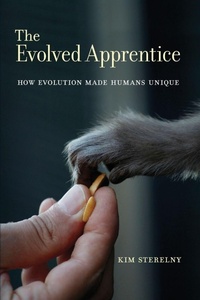
The Evolved Apprentice
Description
Over the last three million years or so, our lineage has diverged sharply from those of our great ape relatives. Change has been rapid (in evolutionary terms) and pervasive. Morphology, life history, social life, sexual behavior, and foraging patterns have all shifted sharply away from those of the other great apes. In The Evolved Apprentice, Kim Sterelny argues that the divergence stems from the fact that humans gradually came to enrich the learning environment of the next generation. Humans came to cooperate in sharing information, and to cooperate ecologically and reproductively as well, and these changes initiated positive feedback loops that drove us further from other great apes.
Sterelny develops a new theory of the evolution of human cognition and human social life that emphasizes the gradual evolution of information-sharing practices across generations and how these practices transformed human minds and social lives. Sterelny proposes that humans developed a new form of ecological interaction with their environment, cooperative foraging. The ability to cope with the immense variety of human ancestral environments and social forms, he argues, depended not just on adapted minds but also on adapted developmental environments.
More details
Other editions
Additional editions


Person
Content
Series Foreword
Preface
1 The Challenge of Novelty
1.1 Introduction
1.2 The Social Intelligence Hypothesis
1.3 Cooperative Foraging
1.4 Cooperative Foraging and Knowledge Accumulation
1.5 Life in a Changing World
2 Accumulating Cognitive Capital
2.1 A Lineage Explanation of Social Learning
2.2 Feedback Loops
2.3 The Apprentice Learning Model
3 Adapted Individuals, Adapted Environments
3.1 Behavioral Modernity
3.2 The Symbolic Species
3.3 Public Symbols and Social Worlds
3.4 Preserving and Expanding Information
3.5 Niche Construction and Neanderthal Extinction
4 The Human Cooperation Syndrome
4.1 Triggering Cooperation
4.2 A Cooperation Complex
4.3 The Grandmother Hypothesis
4.4 Foragers: Ancient and Modern
4.5 Hunting: Provisioning or Signaling?
5 Costs and Commitments
5.1 Free Riders
5.2 Control and Commitment
5.3 Commitment Mechanisms
5.4 Signals, Investments, and Interventions
5.5 Hunting and Commitment
5.6 Commitment through Investment
5.7 Primitive Trust
6 Signals, Cooperation, and Learning
6.1 Sperber's Dilemma
6.2 Two Faces of Cultural Learning
6.3 Honesty Mechanisms
6.4 The Folk as Educators
7 From Skills to Norms
7.1 Norms and Communities
7.2 Moral Nativism
7.3 Self-Control, Vigilance, and Persuasion
7.4 Reactive and Reflective Moral Response
7.5 Moral Apprentices
7.6 The Biological Preparation of Moral Development
7.7 The Expansion of Cultural Learning
8 Cooperation and Conflict
8.1 Group Selection
8.2 Strong Reciprocity and Human Cooperation
8.3 Children of Strife?
8.4 The Holocene: A World Queerer Than We Realized?
Notes
References
Index