

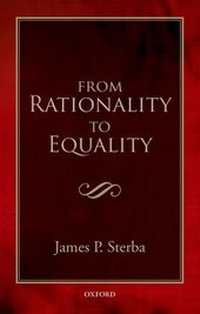
From Rationality to Equality
Published on 4. December 2014
Book
Paperback/Softback
234 pages
978-0-19-870960-2 (ISBN)
Description
Most contemporary moral and political philosophers would like to have an argument showing that morality is rationally required. In From Rationality to Equality, James P. Sterba provides just such an argument and further shows that morality, so justified, requires substantial equality. His argument from rationality to morality is based on the principle of non-question-beggingness and has two forms. The first assumes that the egoist is willing to argue for egoism non-question-beggingly, and the second only assumes that the egoist is willing to assent to premises she actually needs to achieve her egoistic goals. Either way, he argues, morality is rationally (i.e., non-question-beggingly) preferable to egoism.
Sterba's argument from morality to equality non-question-beggingly starts with assumptions that are acceptable from a libertarian perspective, the view that appears to endorse the least enforcement of morality, and then shows that this perspective requires a right to welfare which, when extended to distant peoples and future generations, leads to equality. He defends his two-part argument against recent critics, and shows how it is preferable not only to alternative attempts to justify morality, but also to alternative attempts to show that morality leads to a right to welfare and/or to equality.
Sterba's argument from morality to equality non-question-beggingly starts with assumptions that are acceptable from a libertarian perspective, the view that appears to endorse the least enforcement of morality, and then shows that this perspective requires a right to welfare which, when extended to distant peoples and future generations, leads to equality. He defends his two-part argument against recent critics, and shows how it is preferable not only to alternative attempts to justify morality, but also to alternative attempts to show that morality leads to a right to welfare and/or to equality.
Reviews / Votes
James P. Sterba has put together a clearly written, closely and thoroughly argued, and well-organized book that advances arguments that address two fundamental questions in ethics and social theory. * Social Theory and Practice *More details
Language
English
Place of publication
Oxford
United Kingdom
Target group
College/higher education
Professional and scholarly
Dimensions
Height: 216 mm
Width: 140 mm
Thickness: 13 mm
Weight
298 gr
ISBN-13
978-0-19-870960-2 (9780198709602)
Copyright in bibliographic data and cover images is held by Nielsen Book Services Limited or by the publishers or by their respective licensors: all rights reserved.
Schweitzer Classification
Other editions
Additional editions
James P. Sterba
From Rationality to Equality
Book
02/2013
Oxford University Press
€81.80
Shipment within 15-20 days
Person
James P. Sterba is Professor of Philosophy at the University of Notre Dame. His previous publications include Three Challenges to Ethics (OUP, 2001), The Triumph of Practice over Theory in Ethics (OUP, 2005), and Does Feminism Discriminate Against Men?--A Debate, with Warren Farrell (OUP, 2007). He is past president of the American Philosophical Association (Central Division) and several other organizations.
Content
1. Introduction ; 2. The Historical Connection to Immanuel Kant ; 3. From Rationality to Morality ; 4. Critics of the Rationality to Morality Argument ; 5. Alternative Justifications for Morality ; 6. From Liberty to Equality ; 7. Critics of the Liberty to Equality Argument ; 8. Alternative Justifications for Welfare and Equality ; 9. Conclusion