

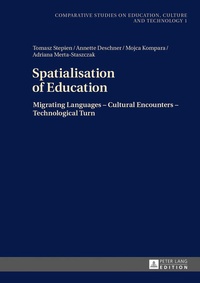
Spatialisation of Education
Migrating Languages - Cultural Encounters - Technological Turn
1st Edition
Published on 28. October 2013
Book
Hardback
178 pages
978-3-631-64039-5 (ISBN)
Description
In a knowledge-based society education and technologies appear as the decisive driving-forces of the development, and one of the most important challenges is the adaptation process of education adequately to the present societal and cultural changes. The following considerations extrapolate a multidisciplinary approach to the present conditions and circumstances of education, and are especially focusing on concerns such as the significance of technological development and the moral agency of technologies in the field of education, the questions concerning methods of languages and competences acquisition basing on the CLIL and e-learning methods, and finally the characteristic of engineers' education orientated on the interdisciplinary concept of the converging technologies.
More details
Persons
Tomasz Stepien, PhD; Head of Political Science and Social Communication Research Team at the Wroclaw University of Technology, Department of Humanities; main research fields: Philosophy of Culture and Technology, Technology Assessment, Research and Science Policy, International Relations.
Annette Deschner, PhD; Institute of Transdisciplinary Social Science, University of Education, Karlsruhe (Germany); main research fields: CLIL, Multilingualism, CLIL and forest pedagogy, theory-guided development of teaching material, Diversity.
Mojca Kompara, PhD; Teaching Assistant at the University of Primorska (Slovenia), Faculty of Management, Faculty of Mathematics, Natural Sciences and Information Technologies, Faculty of Humanities, main research fields: Abbreviations, Lexicography, Computational Lexicography, Automatic recognition of Abbreviations in Texts, Automatic Compilation of Dictionaries, Algorithms, Language Technologies, Translation, Bilingualism, Language Acquisition, CLIL.
Adriana Merta-Staszczak, PhD; Member of the Political Science and Social Communication Research Team at the Wroclaw University of Technology (Poland), Department of Humanities; main research fields: Economic history, rural development, institutional environment of the agriculture.
Annette Deschner, PhD; Institute of Transdisciplinary Social Science, University of Education, Karlsruhe (Germany); main research fields: CLIL, Multilingualism, CLIL and forest pedagogy, theory-guided development of teaching material, Diversity.
Mojca Kompara, PhD; Teaching Assistant at the University of Primorska (Slovenia), Faculty of Management, Faculty of Mathematics, Natural Sciences and Information Technologies, Faculty of Humanities, main research fields: Abbreviations, Lexicography, Computational Lexicography, Automatic recognition of Abbreviations in Texts, Automatic Compilation of Dictionaries, Algorithms, Language Technologies, Translation, Bilingualism, Language Acquisition, CLIL.
Adriana Merta-Staszczak, PhD; Member of the Political Science and Social Communication Research Team at the Wroclaw University of Technology (Poland), Department of Humanities; main research fields: Economic history, rural development, institutional environment of the agriculture.
Content
Contents: Education and Culture - Humanities and the Paradigm of Turns - Comparative Approach in the Fields of Education - Education and New Orientations: Methods and Competences' Acquisition - CLIL and E-learning - Innovations and Converging Technologies in Education.