

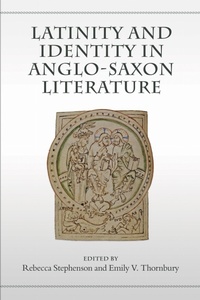
Latinity and Identity in Anglo-Saxon Literature
Published on 4. August 2016
Book
Hardback
264 pages
978-1-4426-3758-0 (ISBN)
Description
For the Anglo-Saxons, Latin was a language of choice that revealed a multitude of beliefs and desires about themselves as subjects, believers, scholars, and artists. In this groundbreaking collection, ten leading scholars explore the intersections between identity and Latin language and literature in Anglo-Saxon England. Ranging from the works of the Venerable Bede and St Boniface in the eighth century to Osbern's account of eleventh-century Canterbury, Latinity and Identity in Anglo-Saxon Literature offers new insights into the Anglo-Saxons' ideas about literary form, monasticism, language, and national identity.
Latin prose, poetry, and musical styles are reconsidered, as is the relationship between Latin and Old English. Monastic identity, intertwined as it was with the learning of Latin and reformation of the self, is also an important theme. By offering fresh perspectives on texts both famous and neglected, Latinity and Identity will transform readers' views of Anglo-Latin literature.
Latin prose, poetry, and musical styles are reconsidered, as is the relationship between Latin and Old English. Monastic identity, intertwined as it was with the learning of Latin and reformation of the self, is also an important theme. By offering fresh perspectives on texts both famous and neglected, Latinity and Identity will transform readers' views of Anglo-Latin literature.
Reviews / Votes
"As a contribution to the study of the Latin textual culture of earlier medieval England - and especially in emphasizing Latin's own diversity as it interacts sensitively with time, place, and situation rather than viewing it as a monolithic member of a simple intellectual hierarchy - Rebecca Stephenson and Emily V. Thornbury's Latinity and Identity in Anglo-Saxon Literature has great value, with each chapter offering insights and several producing real innovations of method or perspective."- Britt Mize, Texas A&M University (Speculum) "While many of these essays have interesting things to say about identity formation, the collection has much to offer beyond that topic to anyone interested in the formal analysis of imitation in Latin."
- Carin Ruff, Independent Scholar (Early Medieval Europe)
More details
Series
Language
English
Place of publication
Toronto
Canada
Target group
College/higher education
Professional and scholarly
Product notice
sewn/stitched
Cloth over boards
With dust jacket
Illustrations
2 figures
Dimensions
Height: 231 mm
Width: 157 mm
Thickness: 28 mm
Weight
544 gr
ISBN-13
978-1-4426-3758-0 (9781442637580)
Copyright in bibliographic data and cover images is held by Nielsen Book Services Limited or by the publishers or by their respective licensors: all rights reserved.
Schweitzer Classification
Persons
Rebecca Stephenson is a Lecturer in Old and Middle English at University College Dublin.
Emily V. Thornbury is an Associate Professor in the Department of English at the University of California, Berkeley.
Emily V. Thornbury is an Associate Professor in the Department of English at the University of California, Berkeley.
Content
1. Introduction
2. Boniface's Epistolary Prose Style: The Letters to the English
Michael Herren, York University
3. Interpretatio Monastica: Biblical Commentary and the Forging of Monastic Identity in the Early Middle Ages
Scott DeGregorio, University of Michigan, Dearborn
4. AEthilwulf poeta
Emily Thornbury, University of California, Berkeley
5. The Old English Martyrology and Anglo-Saxon Glosses
Christine Rauer, University of St. Andrews
6. Sequences and Intellectual Identity at Winchester
Jonathan Davis-Secord, University of New Mexico
7. Saint Who? Building Monastic Identity through Computistical Inquiry in Byrhtferth's Vita S. Ecgwini
Rebecca Stephenson, University of Louisiana, Monroe
8. Hebrew Words and English Identity in Educational Texts of AElfric and Byrhtferth
Damian Fleming, Indiana University-Purdue University, Fort Wayne
9. Oswald's uersus retrogradi: A Forerunner of Post-Conquest Trends in Hexameter Composition
Leslie Lockett, The Ohio State University
10. German Imperial Bishops and Anglo-Saxon Literary Culture on the Eve of the Conquest: The Cambridge Songs and Leofric's Exeter Book
Elizabeth M. Tyler, University of York
11. Writing Community: Osbern and the Negotiations of Identity in the Miracula S. Dunstani
Katherine O'Brien O'Keeffe, University of California, Berkeley
2. Boniface's Epistolary Prose Style: The Letters to the English
Michael Herren, York University
3. Interpretatio Monastica: Biblical Commentary and the Forging of Monastic Identity in the Early Middle Ages
Scott DeGregorio, University of Michigan, Dearborn
4. AEthilwulf poeta
Emily Thornbury, University of California, Berkeley
5. The Old English Martyrology and Anglo-Saxon Glosses
Christine Rauer, University of St. Andrews
6. Sequences and Intellectual Identity at Winchester
Jonathan Davis-Secord, University of New Mexico
7. Saint Who? Building Monastic Identity through Computistical Inquiry in Byrhtferth's Vita S. Ecgwini
Rebecca Stephenson, University of Louisiana, Monroe
8. Hebrew Words and English Identity in Educational Texts of AElfric and Byrhtferth
Damian Fleming, Indiana University-Purdue University, Fort Wayne
9. Oswald's uersus retrogradi: A Forerunner of Post-Conquest Trends in Hexameter Composition
Leslie Lockett, The Ohio State University
10. German Imperial Bishops and Anglo-Saxon Literary Culture on the Eve of the Conquest: The Cambridge Songs and Leofric's Exeter Book
Elizabeth M. Tyler, University of York
11. Writing Community: Osbern and the Negotiations of Identity in the Miracula S. Dunstani
Katherine O'Brien O'Keeffe, University of California, Berkeley