

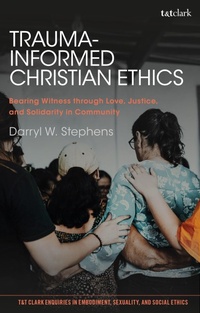
Trauma-Informed Christian Ethics
Bearing Witness through Love, Justice, and Solidarity in Community
Will be published approx. on 22. January 2026
Book
Paperback/Softback
264 pages
978-0-567-70043-8 (ISBN)
Description
Darryl W. Stephens suggests that human dignity and equality under God can be used to address the most intractable moral problems of our time: sexual abuse, racism, environmental degradation, and more. This work examines Christian ethics sensitive to the trauma histories that are already present individually and collectively in and among our faith communities.
Stephens encourages us to see that Christian ethics is real, perspectival, dialogical, participatory and purposeful - he reconceives the entirety of Christian ethics through trauma-informed lens, recognizing that many people wrestle with significant trauma histories every day. He explores the theological implications of trauma-informed approach to a wide range of social issues, and engages with Wesleyan, feminist and liberationist perspectives.
Designed for classroom use, it includes a number of pedagogical features, such as case studies and questions for discussion, engaging with key areas of contemporary concern.
Stephens encourages us to see that Christian ethics is real, perspectival, dialogical, participatory and purposeful - he reconceives the entirety of Christian ethics through trauma-informed lens, recognizing that many people wrestle with significant trauma histories every day. He explores the theological implications of trauma-informed approach to a wide range of social issues, and engages with Wesleyan, feminist and liberationist perspectives.
Designed for classroom use, it includes a number of pedagogical features, such as case studies and questions for discussion, engaging with key areas of contemporary concern.
Reviews / Votes
Historically grounded and oriented toward liberation and justice, Stephens offers an excellent entree into understanding the importance of trauma-informed Christian ethics, while also expanding how we think about trauma by moving from the personal (intimate violence) to the structural (climate change) to the sacred (clergy abuse). In promoting a Christian witness of radical empathy, Stephens challenges readers to take up the task of bearing witness and offers readers tools for developing a trauma-informed Christian ethic that can help Christian leaders and congregations move toward moral repair and restorative justice. It is indispensable reading for shaping ministries of compassion and justice in a world where too many people have experienced violence and exploitation. * Rebecca Todd Peters, Elon University, USA *More details
Series
Language
English
Place of publication
Edinburgh
United Kingdom
Publishing group
Bloomsbury Publishing PLC
Target group
College/higher education
Dimensions
Height: 242 mm
Width: 169 mm
Thickness: 22 mm
Weight
412 gr
ISBN-13
978-0-567-70043-8 (9780567700438)
Copyright in bibliographic data and cover images is held by Nielsen Book Services Limited or by the publishers or by their respective licensors: all rights reserved.
Schweitzer Classification
Person
Darryl W. Stephens teaches ministerial ethics at Lancaster Theological Seminary, Moravian University, in Pennsylvania, USA
Content
List of Tables
Preface
Acknowledgments
List of Abbreviations
Introduction
Part One: Foundations
1.1 Reenvisioning Christian Ethics
1.2 Trauma-Informed Response
1.3 Bearing Witness
1.4 Diakonia
Part Two: Practices of Discipleship
2.1 Grounded Being
2.2 Attentive Presence
2.3 Historical Clarity
2.4 Meaningful Participation
Part Three: Contemporary Challenges
3.1 Racism and Sexual Violence
3.2 Climate Change and Empire
3.3 Abuse of Power
Conclusion: Strengthening Moral Community
Bibliography
index
Preface
Acknowledgments
List of Abbreviations
Introduction
Part One: Foundations
1.1 Reenvisioning Christian Ethics
1.2 Trauma-Informed Response
1.3 Bearing Witness
1.4 Diakonia
Part Two: Practices of Discipleship
2.1 Grounded Being
2.2 Attentive Presence
2.3 Historical Clarity
2.4 Meaningful Participation
Part Three: Contemporary Challenges
3.1 Racism and Sexual Violence
3.2 Climate Change and Empire
3.3 Abuse of Power
Conclusion: Strengthening Moral Community
Bibliography
index