

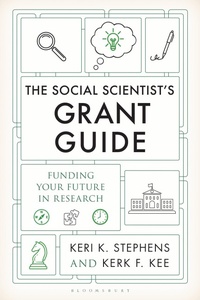
The Social Scientist's Grant Guide
Funding Your Future in Research
Will be published approx. on 3. September 2026
Book
Hardback
416 pages
979-8-8818-0186-1 (ISBN)
Description
It's time for social scientists to thrive in the grant-getting world.
Securing external funding has never been more important for social scientists, nor has it ever required so much creativity! The Social Scientist's Grant Guide answers the call to support researchers who are scrambling to navigate the rules, processes, and social dynamics of the funding world.
This guide welcomes you into the funding landscape and gives you the strategic and cultural knowledge crucial for grant success. As you build a personalized funding action plan that aligns with your research interests and career stage, you'll learn how to
-Identify funding opportunities that genuinely align with your research strengths
-Position your work for maximum impact across different types of funders in the US and internationally
-Navigate political and social dynamics that shape reviewer decisions
-Develop the adaptive mindset needed to thrive as funding landscapes inevitably shift
Having secured more than $25 million from federal, state, industry, and foundational support while working with 5 different academic institutions and 7 different institutional support organizations, Keri K. Stephens and Kerk F. Kee know the keys to success and the pitfalls to avoid as you build your research future.
Securing external funding has never been more important for social scientists, nor has it ever required so much creativity! The Social Scientist's Grant Guide answers the call to support researchers who are scrambling to navigate the rules, processes, and social dynamics of the funding world.
This guide welcomes you into the funding landscape and gives you the strategic and cultural knowledge crucial for grant success. As you build a personalized funding action plan that aligns with your research interests and career stage, you'll learn how to
-Identify funding opportunities that genuinely align with your research strengths
-Position your work for maximum impact across different types of funders in the US and internationally
-Navigate political and social dynamics that shape reviewer decisions
-Develop the adaptive mindset needed to thrive as funding landscapes inevitably shift
Having secured more than $25 million from federal, state, industry, and foundational support while working with 5 different academic institutions and 7 different institutional support organizations, Keri K. Stephens and Kerk F. Kee know the keys to success and the pitfalls to avoid as you build your research future.
Reviews / Votes
The Social Scientist's Grant Guide uncovers the hidden curriculum of academic funding for those who haven't been steeped in grant-seeking culture. It doesn't tell you how to write a proposal, it explains why you should or shouldn't develop collaborations and apply for funding based on your institutional or disciplinary context. -- Amy Gantt, Director, Strategic Research Development, Tufts University, USA, and Vice President, National Organization of Research Development Professionals The Social Scientist's Grant Guide is easy to read and incredibly useful. Written for social scientists, it covers the most important aspects of the external funding process: seeking funding, preparing to write, writing the proposal, evaluating your work, getting funded, and grants management. This is now my go-to book on how to write successful grant proposals. -- Michelle Miller-Day, Director of the Graduate Programs in the School of Communication, Chapman University, USA Stephens and Kee have delivered an indispensable resource for social scientists navigating the increasingly difficult arena of university-based external funding. Far more than a proposal-writing manual, The Social Scientist's Grant Guide offers a comprehensive strategic framework steeped in the authors' extensive experience as principal investigators, grant reviewers, and research mentors. Highly accessible and thoughtfully organized to serve scholars at every career stage, this book equips readers with the practical tools needed to expertly navigate an ever-shifting funding landscape. This work should be considered essential reading for any social scientist interested in developing an externally funded research program. -- Sam Brody, Regents Professor and George P. Mitchell '40 Chair in Sustainable Coasts, and Director of Institute for a Disaster Resilient Texas, Texas A&M University, USA The Social Scientist's Grant Guide is an incredible resource for both new and seasoned researchers in the social sciences. Stephens and Kee offer a comprehensive and actionable guide for navigating every step of the grant process from idea formulation through execution of a funded project. -- Steve Rains, Professor of Communications, University of Arizona, USA The Social Scientist's Grant Guide is an amazing practical guide to navigating the academic funding world. Keri K. Stephens and Kerk F. Kee draw on their own hard-won experiences to offer social scientists indispensable insight on building interdisciplinary partnerships and framing research for different funders at every level of their career. -- Adriana de Souza e Silva, Professor of Communication Studies and Director, Center for Transformative Media, Northeastern University, USAMore details
Language
English
Place of publication
London
United Kingdom
Publishing group
Bloomsbury Publishing PLC
Target group
Professional and scholarly
Illustrations
2 b/w illustrations; 23 textboxes; 2 tables
Dimensions
Height: 229 mm
Width: 152 mm
Thickness: 25 mm
Weight
454 gr
ISBN-13
979-8-8818-0186-1 (9798881801861)
Copyright in bibliographic data and cover images is held by Nielsen Book Services Limited or by the publishers or by their respective licensors: all rights reserved.
Schweitzer Classification
Persons
Keri K. Stephens is the George Christian Centennial Professor, University Distinguished Teaching Professor, and Co-Director Technology & Information Policy Institute at The University of Texas at Austin, USA. With over 25 years of interdisciplinary expertise, her research program examines communication dynamics in crises/disasters, infrastructure, organizational settings, mobile/AI technologies, and health. She has authored over 140 peer-reviewed publications appearing in prestigious research journals, proceedings, and books and her two most recent books (Negotiating Control: Organizations and Mobile Communication and New Media in Times of Crisis) have won three national-level awards. Her research has garnered over $10 million USD in external funding including 15 National Science Foundation (NSF) Grants, 13 State contracts, and industry and foundation funding. She has given over 30 international and US-based keynote talks, a TEDxTalk, and her community-engaged work has received awards from both the National and State Association of Counties. She has published with over 92 different graduate students, and her advisees have won four dissertation awards, and career awards such as the ICA Linda Putnam Early Career Award, the NSF CAREER Award, the NSF Dissertation Award, and the Waterhouse Family Foundation Award.
Kerk F. Kee is the Virginia & Choc Hutcheson Professor in Mass Communication in the College of Media & Communication at Texas Tech University, USA. He is a communication researcher and an interdisciplinary social scientist of innovation diffusion. His research focuses on the adoption of emerging technologies (i.e., AI, cyberinfrastructure, social media) in organizations, the dissemination of health interventions (i.e., cancer screening, measles vaccine, workplace safety protocols) in cultural communities, and the spread of new information (i.e., news of mass shooting, political protests, natural disasters) on social media in modern society. Trained in both engineering (undergraduate) and communication (graduate), his research has been funded by the National Science Foundation (NSF), National Academy of Sciences, Bill & Melinda Gates Foundation, and Robert Wood Johnson Foundation, amounting to over $13M in external funding. He received a prestigious NSF CAREER grant (2015), awarded by the Office of Advanced Cyberinfrastructure under NSF's Computer & Information Science & Engineering Directorate. He has published more than 80 peer-reviewed publications, including journal articles, proceeding papers, book chapters, and a book. His research has been cited over 8,600 times according to Google Scholar in September 2025.
Kerk F. Kee is the Virginia & Choc Hutcheson Professor in Mass Communication in the College of Media & Communication at Texas Tech University, USA. He is a communication researcher and an interdisciplinary social scientist of innovation diffusion. His research focuses on the adoption of emerging technologies (i.e., AI, cyberinfrastructure, social media) in organizations, the dissemination of health interventions (i.e., cancer screening, measles vaccine, workplace safety protocols) in cultural communities, and the spread of new information (i.e., news of mass shooting, political protests, natural disasters) on social media in modern society. Trained in both engineering (undergraduate) and communication (graduate), his research has been funded by the National Science Foundation (NSF), National Academy of Sciences, Bill & Melinda Gates Foundation, and Robert Wood Johnson Foundation, amounting to over $13M in external funding. He received a prestigious NSF CAREER grant (2015), awarded by the Office of Advanced Cyberinfrastructure under NSF's Computer & Information Science & Engineering Directorate. He has published more than 80 peer-reviewed publications, including journal articles, proceeding papers, book chapters, and a book. His research has been cited over 8,600 times according to Google Scholar in September 2025.
Content
List of Boxes
Notes on Contributors
Acknowledgments
Introduction: Why Social Scientists Need This Book Now
1. Grant Readiness - Building Your Foundation
2. The Multilingual Scholar - Mindset for Grant Success
3. Finding a Funding Match for Your Research
4. Partnerships and Community Engagement
5. Understanding Different Roles and Responsibilities
6. Begin with the Hiring End in Mind
7. Understanding Pre-Award and Post-Award
8. Inside the World of Research Administration
9. Early Career and Tenure-Track Success
10. Building Labs, Centers, and Social Science Institutes
11. Grant Opportunities for Graduate Students
12. Writing for Your Reviewer Audience
13. Grant Writing Mechanics
14. Writing Research Plans and Broader Impacts
15. Understanding Grant Budgets: From Confusion to Confidence
16. You Got the Grant: Setting Up for Success
17. Managing Your Grant - From Vision to Impact
18. Managing Multiple External Funding Awards
19. International Grant Seeking and Partnering
20. Interdisciplinary Research: High Risk, High Reward
21. Building Capacity for Externally Funded Social Science
References
Appendix A: Key Terms Defined
Appendix B
Notes on Contributors
Acknowledgments
Introduction: Why Social Scientists Need This Book Now
1. Grant Readiness - Building Your Foundation
2. The Multilingual Scholar - Mindset for Grant Success
3. Finding a Funding Match for Your Research
4. Partnerships and Community Engagement
5. Understanding Different Roles and Responsibilities
6. Begin with the Hiring End in Mind
7. Understanding Pre-Award and Post-Award
8. Inside the World of Research Administration
9. Early Career and Tenure-Track Success
10. Building Labs, Centers, and Social Science Institutes
11. Grant Opportunities for Graduate Students
12. Writing for Your Reviewer Audience
13. Grant Writing Mechanics
14. Writing Research Plans and Broader Impacts
15. Understanding Grant Budgets: From Confusion to Confidence
16. You Got the Grant: Setting Up for Success
17. Managing Your Grant - From Vision to Impact
18. Managing Multiple External Funding Awards
19. International Grant Seeking and Partnering
20. Interdisciplinary Research: High Risk, High Reward
21. Building Capacity for Externally Funded Social Science
References
Appendix A: Key Terms Defined
Appendix B