

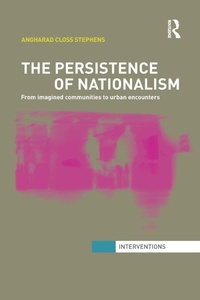
The Persistence of Nationalism
From Imagined Communities to Urban Encounters
1st Edition
Published on 27. April 2015
Book
Paperback/Softback
176 pages
978-1-138-85489-5 (ISBN)
Description
This is a book about the difficulties of thinking and acting politically in ways that refuse the politics of nationalism. The book offers a detailed study of how contemporary attempts by theorists of cosmopolitanism, citizenship, globalism and multiculturalism to go beyond nationalism often reproduce key aspects of a nationalist imaginary. It argues that the challenge of resisting nationalism will require more than a shift in the scale of politics - from the national up to the global or down to the local, and more than a shift in the count of politics - to an emphasis on diversity and multiculturalism. In order to avoid the grip of 'nationalist thinking', we need to re-open the question of what it means to imagine community.
Set against the backdrop of the imaginative geographies of the War in Terror and the new beginning promised by the Presidency of Barack Obama, the book shows how critical interventions often work in collaboration with nationalist politics, even when the aim is to resist nationalism. It claims that a nationalist imaginary includes powerful understandings of freedom, subjectivity, sovereignty and political space/time which must also be placed under question if we want to avoid reproducing ideas about 'us' and 'them'. Drawing on insights from feminist, cultural and postcolonial studies as well as critical approaches to International Relations and Geography, this book presents a unique and refreshing approach to the politics of nationalism.
Set against the backdrop of the imaginative geographies of the War in Terror and the new beginning promised by the Presidency of Barack Obama, the book shows how critical interventions often work in collaboration with nationalist politics, even when the aim is to resist nationalism. It claims that a nationalist imaginary includes powerful understandings of freedom, subjectivity, sovereignty and political space/time which must also be placed under question if we want to avoid reproducing ideas about 'us' and 'them'. Drawing on insights from feminist, cultural and postcolonial studies as well as critical approaches to International Relations and Geography, this book presents a unique and refreshing approach to the politics of nationalism.
Reviews / Votes
The Persistence of Nationalism convincingly shows a way out of the either/or quandary between nationalism and cosmopolitanism by bringing the city back at the centre of the debate. By investigating how people actually develop elective affinities, affective investments and identifications through quotidian encounters, it shows how people negotiate workable terms of living together. This is the best critical introduction to nationalism from an urban perspective.Engin Isin, The Open University, UK
More details
Series
Language
English
Place of publication
London
United Kingdom
Publishing group
Taylor & Francis Ltd
Target group
College/higher education
Illustrations
5 s/w Abbildungen, 5 s/w Photographien bzw. Rasterbilder
5 Halftones, black and white; 5 Illustrations, black and white
Dimensions
Height: 234 mm
Width: 156 mm
Thickness: 10 mm
Weight
278 gr
ISBN-13
978-1-138-85489-5 (9781138854895)
Copyright in bibliographic data and cover images is held by Nielsen Book Services Limited or by the publishers or by their respective licensors: all rights reserved.
Schweitzer Classification
Other editions
Additional editions
E-Book
03/2013
1st Edition
Routledge
€52.49
Available for download
E-Book
03/2013
1st Edition
Routledge
€52.49
Available for download
Book
03/2013
1st Edition
Routledge
€231.20
Shipment within 15-20 days
Person
Angharad Closs Stephens is a Lecturer in the Geography Department at Durham University, UK.
Content
Part One: Unpacking Nationalist Imaginaries 1. Beyond 'imagined communities': nationalism and the politics of knowledge 2. Weberian tales: disenchantment, mastery and meaning 3. Rousseau's legacies: the politics of time, community and loss Part Two: Contesting Nationalist Imaginaries 4. Urban cosmopolitanism: the return of the nation in times of terror 5. Nationalism and its limits: the politics of imagination 6. Sites of memory and the city as a melee Conclusion: the aftermath of nationalist imaginaries