

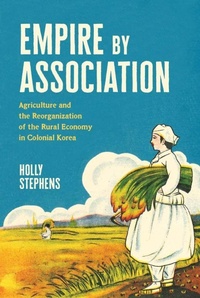
Empire by Association
Agriculture and the Reorganization of the Rural Economy in Colonial Korea
Will be published approx. on 24. November 2026
Book
Hardback
320 pages
978-0-300-28432-4 (ISBN)
Description
How governmental associations shaped agricultural production in Korea during Japan's colonization
Drawing on the diaries of everyday farmers, Holly Stephens examines the introduction of scientific and commercial agriculture in Korea from the late nineteenth century through liberation from Japanese rule in 1945. After Japan annexed Korea in 1910, colonial bureaucrats introduced numerous agricultural policies as they sought to turn Korea into a useful imperial possession. In particular, the colonial government hoped to establish Korea as a source of raw materials. To support the necessary increase in cultivation, it created policies introducing new cultivars, new farming methods, and new procedures for crop sales. Yet nature and farmers alike defied the expectations of colonial planners.
To demonstrate how the colonial infrastructure of scientific agriculture was experienced and interpreted by ordinary farmers, Stephens traces the implementation of colonial agricultural policies through a series of semi-governmental associations, which were the main agents of the colonial state in the rural economy. As these associations became embedded within the rural economy, they took on significance not just as a representation of the government but also as a conduit of new exchange networks and understandings of agriculture based on scientific and commercial principles, issues that would continue to influence agricultural production even after liberation.
Drawing on the diaries of everyday farmers, Holly Stephens examines the introduction of scientific and commercial agriculture in Korea from the late nineteenth century through liberation from Japanese rule in 1945. After Japan annexed Korea in 1910, colonial bureaucrats introduced numerous agricultural policies as they sought to turn Korea into a useful imperial possession. In particular, the colonial government hoped to establish Korea as a source of raw materials. To support the necessary increase in cultivation, it created policies introducing new cultivars, new farming methods, and new procedures for crop sales. Yet nature and farmers alike defied the expectations of colonial planners.
To demonstrate how the colonial infrastructure of scientific agriculture was experienced and interpreted by ordinary farmers, Stephens traces the implementation of colonial agricultural policies through a series of semi-governmental associations, which were the main agents of the colonial state in the rural economy. As these associations became embedded within the rural economy, they took on significance not just as a representation of the government but also as a conduit of new exchange networks and understandings of agriculture based on scientific and commercial principles, issues that would continue to influence agricultural production even after liberation.
Reviews / Votes
"Methodologically innovative and meticulously researched, Empire by Association represents agrarian history at its finest. Where most scholarship on colonial Korea pays only passing attention to rural society, Stephens brings it to light in stunning detail. It is a must-read for anyone interested in modern Korea, the history of Japanese imperialism, or comparative colonialism."-David Fedman, University of California, Irvine"Empire by Association opens a new window onto colonial Korea. Deftly reading farmers' diaries against official archives, Stephens reveals how rural life was reshaped from within, as middling cultivators navigated, and often confounded, colonial drives for scientific and commercial agriculture."-Jun Uchida, author of Provincializing Empire: Omi Merchants in the Japanese Transpacific Diaspora
More details
Series
Language
English
Place of publication
United States
Product notice
Cloth over boards
Illustrations
18 b-w illus.
Dimensions
Height: 235 mm
Width: 156 mm
ISBN-13
978-0-300-28432-4 (9780300284324)
Copyright in bibliographic data and cover images is held by Nielsen Book Services Limited or by the publishers or by their respective licensors: all rights reserved.
Schweitzer Classification
Person
Holly Stephens is a lecturer in Japanese and Korean Studies in the Department of Asian Studies at the University of Edinburgh.