

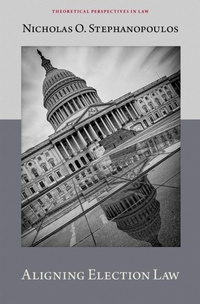
Aligning Election Law
Published on 23. December 2024
Book
Hardback
418 pages
978-0-19-766215-1 (ISBN)
Description
Alignment between governmental outputs and popular preferences is a core democratic value. For the people genuinely to rule, their government should heed their wishes. Yet alignment is not appreciated by election law scholarship, much of which focuses on other democratic goals. Nor do the courts consider alignment when deciding election law cases. Aligning Election Law fills this gap, providing a new theoretical perspective on election law and showing how alignment theory would operate in practice, in both litigation and legislation.
Nicholas O. Stephanopoulos examines alignment from a variety of angles, including its democratic value, its place in legal doctrine, its rarity in modern American politics, and its application to particular election law topics. The book also engages with issues facing American constitutional law and society, including voting restrictions, political parties, partisan gerrymandering, minority representation, and campaign finance, and how alignment theory would tackle these. The book's orientation is normative, suggesting how judicial (and nonjudicial) institutions should approach electoral regulations, not how they have addressed them in the past.
By thoroughly canvassing the democratic theory, empirical political science, and election law literatures, the book argues that alignment should be a tenet of the law of democracy. Accordingly, Aligning Election Law will be valuable not just to scholars, students, and practitioners of election law, but to anyone wishing to understand how the law of democracy could better achieve the values of democracy.
Nicholas O. Stephanopoulos examines alignment from a variety of angles, including its democratic value, its place in legal doctrine, its rarity in modern American politics, and its application to particular election law topics. The book also engages with issues facing American constitutional law and society, including voting restrictions, political parties, partisan gerrymandering, minority representation, and campaign finance, and how alignment theory would tackle these. The book's orientation is normative, suggesting how judicial (and nonjudicial) institutions should approach electoral regulations, not how they have addressed them in the past.
By thoroughly canvassing the democratic theory, empirical political science, and election law literatures, the book argues that alignment should be a tenet of the law of democracy. Accordingly, Aligning Election Law will be valuable not just to scholars, students, and practitioners of election law, but to anyone wishing to understand how the law of democracy could better achieve the values of democracy.
Reviews / Votes
This is a welcome reconsideration of how to understand and approach the electoral system. * C. Shortell, Choice *More details
Series
Language
English
Place of publication
New York
United States
Target group
Professional and scholarly
Product notice
sewn/stitched
Cloth over boards
Dimensions
Height: 241 mm
Width: 165 mm
Thickness: 38 mm
Weight
703 gr
ISBN-13
978-0-19-766215-1 (9780197662151)
Copyright in bibliographic data and cover images is held by Nielsen Book Services Limited or by the publishers or by their respective licensors: all rights reserved.
Schweitzer Classification
Other editions
Additional editions
Nicholas O. Stephanopoulos
Aligning Election Law
E-Book
09/2024
OUP eBook
€28.49
Available for download
Nicholas O. Stephanopoulos
Aligning Election Law
E-Book
09/2024
OUP eBook
€28.49
Available for download
Person
Nicholas O. Stephanopoulos is the Kirkland & Ellis Professor of Law at Harvard Law School. Before joining the Harvard Law School faculty, Stephanopoulos was a Professor of Law at the University of Chicago Law School. He was previously an Associate-in-Law at Columbia Law School and an Associate in the Washington, DC office of Jenner & Block LLP. A graduate of Yale Law School, Stephanopoulos also holds an M.Phil. in European Studies from Cambridge University and an A.B. in Government from Harvard College. His work is particularly focused on the intersection of democratic theory, empirical political science, and the American electoral system. His academic articles have appeared in, among others, the Harvard Law Review, Stanford Law Review, and Yale Law Journal. He has also written for popular publications including the New York Times and Washington Post.
Content
Introduction
1. The Rights-Structure Debate
2. The Concept of Alignment
3. Misaligned America
4. The Law of Alignment
5. Voting
6. Political Parties
7. Redistricting
8. The Voting Rights Act
9. Campaign Finance
10. Non-Electoral Domains
11. The Anti-Alignment Court
12. Aligning Alternatives
Conclusion
1. The Rights-Structure Debate
2. The Concept of Alignment
3. Misaligned America
4. The Law of Alignment
5. Voting
6. Political Parties
7. Redistricting
8. The Voting Rights Act
9. Campaign Finance
10. Non-Electoral Domains
11. The Anti-Alignment Court
12. Aligning Alternatives
Conclusion