

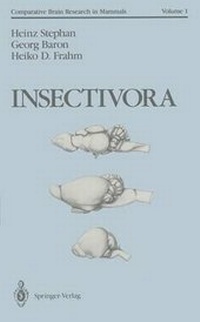
Insectivora
With a Stereotaxic Atlas of the Hedgehog Brain
Published on 18. April 1991
Book
Hardback
II, 573 pages
978-0-387-97505-4 (ISBN)
Description
This first volume in the series on "Comparative Brain Research in Mammals" deals with the brains of Insectivora. The importance of Insectivora lies above all in the fact that, (1) insectivore-like ancestors are regarded as the initial group for the evolution of higher mammals, and (2) the insectivore brains retained many conservative traits, though the animals have adapted to different living environments. Therefore, the study of Insectivora brains enables an insight into the size and composition of the brain structure of earlier ancestors of the higher mammals including primates and humans; in addition, it illumi nates the various evolutionary trends which made the successful adaptation to different biotopes possible. The alterations which the brain has experienced in the course of the phylo geny and the related adaptive radiation will be examined in the succeeding volumes on the brains of other Eutheria, e.g., bats (Volume 2) and primates (Volume 4). In Volume 3 the brains of marsupials will be compared with those of conservative and evolved Eutheria.
More details
Other editions
Additional editions
Heinz Stephan | Georg Baron | Heiko D. Frahm
Insectivora
With a Stereotaxic Atlas of the Hedgehog Brain
E-Book
12/2012
Springer
€96.29
Available for download
Heinz Stephan | Georg Baron | Heiko D. Frahm
Insectivora
With a Stereotaxic Atlas of the Hedgehog Brain
Book
10/2011
Springer
€106.99
Shipment within 7-9 days
Content
1 Introduction.- Acknowledgements.- List of the Available Species.- Abbreviations.- 2 Material and Methods.- 3 Comparative Brain Characteristics.- 3.1 Comparative Macromorphology.- 3.2 Total Brain Size and its Comparison.- 3.3 Comparison of Brain Components.- 3.3.1 Medulla oblongata (OBL).- 3.3.2 Mesencephalon (MES).- 3.3.3 Cerebellum (CER).- 3.3.4 Diencephalon (DIE).- 3.3.5 Telencephalon (TEL).- Main olfactory bulb (MOB).- Accessory olfactory bulb (AOB).- Paleocortex (PAL).- Striatum (STR).- Septum (SEP).- Amygdala (AMY).- Hippocampus (HIP).- Schizocortex (SCH).- Neocortex (NEO).- 3.3.6 Comparison with Primates.- 4 Brain Characteristics in Taxonomic Units.- 4.1 Tenrecidae.- 4.1.1 Tenrecinae.- 4.1.2 Geogalinae.- 4.1.3 Oryzorictinae.- 4.1.4 Potamogalinae.- 4.1.5 Summary.- 4.2 Chrysochloridae.- 4.3 Solenodontidae.- 4.4 Erinaceidae.- 4.4.1 Echinosoricinae.- 4.4.2 Erinaceinae.- 4.4.3 Summary.- 4.5 Talpidae.- 4.5.1 Desmaninae.- 4.5.2 Talpinae.- 4.5.3 Summary.- 4.6 Soricidae.- 4.6.1 Soricinae.- 4.6.2 Crocidurinae.- 4.6.3 Summary.- 4.7 Index Profiles of Taxonomic Units.- 5 Adaptive Radiation.- 6 Brain Characteristics Related to Ecoethological Adaptations.- 6.1 Surface Dwellers.- 6.2 Subterranean or Fossorial Species.- 6.3 Semiaquatic Species.- 6.4 Morphological Adaptations for Winter Survival.- 7 Brain Characteristics Related to Functional Systems.- 7.1 Main Olfactory System.- 7.2 Accessory Olfactory (Vomeronasal) System.- 7.3 Visual System.- 7.4 Somatosensory System.- 7.5 Auditory System.- 7.6 Vestibular System.- 7.7 Motor Systems.- 7.8 Limbic System.- 7.9 Neocortex.- 8 Conclusions.- 9 References.- 10 Tables.- 12 Subject Index.