

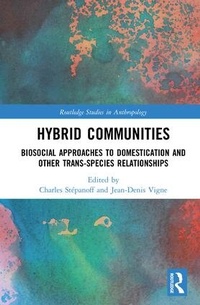
Hybrid Communities
Biosocial Approaches to Domestication and Other Trans-species Relationships
1st Edition
Published on 14. August 2018
Book
Hardback
306 pages
978-1-138-89399-3 (ISBN)
Description
Domestication challenges our understanding of human-environment relationships because it blurs the dichotomy between what is artificial and what is natural. In domestication, biological evolution, environmental change, techniques and practices, anthropological trajectories and sociocultural choices are inextricably interconnected. Domestication is essentially a hybrid phenomenon that needs to be explored with hybrid scientific approaches.
Hybrid Communities: Biosocial Approaches to Domestication and Other Trans-species Relationships attempts for the first time to explore domestication viewed from across disciplines both in its origins and as an ongoing process. This edited collection proposes new biosocial approaches and concepts which integrate the methods of social sciences, archaeology and biology to shed new light on domestication in diachrony and in synchrony.
This book will be of great interest to all scholars working on human-environment relationships, and should also attract readers from the fields of social anthropology, archaeology, genetics, ecology, botany, zoology, history and philosophy.
Hybrid Communities: Biosocial Approaches to Domestication and Other Trans-species Relationships attempts for the first time to explore domestication viewed from across disciplines both in its origins and as an ongoing process. This edited collection proposes new biosocial approaches and concepts which integrate the methods of social sciences, archaeology and biology to shed new light on domestication in diachrony and in synchrony.
This book will be of great interest to all scholars working on human-environment relationships, and should also attract readers from the fields of social anthropology, archaeology, genetics, ecology, botany, zoology, history and philosophy.
More details
Series
Language
English
Place of publication
London
United Kingdom
Publishing group
Taylor & Francis Ltd
Target group
College/higher education
Illustrations
29 s/w Abbildungen, 27 s/w Photographien bzw. Rasterbilder, 2 s/w Zeichnungen, 17 s/w Tabellen
17 Tables, black and white; 2 Line drawings, black and white; 27 Halftones, black and white; 29 Illustrations, black and white
Dimensions
Height: 234 mm
Width: 156 mm
Weight
740 gr
ISBN-13
978-1-138-89399-3 (9781138893993)
Copyright in bibliographic data and cover images is held by Nielsen Book Services Limited or by the publishers or by their respective licensors: all rights reserved.
Schweitzer Classification
Other editions
Additional editions
Charles Stepanoff | Jean-Denis Vigne
Hybrid Communities
Biosocial Approaches to Domestication and Other Trans-species Relationships
Book
06/2020
1st Edition
Routledge
€70.30
Shipment within 15-20 days
Charles Stepanoff | Jean-Denis Vigne
Hybrid Communities
Biosocial Approaches to Domestication and Other Trans-species Relationships
E-Book
08/2018
1st Edition
Routledge
€63.49
Available for download
Charles Stepanoff | Jean-Denis Vigne
Hybrid Communities
Biosocial Approaches to Domestication and Other Trans-species Relationships
E-Book
08/2018
1st Edition
Routledge
€63.49
Available for download
Persons
Charles Stepanoff is a social anthropologist (Laboratoire d'anthropologie sociale, Ecole pratique des hautes etudes, Sorbonne, France). His research interests include human-animal relationships in hunting, herding and shamanism in North Asia.
Jean-Denis Vigne is an archaeologist (Centre national de la recherche scientifique, Museum national d'Histoire naturelles, Sorbonne Universites, France). His research interests lie in archaeozoology, focused on interaction dynamics between animals and human societies, namely domestication, since the last hunters to the preindustrial farmer societies, mostly in the Mediterranean area, Southwest Asia and Central Asia and China.
Jean-Denis Vigne is an archaeologist (Centre national de la recherche scientifique, Museum national d'Histoire naturelles, Sorbonne Universites, France). His research interests lie in archaeozoology, focused on interaction dynamics between animals and human societies, namely domestication, since the last hunters to the preindustrial farmer societies, mostly in the Mediterranean area, Southwest Asia and Central Asia and China.
Content
List of figures; List of tables; List of contributors; Introduction - Charles Stepanoff and Jean-Denis Vigne; Part I: Liminal processes: beyond the wild and the domestic; 1. A genetic perspective on the domestication continuum - Laurent A. F. Frantz and Greger Larson; 2. Self-domestication or human control? The Upper Palaeolithic domestication of the wolf - Mietje Germonpre, Martina Laznickova-Galetova, Mikhail V. Sablin and Herve Bocherens; 3. Beyond wild and domestic: human complex relationships with dogs, wolves, and wolf-dog hybrids - Nicolas Lescureux; 4. Wild game or farm animal? Tracking human-pig relationships in ancient times through stable isotope analysis - Marie Balasse, Thomas Cucchi, Allowen Evin, Adrian Balasescu, Delphine Fremondeau and Marie-Pierre Horard-Herbin; 5. Arable weeds as a case study in plant-human relationships beyond domestication - Amy Bogaard, Mohammed Ater and John G. Hodgson; Part II: How domestication changes humans' bodies and sociality; 6. From fighting against to becoming with: viruses as companion species - Charlotte Brives; 7. Milk as a pivotal medium in the domestication of cattle, sheep and goats - Melanie Roffet-Salque, Rosalind E. Gillis, Richard P. Evershed and Jean-Denis Vigne; 8. Watching the horses: the impact of horses on early pastoralists' sociality and political ethos in Inner Asia - Gala Argent; Part III: Shared places, entangled lives; 9. Growing a shared landscape: plants and humans over generations among the Duupa farmers of northern Cameroon - Eric Garine, Adeline Barnaud and Christine Raimond; 10. Fig and olive domestication in the Rif, northern Morocco: entangled human and tree lives and history - Yildiz Aumeeruddy-Thomas and Younes Hmimsa; 11. Cooperating with the wild: past and present auxiliary animals assisting humans in their foraging activities - Edmond Dounias; 12. Why did the Khamti not domesticate their elephants? Building a hybrid sociality with tamed elephants - Nicolas Laine; 13. Cognition and emotions in dog domestication - Sarah Jeannin; Part IV: Ongoing transformations; 14. Domestication and animal labour - Jocelyne Porcher and Sophie Nicod; 15. Human-dog-reindeer communities in the Siberian Arctic and Subarctic - Konstantin Klokov and Vladimir Davydov; 16. Domesticating the machine? (Re)configuring domestication practices in robotic dairy farming - Severine Lagneaux; 17. From parasite to reared insect: humans and mosquitoes in Reunion Island - Sandrine Dupe; Index