

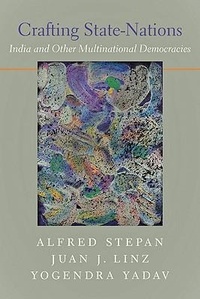
Crafting State-Nations
India and Other Multinational Democracies
Published on 26. May 2011
Book
Hardback
336 pages
978-0-8018-9723-8 (ISBN)
Description
Political wisdom holds that the political boundaries of a state necessarily coincide with a nation's perceived cultural boundaries. Today, the sociocultural diversity of many polities renders this understanding obsolete. This volume provides the framework for the state-nation, a new paradigm that addresses the need within democratic nations to accommodate distinct ethnic and cultural groups within a country while maintaining national political coherence. First introduced briefly in 1996 by Alfred Stepan and Juan J. Linz, the state-nation is a country with significant multicultural-even multinational-components that engenders strong identification and loyalty from its citizens. Here, Indian political scholar Yogendra Yadav joins Stepan and Linz to outline and develop the concept further. The core of the book documents how state-nation policies have helped craft multiple but complementary identities in India in contrast to nation-state policies in Sri Lanka, which contributed to polarized and warring identities. The authors support their argument with the results of some of the largest and most original surveys ever designed and employed for comparative political research.
They include a chapter discussing why the U.S. constitutional model, often seen as the preferred template for all the world's federations, would have been particularly inappropriate for crafting democracy in politically robust multinational countries such as India or Spain. To expand the repertoire of how even unitary states can respond to territorially concentrated minorities with some secessionist desires, the authors develop a revised theory of federacy and show how such a formula helped craft the recent peace agreement in Aceh, Indonesia. Empirically thorough and conceptually clear, Crafting State-Nations will have a substantial impact on the study of comparative political institutions and the conception and understanding of nationalism and democracy.
They include a chapter discussing why the U.S. constitutional model, often seen as the preferred template for all the world's federations, would have been particularly inappropriate for crafting democracy in politically robust multinational countries such as India or Spain. To expand the repertoire of how even unitary states can respond to territorially concentrated minorities with some secessionist desires, the authors develop a revised theory of federacy and show how such a formula helped craft the recent peace agreement in Aceh, Indonesia. Empirically thorough and conceptually clear, Crafting State-Nations will have a substantial impact on the study of comparative political institutions and the conception and understanding of nationalism and democracy.
Reviews / Votes
Useful and important. Choice For its conceptual innovation, erudition, and real-world applicability, this book deserves to be widely read... The authors tell us that the goal of their analysis is "to expand our collective political imaginations" (p. xiv) about how to combine democracy and ethnic diversity. They have brilliantly succeeded in meeting that goal. -- Ashutosh Varshney Journal of Democracy This book offers a compelling account of "state-nation" -ism as a political model. -- Louise Tillin Publius The book makes a very timely and important intervention to understanding nationalism and democracy in the study of comparative politics. -- Rohit K. Dasgupta Asian Affairs As they intended, Stepan, Linz, and Yadav have imagined alternative democratic formations for managing deeply pluralistic societies. Their models of state-nations, and of federacies, expand the realm of what might be considered politically possible in democracies. For this reason, their work will be of interest to scholars interested in pluralistic societies and concerned about democracy in all parts of the world. -- Daniel Jasper International Journal on World PeaceMore details
Language
English
Place of publication
Baltimore, MD
United States
Target group
Professional and scholarly
Product notice
sewn/stitched
Cloth over boards
Illustrations
3 s/w Zeichnungen
3 Line drawings, black and white
Dimensions
Height: 231 mm
Width: 152 mm
Thickness: 23 mm
Weight
590 gr
ISBN-13
978-0-8018-9723-8 (9780801897238)
DOI
10.1353/book.132
Copyright in bibliographic data and cover images is held by Nielsen Book Services Limited or by the publishers or by their respective licensors: all rights reserved.
Schweitzer Classification
Other editions
Additional editions
Alfred Stepan | Juan J. Linz | Yogendra Yadav
Crafting State-Nations
India and Other Multinational Democracies
Book
05/2011
Johns Hopkins University Press
€35.00
Article not available for order
Alfred Stepan | Juan J. Linz | Yogendra Yadav
Crafting State-Nations
India and Other Multinational Democracies
E-Book
05/2011
Johns Hopkins University Press
€24.99
Available for download
Persons
Alfred Stepan is the Wallace Sayre Professor of Government at Columbia University. His books include Democracies in Danger, Problems of Democratic Transition and Consolidation, and The Breakdown of Democratic Regimes, all also published by Johns Hopkins, the last two with Juan J. Linz. Juan J. Linz is Sterling Professor Emeritus of Political and Social Science at Yale University. In addition to the works coauthored and coedited with Professor Stepan, Professor Linz has published works on democracy, democratization, and comparative politics, including Sultanistic Regimes, also published by Johns Hopkins. Yogendra Yadav is the codirector of Lokniti and a Senior Fellow with the Center for the Study of Developing Societies (CSDS), Delhi, India. He has written articles for Hindi- and English-language newspapers and magazines, is a member of the editorial collective of the monthly Hindi-language magazine Samayik Varta, and is the general editor of Lokchintan Granthamala, a four-volume series on social science published in Hindi.
Content
List of Tables and Figures
Preface
1. Comparative Theory and Political Practice: Do We Need a ''State-Nation'' Model as Well as a ''Nation-State'' Model?
2. India as a State-Nation: Shared Political Community amidst Deep Cultural Diversity
3. Four Indian Cases That Challenge State-Nation Theory?
4. Tamils in India: How State-Nation Policies Helped Construct Multiple but Complementary Identities
5. Tamils in Sri Lanka: How Nation-State Policies Helped Construct Polar and Conflictual Identities
6. Ukraine: State-Nation Policies in a Unitary State
7. Federacy: A Formula for Democratically Managing MultinationalSocieties in Unitary States
8. The U.S. Federal Model and Multinational Societies: Some Problems for Democratic Theory and Practice
Bibliography
Index
Preface
1. Comparative Theory and Political Practice: Do We Need a ''State-Nation'' Model as Well as a ''Nation-State'' Model?
2. India as a State-Nation: Shared Political Community amidst Deep Cultural Diversity
3. Four Indian Cases That Challenge State-Nation Theory?
4. Tamils in India: How State-Nation Policies Helped Construct Multiple but Complementary Identities
5. Tamils in Sri Lanka: How Nation-State Policies Helped Construct Polar and Conflictual Identities
6. Ukraine: State-Nation Policies in a Unitary State
7. Federacy: A Formula for Democratically Managing MultinationalSocieties in Unitary States
8. The U.S. Federal Model and Multinational Societies: Some Problems for Democratic Theory and Practice
Bibliography
Index