

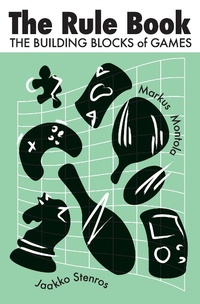
The Rule Book
The Building Blocks of Games
Published on 12. March 2024
Book
Paperback/Softback
256 pages
978-0-262-54744-4 (ISBN)
Description
How games are built on the foundations of rules, and how rules—of which there are only five kinds—really work.
Board games to sports, digital games to party games, gambling to role-playing games. They all share one thing in common: rules. Indeed, rules are the one and only thing game scholars agree is central to games. But what, in fact, are rules? In The Rule Book, Jaakko Stenros and Markus Montola explore how different kinds of rules work as building blocks of games. Rules are constraints placed on us while we play, carving a limited possibility space for us. They also inject meaning into our play: without rules there is no queen in chess, no ball in Pong, and no hole in one in golf.
Stenros and Montola discuss how rules constitute games through five foundational types: the explicit statements listed in the official rules, the private limitations and goals players place on themselves, the social and cultural norms that guide gameplay, the external regulation the surrounding society places on playing, and the material embodiments of rules. Depending on the game, rules can be formal, internal, social, external, or material.
By considering the similarities and differences of wildly different games and rules within a shared theoretical framework, The Rule Book renders all games more legible.
Board games to sports, digital games to party games, gambling to role-playing games. They all share one thing in common: rules. Indeed, rules are the one and only thing game scholars agree is central to games. But what, in fact, are rules? In The Rule Book, Jaakko Stenros and Markus Montola explore how different kinds of rules work as building blocks of games. Rules are constraints placed on us while we play, carving a limited possibility space for us. They also inject meaning into our play: without rules there is no queen in chess, no ball in Pong, and no hole in one in golf.
Stenros and Montola discuss how rules constitute games through five foundational types: the explicit statements listed in the official rules, the private limitations and goals players place on themselves, the social and cultural norms that guide gameplay, the external regulation the surrounding society places on playing, and the material embodiments of rules. Depending on the game, rules can be formal, internal, social, external, or material.
By considering the similarities and differences of wildly different games and rules within a shared theoretical framework, The Rule Book renders all games more legible.
More details
Language
English
Place of publication
Cambridge (Massachusetts)
United States
Publishing group
MIT Press Ltd
Illustrations
22 BLACK AND WHITE ILLUS.
Dimensions
Height: 200 mm
Width: 131 mm
Thickness: 19 mm
Weight
242 gr
ISBN-13
978-0-262-54744-4 (9780262547444)
Copyright in bibliographic data and cover images is held by Nielsen Book Services Limited or by the publishers or by their respective licensors: all rights reserved.
Schweitzer Classification
Other editions
Additional editions
E-Book
03/2024
MIT Press
€39.49
Available for download
Persons
Jaakko Stenros is University Lecturer in Game Studies working at the Centre of Excellence in Game Culture Studies at Tampere University. He has published ten books and over a hundred articles and reports on games and play and heads the international Master’s Programme in Game Studies.
Markus Montola has published several books on role-playing, pervasive games, and larp, and has worked as a lead designer on mobile games such as Shadow Cities, The Walking Dead: Our World, and most recently Friends & Dragons. He is a cofounder of the mobile game studio Playsome.
Markus Montola has published several books on role-playing, pervasive games, and larp, and has worked as a lead designer on mobile games such as Shadow Cities, The Walking Dead: Our World, and most recently Friends & Dragons. He is a cofounder of the mobile game studio Playsome.
Content
Contents
On Thinking Playfully vii
Acknowledgments ix
Introduction 1
1 Formal Rules 21
2 Internal Rules 57
3 Social Rules 83
4 External Regulation 113
5 Material Rules 141
Conclusions 173
Notes 195
References 217
Index 235
On Thinking Playfully vii
Acknowledgments ix
Introduction 1
1 Formal Rules 21
2 Internal Rules 57
3 Social Rules 83
4 External Regulation 113
5 Material Rules 141
Conclusions 173
Notes 195
References 217
Index 235