

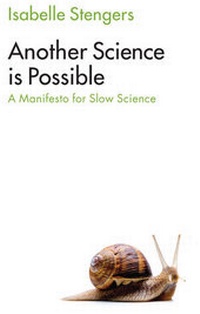
Another Science is Possible
A Manifesto for Slow Science
Published on 15. December 2017
Book
Hardback
220 pages
978-1-5095-2180-7 (ISBN)
Description
Like fast food, fast science is quickly prepared, not particularly good and it clogs up the system. Efforts to tackle our most pressing issues, like global warming, have been stymied by conflict within the scientific community and mixed messages, symptomatic of a rushed approach. From another flank, scientific research is being shaped by the bubbles and crashes associated with economic speculation and the market. A focus on conformism, competitiveness, opportunism and flexibility has made it extremely difficult to present cases of failure to the public, for fear that the public will lose confidence in science altogether.
In this book, distinguished philosopher Isabelle Stengers shows that research is deeply intertwined with broader social interests, which means that science cannot race ahead in isolation but must learn instead to slow down. Stengers offers a path to an alternative science, arguing that researchers should stop seeing themselves as the "thinking, rational brain of humanity" and refuse to allow their expertise to be used to shut down the concerns of the public, or to spread the belief that scientific progress is inevitable and will resolve all of society's problems. Rather, science must engage openly and honestly with an intelligent public and be clear about the kind of knowledge it is capable of producing.
Covering a wide range of topical issues, including the politics of research, the role of women in science and environmental issues, this accessible book by a leading philosopher of science will be of great interest to students, scholars and policymakers in a wide range of fields, as well anyone concerned with the role of science and its future.
Reviews / Votes
"Today, more than ever before, we need this book. Stengers, a philosopher known internationally for her willingness to tackle the big questions of our time, insists that Another Science is Possible. Toughly and tightly argued her book spells out how 'slow science' could get us there. One key point she raises, missed by so many, is the disillusion and distress, Marx might well have said alienation, of the young scientists who find that the science they believed they were going to be part of, is not the science they are working within. Only crack heads can deny climate change and its threat to life itself, but flinching, and looking away from the necessity of transforming science is politically and ethically inadequate. Stengers offers the new generation that is rising up with its new political narrative, intellectual weaponry in the formidable project of turning science away from its destructive collaboration with neoliberal capital to help build - yes - a better world. And don't we need one!" Hilary Rose, Emerita Professor of Social Policy, University of BradfordMore details
Edition
1. Auflage
Language
English
Place of publication
Oxford
United Kingdom
Publishing group
John Wiley and Sons Ltd
Product notice
sewn/stitched
Cloth over boards
Dimensions
Height: 218 mm
Width: 140 mm
Thickness: 18 mm
Weight
318 gr
ISBN-13
978-1-5095-2180-7 (9781509521807)
Schweitzer Classification
Other editions
Additional editions
E-Book
03/2018
1st Edition
Wiley
€17.99
Available for download
E-Book
01/2018
1st Edition
Wiley-Scrivener
€17.99
Available for download
Book
12/2017
Polity Press
€21.00
Shipment within 15-20 days
Persons
Isabelle Stengers is Professor of Philosophy of Science at the Université Libre de Bruxelles.
Content
1 Towards a Public Intelligence of the Sciences 1
2 Researchers with the Right Stuff 23
3 Sciences and Values: How Can we Slow Down? 48
4 Ludwik Fleck, Thomas Kuhn and the Challenge of Slowing Down the Sciences 83
5 'Another Science is Possible!' A Plea for Slow Science 106
6 Cosmopolitics: Civilising Modern Practices 133
Notes 157
2 Researchers with the Right Stuff 23
3 Sciences and Values: How Can we Slow Down? 48
4 Ludwik Fleck, Thomas Kuhn and the Challenge of Slowing Down the Sciences 83
5 'Another Science is Possible!' A Plea for Slow Science 106
6 Cosmopolitics: Civilising Modern Practices 133
Notes 157