

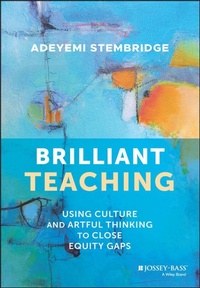
Brilliant Teaching
Description
In Brilliant Teaching, you will come to understand that equity-when we view it from an informed, multi-layered, and artistic perspective-is the essential purpose of teaching. As education thought leader Dr. Adeyemi Stembridge argues, true equity does not need to defend or justify itself against detractors. Teaching for equity means creating student-centered opportunities that match the social, political, and economic context of the learning environment. Informed by both theory and extensive collaboration with K-12 teachers, Brilliant Teaching will help you develop a deep understanding of culture, one that you can leverage in order to be responsive to students.
This book draws from a range of disciplines, including but going well beyond the post-modern and critical-theory-based discourse that dominate conversations today. Brilliant Teaching also pulls from art theory, cultural psychology, cognitive science, and learning theory, as well as classic historical texts within education. With this broad foundation, Dr. Stembridge offers an empowering, engaging approach that educators can use to help learners reach their own goals, and to move society onward and upward.
Discover practices that you can use to provide vulnerable students with high quality, effective, and meaningful learning opportunities
Learn to empathize with and respond to your students in a way that will engage and empower them in rigorous learning experiences
Embrace artful thinking and an integrated understanding of culture in your approach to equity in the classroom
View the K-12 classroom with a more expansive mindset and fresh ideas from an expert educator
For K-12 educators, preservice teachers, parents, school board members, and policymakers, this book is a breath of fresh air and inspiration in a world where culturally responsive teaching is increasingly recognized as a must.
<b>Think like an artist and design a classroom that works-well-for everyone</b>
In <i>Brilliant Teaching</i>, you will come to understand that equity-when we view it from an informed, multi-layered, and artistic perspective-is the essential purpose of teaching. As education thought leader Dr. Adeyemi Stembridge argues, true equity does not need to defend or justify itself against detractors. Teaching for equity means creating student-centered opportunities that match the social, political, and economic context of the learning environment. Informed by both theory and extensive collaboration with K-12 teachers, <i>Brilliant Teaching</i> will help you develop a deep understanding of culture, one that you can leverage in order to be responsive to students.
This book draws from a range of disciplines, including but going well beyond the post-modern and critical-theory-based discourse that dominate conversations today. <i>Brilliant Teaching </i>also pulls from art theory, cultural psychology, cognitive science, and learning theory, as well as classic historical texts within education. With this broad foundation, Dr. Stembridge offers an empowering, engaging approach that educators can use to help learners reach their own goals, and to move society onward and upward.
<ul><li>Discover practices that you can use to provide vulnerable students with high quality, effective, and meaningful learning opportunities</li><li>Learn to empathize with and respond to your students in a way that will engage and empower them in rigorous learning experiences</li><li>Embrace artful thinking and an integrated understanding of culture in your approach to equity in the classroom</li><li>View the K-12 classroom with a more expansive mindset and fresh ideas from an expert educator</li></ul>For K-12 educators, preservice teachers, parents, school board members, and policymakers, this book is a breath of fresh air and inspiration in a world where culturally responsive teaching is increasingly recognized as a must.
More details
Other editions
Additional editions
Person
<b>Dr. Adeyemi Stembridge</b> is an educational consultant specializing in equity-focused school improvement. He works with districts around the country to identify root causes of achievement gaps and formulate pedagogy and policy-based efforts to redress the underperformance of vulnerable student populations. Dr. Stembridge holds a PhD in Educational Leadership from the School of Education, Teaching, and Health at American University, a Master of Arts degree in Literature from Old Dominion University, and a Bachelor of Arts degree in English from Norfolk State University.
Content
Dedication
Preface
Do I, or Do I Not, Take This Picture?
What Is This Book About?
To Whom Am I Speaking?
Part One: Culturally Responsible Artmaking Teaching
Chapter 1: What Does It Mean to Think Like an Artist?
What Is Artmaking?
Social Learning
Notes on Artmaking: Influence and Inspiration
Endnotes
Chapter 2: Defining Equity...and the Problem of Fairness
A Problem of Fairness
Measured by Outputs
Quality and Effectiveness
Difference ? Deficits
What Schools Can Do
Notes on Artmaking: The Heart of Equity
Endnotes
Chapter 3: Shifting Paradigms
Equity Problems of Practice
Race
Nonstarters
Notes on Artmaking: Layered Methodologies
Endnotes
Chapter 4: Artmaking-As an Equity Issue
What Does It Mean to Understand?
The Role of Culture Relative to Achievement
Notes on Artmaking: Composition
Endnotes
Part Two: The Culturally Responsive Artmaking Teaching (In) You
Chapter 5: 12 Days of Instruction
Seating Charts, Volcanoes, and Different Glimpses of Themselves
Week 1
Week 2
Week 3
Notes on Artmaking: Ordinary Resurrections
Endnotes
Chapter 6: Improvisation
Make It into a Melody
Uncertainty
Imprint the Memory
Notes on Artmaking: Have Students Translate the Melody
Endnotes
Chapter 7: Story
Our Job Is To Be a Storyteller...
The Star of the Show
The Story Unfolds as a Question...
Notes on Artmaking: The Power of Story
Endnotes
Chapter 8: Audience
A Captive Audience
A Good Classroom Is Supportive of New Ideas...
In Defense of Incentives
Notes on Artmaking: Incentives Are Not the Reward
Endnotes
Chapter 9: The Art of Culturally Responsive Assessment
A Culture of Responsive Assessments
Why Are Performative Assessments More Equitable than Traditional Standardized Assessments?
Measure It Performatively...
Notes on Artmaking: "They Weren't Taking Cues Off of Me."
Afterword
References