

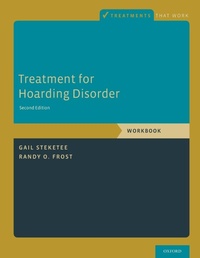
Treatment for Hoarding Disorder
Workbook
2nd Edition
Published on 28. November 2013
Book
Paperback/Softback
204 pages
978-0-19-933494-0 (ISBN)
Description
The relationship people have with their possessions ranges from purely utilitarian to intensely emotional. For most people, their personal possessions provide them with a sense of security, comfort, and pleasure. However, if someone loses the ability to distinguish useful or important possessions from those that make life overly complicated, the objects can become a prison. For people who suffer from Hoarding Disorder (HD), the process of getting rid of unneeded objects is not easy. For them, possessions never "feel" unneeded and trying to get rid of them is an excruciating emotional ordeal.
This Second Edition of Treatment for Hoarding Disorder is the culmination of more than 20 years of research on understanding hoarding and building an effective intervention to address its myriad components. Thoroughly updated and reflective of changes made to the Fifth Edition of the Diagnostic and Statistical Manual for Mental Disorders (DSM-5), this second edition of the client Workbook and accompanying Therapist Guide outlines an empirically supported and effective CBT program for treating hoarding disorder. This Workbook is meant to guide clients through their treatment for hoarding disorder with their clinician. It includes homework, forms, exercises, and behavioral experiments for clients to test their personal beliefs about possessions, develop an organization plan and filing system, and sort and organize items room by room. A major goal of the treatment is to recapture the positive role of possessions in the lives of people with hoarding problems, and strategies are outlined for sustaining gains and making further progress, as well as for managing stressful life events that can provoke problematic acquiring and difficulty discarding.
This Second Edition of Treatment for Hoarding Disorder is the culmination of more than 20 years of research on understanding hoarding and building an effective intervention to address its myriad components. Thoroughly updated and reflective of changes made to the Fifth Edition of the Diagnostic and Statistical Manual for Mental Disorders (DSM-5), this second edition of the client Workbook and accompanying Therapist Guide outlines an empirically supported and effective CBT program for treating hoarding disorder. This Workbook is meant to guide clients through their treatment for hoarding disorder with their clinician. It includes homework, forms, exercises, and behavioral experiments for clients to test their personal beliefs about possessions, develop an organization plan and filing system, and sort and organize items room by room. A major goal of the treatment is to recapture the positive role of possessions in the lives of people with hoarding problems, and strategies are outlined for sustaining gains and making further progress, as well as for managing stressful life events that can provoke problematic acquiring and difficulty discarding.
More details
Series
Edition
2nd Revised edition
Language
English
Place of publication
New York
United States
Target group
Professional and scholarly
Edition type
Revised edition
Dimensions
Height: 280 mm
Width: 216 mm
Thickness: 11 mm
Weight
523 gr
ISBN-13
978-0-19-933494-0 (9780199334940)
Copyright in bibliographic data and cover images is held by Nielsen Book Services Limited or by the publishers or by their respective licensors: all rights reserved.
Schweitzer Classification
Other editions
Additional editions
E-Book
10/2013
2nd Edition
OUP eBook
€35.49
Available for download
Persons
Dr. Gail Steketee is Dean and Professor at the Boston University School of Social Work. Her scholarly work has focused on developing and testing treatments for obsessive compulsive spectrum disorders, especially hoarding symptoms in recent years. Dr. Steketee has published over 200 articles and chapters, and over a dozen books on these topics, including therapist guides, client workbooks, edited volumes, and self-help books on hoarding and related conditions. She gives frequent lectures, workshops, and media interviews on hoarding and related conditions to professional and public audiences in the U.S. and abroad.
Dr. Randy O. Frost is the Israel Professor of Psychology at Smith College and an international expert on hoarding and related phenomena. He has published over 150 scientific articles and book chapters on these topics. Dr. Frost has co-authored several books on hoarding and was awarded the Lifetime Achievement Award for excellence in innovation, treatment, and research in the field of hoarding and cluttering by the Mental Health Association of San Francisco. He gives frequent lectures, workshops, and media interviews on the topic of hoarding and related conditions.
Dr. Randy O. Frost is the Israel Professor of Psychology at Smith College and an international expert on hoarding and related phenomena. He has published over 150 scientific articles and book chapters on these topics. Dr. Frost has co-authored several books on hoarding and was awarded the Lifetime Achievement Award for excellence in innovation, treatment, and research in the field of hoarding and cluttering by the Mental Health Association of San Francisco. He gives frequent lectures, workshops, and media interviews on the topic of hoarding and related conditions.
Content
Chapter 1 Introduction ; Chapter 2 Assessing Hoarding Problems ; Chapter 3 Developing Your Personal Hoarding Model ; Chapter 4 Planning Your Treatment ; Chapter 5 Reducing Acquiring ; Chapter 6 Skills Training ; Chapter 7 Making Decisions about Saving and Discarding ; Chapter 8 Changing Beliefs: Thinking Your Way Out of the Hoarding Box ; Chapter 9 Maintaining Your Gains ; Appendix Forms ; 1. Personal Session Form (chapter 2) ; 2. Instructions for Coaches (chapter 2) ; 3. Scoring Key for Assessments (chapters 2 & 9) ; 4. Brief Thought Record (chapter 3) ; 5. Hoarding Model (chapter 3) ; 6. Practice Form (chapter 4) ; 7. Downward Arrow Form (chapter 4) ; 8. Acquiring Questions Form (chapter 5) ; 9. Task List (chapter 6) ; 10. Personal Organizing Form (chapter 6) ; 11. Preparing for Organizing Form (chapter 6) ; 12. Thought Listing Exercise Form (chapter 7) ; 13. Questions About Possessions Form (chapter 7) ; 14. Behavioral Experiment Form (chapter 7) ; 15. Thought Record Form (chapter 8) ; About the Authors ; Index