

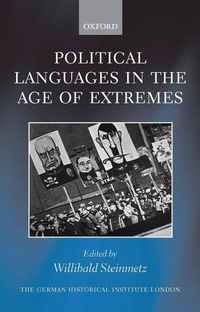
Political Languages in the Age of Extremes
Published on 18. October 2012
Book
Paperback/Softback
422 pages
978-0-19-966333-0 (ISBN)
Description
The short twentieth century was an age of total wars and aggressive ideological struggles. It was also an age of growing linguistic awareness in the political sphere. Communist, fascist, and Liberal regimes fought each other with violence as well as words, and verbal warfare became increasingly sophisticated. The regimes were supported by propaganda experts and took advantage of new mass media which facilitated the interplay of words, images, and sounds. Leaders and
their propagandists used language to persuade followers, terrorize opponents, and annihilate enemies. Knowing how to adapt one's own use of language to changing political situations was of vital importance for everyone. In the Age of Extremes words could wield political power, but at another moment
even a whisper could endanger one's life.
This volume explores the ways in which language served to create, uphold, subvert, or deflect political power in the Age of Extremes. The book is unusual in encouraging its readers to compare totalitarian and democratic regimes under this aspect. Moving beyond propaganda studies the book opens up a variety of perspectives. While some authors take a look from above and show how those in power succeeded, or failed, in policing the boundaries of what could be said, others investigate the
strategies of those who attacked the rules of the powerful by promoting alternative concepts and counter-discourses. Finally, there are also essays on the experiences of those who simply tried to stay alive by presenting themselves in a flexible manner or preserving their own private languages in diaries,
poems, or secret conversations.
their propagandists used language to persuade followers, terrorize opponents, and annihilate enemies. Knowing how to adapt one's own use of language to changing political situations was of vital importance for everyone. In the Age of Extremes words could wield political power, but at another moment
even a whisper could endanger one's life.
This volume explores the ways in which language served to create, uphold, subvert, or deflect political power in the Age of Extremes. The book is unusual in encouraging its readers to compare totalitarian and democratic regimes under this aspect. Moving beyond propaganda studies the book opens up a variety of perspectives. While some authors take a look from above and show how those in power succeeded, or failed, in policing the boundaries of what could be said, others investigate the
strategies of those who attacked the rules of the powerful by promoting alternative concepts and counter-discourses. Finally, there are also essays on the experiences of those who simply tried to stay alive by presenting themselves in a flexible manner or preserving their own private languages in diaries,
poems, or secret conversations.
More details
Series
Language
English
Place of publication
Oxford
United Kingdom
Target group
College/higher education
Product notice
Paperback (trade)
Unsewn / adhesive bound
Illustrations
7 colour illustrations
Dimensions
Height: 213 mm
Width: 137 mm
Thickness: 25 mm
Weight
522 gr
ISBN-13
978-0-19-966333-0 (9780199663330)
Copyright in bibliographic data and cover images is held by Nielsen Book Services Limited or by the publishers or by their respective licensors: all rights reserved.
Schweitzer Classification
Other editions
Additional editions
Willibald Steinmetz
Political Languages in the Age of Extremes
Book
05/2011
Oxford University Press
€115.32
Shipment within 15-20 days
Person
Willibald Steinmetz is Professor of Modern and Contemporary Political History at University of Bielefeld.
Content
PART I. INTRODUCTION ; PART II. THE RISE OF THE DICTATORS AND THE SEMANTICS OF LEADERSHIP ; PART III. MIND YOUR WORDS! POLICING LINGUISTIC BOUNDARIES (1920S-40S) ; PART IV. THE GROWTH OF LINGUISTIC AWARENESS IN THE COLD WAR ERA