

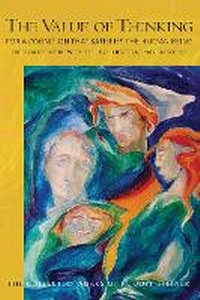
The Value of Thinking
For a Cognition that Satisfies the Human Being The Relationship Between Spiritual Science and Natural Science
Published on 15. May 2023
Book
Paperback/Softback
282 pages
978-1-85584-609-8 (ISBN)
Description
'As soon as you start thinking about the living sphere, you have to make the thought itself mobile. The thought must begin to gain inner mobility through your own power.' - Rudolf Steiner
Rudolf Steiner divides these absorbing, previously-untranslated lectures into three sections, opening with 'The Value of Thinking'. Here, he discusses the quality of thinking itself, contrasting 'dead physical cognition', 'living imaginative cognition', 'inspired cognition', and the latter's connection with previous periods of human and planetary development. He clarifies how 'visionary clairvoyance' can relate to individual intelligence, and also speaks of the submergence of ideas - the effects of sad or joyful experiences and feelings - into the unconscious. These can be 'life-promoting' or 'life-inhibiting'.
In the second section he speaks about 'The Relationship between Spiritual Science and Natural Science', using a contemporary publication as a case study for how texts can be fruitfully analysed. He characterizes the spiritual-scientific method as allowing facts or personalities to speak for themselves, rather than making personal judgements. Finally, he deliberates on 'Episodic Observations about Space, Time, Movement' - kinetic formula and concepts such as the speed of light - introducing, directly from his spiritual observations, notions such as 'light ether'.
The lectures are supplemented with an introduction, comprehensive notes, line drawings and an index.
Rudolf Steiner divides these absorbing, previously-untranslated lectures into three sections, opening with 'The Value of Thinking'. Here, he discusses the quality of thinking itself, contrasting 'dead physical cognition', 'living imaginative cognition', 'inspired cognition', and the latter's connection with previous periods of human and planetary development. He clarifies how 'visionary clairvoyance' can relate to individual intelligence, and also speaks of the submergence of ideas - the effects of sad or joyful experiences and feelings - into the unconscious. These can be 'life-promoting' or 'life-inhibiting'.
In the second section he speaks about 'The Relationship between Spiritual Science and Natural Science', using a contemporary publication as a case study for how texts can be fruitfully analysed. He characterizes the spiritual-scientific method as allowing facts or personalities to speak for themselves, rather than making personal judgements. Finally, he deliberates on 'Episodic Observations about Space, Time, Movement' - kinetic formula and concepts such as the speed of light - introducing, directly from his spiritual observations, notions such as 'light ether'.
The lectures are supplemented with an introduction, comprehensive notes, line drawings and an index.
More details
Series
Language
English
Place of publication
East Sussex
United Kingdom
Dimensions
Height: 156 mm
Width: 234 mm
Thickness: 25 mm
Weight
446 gr
ISBN-13
978-1-85584-609-8 (9781855846098)
Copyright in bibliographic data and cover images is held by Nielsen Book Services Limited or by the publishers or by their respective licensors: all rights reserved.
Schweitzer Classification
Other editions
Additional editions
Rudolf Steiner
The Value of Thinking
For a Cognition that Satisfies the Human Being. The Relationship Between Spiritual Science and Natural Science
E-Book
05/2023
Rudolf Steiner Press
€15.59
Available for download
Persons
Rudolf Steiner (1861-1925) called his spiritual philosophy "anthroposophy", meaning "wisdom of the human being". As a highly developed seer, he based his work on direct knowledge and perception of spiritual dimensions. He initiated a modern and universal "science of spirit", accessible to anyone willing to exercise clear and unprejudiced thinking.
From his spiritual investigations Steiner provided suggestions for the renewal of many activities, including education (both general and special), agriculture, medicine, economics, architecture, science, philosophy, religion and the arts. Today there are thousands of schools, clinics, farms and other organizations involved in practical work based on his principles. His many published works feature his research into the spiritual nature of the human being, the evolution of the world and humanity, and methods of personal development. Steiner wrote some 30 books and delivered over 6000 lectures across Europe. In 1924 he founded the General Anthroposophical Society, which today has branches throughout the world.
From his spiritual investigations Steiner provided suggestions for the renewal of many activities, including education (both general and special), agriculture, medicine, economics, architecture, science, philosophy, religion and the arts. Today there are thousands of schools, clinics, farms and other organizations involved in practical work based on his principles. His many published works feature his research into the spiritual nature of the human being, the evolution of the world and humanity, and methods of personal development. Steiner wrote some 30 books and delivered over 6000 lectures across Europe. In 1924 he founded the General Anthroposophical Society, which today has branches throughout the world.