

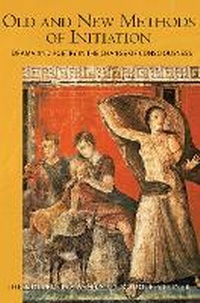
Old and New Methods of Initiation
Drama and Poetry in the Change of Consciousness in Modern Times
Published on 26. May 2025
Book
Paperback/Softback
256 pages
978-1-85584-674-6 (ISBN)
Description
What are the key differences between the contemporary spiritual path and that of the ancient mysteries?
With remarkable clarity and insight, Rudolf Steiner throws new light on the contrasting methods of initiation in the ancient and modern day. The old mysteries worked to transform the physical body - 'the brain on the one hand, and the rest of the organism on the other' - whereas modern initiation 'transforms the element of spirit and soul, strengthening it with regard to the thought aspect on the one hand, and the will aspect on the other...'
These wide-ranging lectures additionally cover topics that include: the working of Lucifer and Ahriman in the human being; the relationship of the individual to the Folk Spirit; the development of religious life, particularly with reference to the pagan Old Testament streams; and the role of Imagination, Inspiration and Intuition in modern life. The final lectures examine the impulse of freedom behind the work of Goethe and Schiller, drawing connections with Shakespeare and the French Revolution. An overarching theme is the significance of the transition between cultural epochs and the importance of freeing ourselves from the intellectualism of our age through the spiritual quality of Imaginative consciousness.
This new edition features an introduction by Margaret Jonas, notes and an index.
Fourteen lectures, Dornach, Mannheim & Breslau, Jan.-March 1922, GA 210
With remarkable clarity and insight, Rudolf Steiner throws new light on the contrasting methods of initiation in the ancient and modern day. The old mysteries worked to transform the physical body - 'the brain on the one hand, and the rest of the organism on the other' - whereas modern initiation 'transforms the element of spirit and soul, strengthening it with regard to the thought aspect on the one hand, and the will aspect on the other...'
These wide-ranging lectures additionally cover topics that include: the working of Lucifer and Ahriman in the human being; the relationship of the individual to the Folk Spirit; the development of religious life, particularly with reference to the pagan Old Testament streams; and the role of Imagination, Inspiration and Intuition in modern life. The final lectures examine the impulse of freedom behind the work of Goethe and Schiller, drawing connections with Shakespeare and the French Revolution. An overarching theme is the significance of the transition between cultural epochs and the importance of freeing ourselves from the intellectualism of our age through the spiritual quality of Imaginative consciousness.
This new edition features an introduction by Margaret Jonas, notes and an index.
Fourteen lectures, Dornach, Mannheim & Breslau, Jan.-March 1922, GA 210
More details
Series
Language
English
Place of publication
East Sussex
United Kingdom
Product notice
Paperback (trade)
Unsewn / adhesive bound
Dimensions
Height: 232 mm
Width: 156 mm
Thickness: 18 mm
Weight
386 gr
ISBN-13
978-1-85584-674-6 (9781855846746)
Copyright in bibliographic data and cover images is held by Nielsen Book Services Limited or by the publishers or by their respective licensors: all rights reserved.
Schweitzer Classification
Other editions
Additional editions
Rudolf Steiner
Old and New Methods of Initiation
Drama and Poetry in the Change of Consciousness in Modern Times
E-Book
05/2025
Rudolf Steiner Press
€15.59
Available for download
Persons
Rudolf Steiner (1861-1925) called his spiritual philosophy "anthroposophy", meaning "wisdom of the human being". As a highly developed seer, he based his work on direct knowledge and perception of spiritual dimensions. He initiated a modern and universal "science of spirit", accessible to anyone willing to exercise clear and unprejudiced thinking.
From his spiritual investigations Steiner provided suggestions for the renewal of many activities, including education (both general and special), agriculture, medicine, economics, architecture, science, philosophy, religion and the arts. Today there are thousands of schools, clinics, farms and other organizations involved in practical work based on his principles. His many published works feature his research into the spiritual nature of the human being, the evolution of the world and humanity, and methods of personal development. Steiner wrote some 30 books and delivered over 6000 lectures across Europe. In 1924 he founded the General Anthroposophical Society, which today has branches throughout the world.
From his spiritual investigations Steiner provided suggestions for the renewal of many activities, including education (both general and special), agriculture, medicine, economics, architecture, science, philosophy, religion and the arts. Today there are thousands of schools, clinics, farms and other organizations involved in practical work based on his principles. His many published works feature his research into the spiritual nature of the human being, the evolution of the world and humanity, and methods of personal development. Steiner wrote some 30 books and delivered over 6000 lectures across Europe. In 1924 he founded the General Anthroposophical Society, which today has branches throughout the world.