

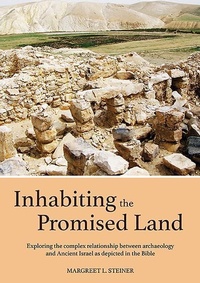
Inhabiting the Promised Land
Exploring the Complex Relationship between Archaeology and Ancient Israel as Depicted in the Bible
Published on 15. August 2019
Book
Paperback/Softback
192 pages
978-1-78925-330-6 (ISBN)
Description
For many people it is clear: the actions and beliefs of Ancient Israel are described in the Bible. The stories about its peoples and kings, struggles and wars, deities and shrines, are supposed to have been told and retold throughout the ages and recorded in ancient archives. At a certain moment in time these stories have been assembled in the Bible which becomes history. However, from the 19th century at least, scholars have doubted the historical reliability of many biblical stories, and archaeological research has hardly been able to confirm their historicity.
The aim of this book is to describe the often-complicated relationship between archaeology and the Bible. It is not a book on `biblical archaeology', and archaeology is not used to illustrate the biblical stories, let alone to prove that the Bible is right. On the contrary, it focuses on the information that archaeology can provide of the lives and beliefs of the ancient peoples that inhabited the land in which the Bible was written, and on the question of how this information relates to the biblical stories. It aims at providing some examples of how this interplay of archaeology and biblical stories works, and how to interpret the discrepancy that may exist between the results of archaeological research and the biblical narrative. It thus offers an introduction into the field from the standpoint of an archaeologist.
The book is intended for the general public, and will also be of interest to biblical scholars, historians and teachers, as well as archaeologists in other fields. It differs from the average non-scholarly book on this subject in that it is more personal, more eclectic, more archaeological. Reviews of the Dutch edition praise the passionate style and the way it focuses on the scientific process of researching problems, instead of on finding answers and presenting the solution.
The aim of this book is to describe the often-complicated relationship between archaeology and the Bible. It is not a book on `biblical archaeology', and archaeology is not used to illustrate the biblical stories, let alone to prove that the Bible is right. On the contrary, it focuses on the information that archaeology can provide of the lives and beliefs of the ancient peoples that inhabited the land in which the Bible was written, and on the question of how this information relates to the biblical stories. It aims at providing some examples of how this interplay of archaeology and biblical stories works, and how to interpret the discrepancy that may exist between the results of archaeological research and the biblical narrative. It thus offers an introduction into the field from the standpoint of an archaeologist.
The book is intended for the general public, and will also be of interest to biblical scholars, historians and teachers, as well as archaeologists in other fields. It differs from the average non-scholarly book on this subject in that it is more personal, more eclectic, more archaeological. Reviews of the Dutch edition praise the passionate style and the way it focuses on the scientific process of researching problems, instead of on finding answers and presenting the solution.
Reviews / Votes
A good acquisition for archaeology collections. * Association of Jewish Libraries Reviews *More details
Language
English
Place of publication
Oxford
United Kingdom
Target group
Professional and scholarly
Product notice
Paperback (trade)
Unsewn / adhesive bound
Illustrations
b/w
Dimensions
Height: 239 mm
Width: 173 mm
Thickness: 10 mm
Weight
408 gr
ISBN-13
978-1-78925-330-6 (9781789253306)
Copyright in bibliographic data and cover images is held by Nielsen Book Services Limited or by the publishers or by their respective licensors: all rights reserved.
Schweitzer Classification
Other editions
Additional editions
Steiner Margreet L. Steiner
Inhabiting the Promised Land
Exploring the Complex Relationship between Archaeology and Ancient Israel as Depicted in the Bible
E-Book
10/2019
OXBOW BOOKS
€21.99
Available for download
Steiner Margreet L. Steiner
Inhabiting the Promised Land
Exploring the Complex Relationship between Archaeology and Ancient Israel as Depicted in the Bible
E-Book
09/2019
Oxbow Books
€21.99
Available for download
Person
Margreet L. Steiner (University of Leiden, 1994) is an independent scholar in Leiden, The Netherlands. She has produced final publications of Kathleen Kenyon's excavations in Jerusalem and is the co-editor of The Oxford Handbook of the Archaeology of the Levant (10.000 - 350 BCE). For the past thirty-five years she has participated in or directed excavations in Jordan, Syria, Lebanon and the Palestinian Territories. Currently she is co-director of the renewed excavations of Tell Abu Sarbut, Jordan. Margreet Steiner has published widely on the archaeology of the Levant.
Content
List of figures
Prologue
1. In search of ... archaeology and the Bible
2. In search of ... Abraham and his descendants
3. In search of ... Saul and the days of the Judges
4. In search of ... Goliath, the Philistine
5. In search of ... David and Solomon
6. In search of ... Jezebel and the House of Omri
7. In search of ... Mesha of Moab
8. In search of ... Jehoiachin and the Exile
9. In search of ... the prophet Balaam
10. In search of ... the goddess Asherah
11. In search of ... the temple of Jerusalem
Epilogue
Further reading
Prologue
1. In search of ... archaeology and the Bible
2. In search of ... Abraham and his descendants
3. In search of ... Saul and the days of the Judges
4. In search of ... Goliath, the Philistine
5. In search of ... David and Solomon
6. In search of ... Jezebel and the House of Omri
7. In search of ... Mesha of Moab
8. In search of ... Jehoiachin and the Exile
9. In search of ... the prophet Balaam
10. In search of ... the goddess Asherah
11. In search of ... the temple of Jerusalem
Epilogue
Further reading