

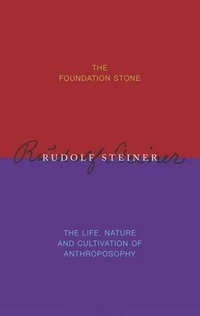
The Foundation Stone
(Cw 260/260a)
Published on 20. October 1998
Book
Paperback/Softback
144 pages
978-1-85584-075-1 (ISBN)
Description
This volume brings together for the first time two classic booklets: The Foundation Stone and The Life, Nature, and Cultivation of Anthroposophy. The former contains Rudolf Steiner's comments of the Foundation Stone Meditation made during the refounding of the Anthroposophical Society at the Christmas Conference of 1923-24. This key meditation -- of which several alternative translations are included -- holds a central place in the meditative life of many students of Rudolf Steiner's work.
The second booklet contains a number of letters that Rudolf Steiner wrote to members of the Anthroposophical Society following the Christmas Conference. In them he gave valuable thoughts on the new character of the Society and guidelines for its conduct and relation to the world following its refounding.
The second booklet contains a number of letters that Rudolf Steiner wrote to members of the Anthroposophical Society following the Christmas Conference. In them he gave valuable thoughts on the new character of the Society and guidelines for its conduct and relation to the world following its refounding.
More details
Language
English
Place of publication
East Sussex
United Kingdom
Product notice
Paperback (trade)
Unsewn / adhesive bound
Dimensions
Height: 216 mm
Width: 139 mm
Thickness: 10 mm
Weight
227 gr
ISBN-13
978-1-85584-075-1 (9781855840751)
Copyright in bibliographic data and cover images is held by Nielsen Book Services Limited or by the publishers or by their respective licensors: all rights reserved.
Schweitzer Classification
Other editions
Additional editions
Persons
Rudolf Steiner (1861-1925) was born in the small village of Kraljevec, Austro-Hungarian Empire (now in Croatia), where he grew up. As a young man, he lived in Weimar and Berlin, where he became a well-published scientific, literary, and philosophical scholar, known especially for his work with Goethe's scientific writings. At the beginning of the twentieth century, he began to develop his early philosophical principles into an approach to systematic research into psychological and spiritual phenomena. Formally beginning his spiritual teaching career under the auspices of the Theosophical Society, Steiner came to use the term Anthroposophy (and spiritual science) for his philosophy, spiritual research, and findings. The influence of Steiner's multifaceted genius has led to innovative and holistic approaches in medicine, various therapies, philosophy, religious renewal, Waldorf education, education for special needs, threefold economics, biodynamic agriculture, Goethean science, architecture, and the arts of drama, speech, and eurythmy. In 1924, Rudolf Steiner founded the General Anthroposophical Society, which today has branches throughout the world. He died in Dornach, Switzerland.